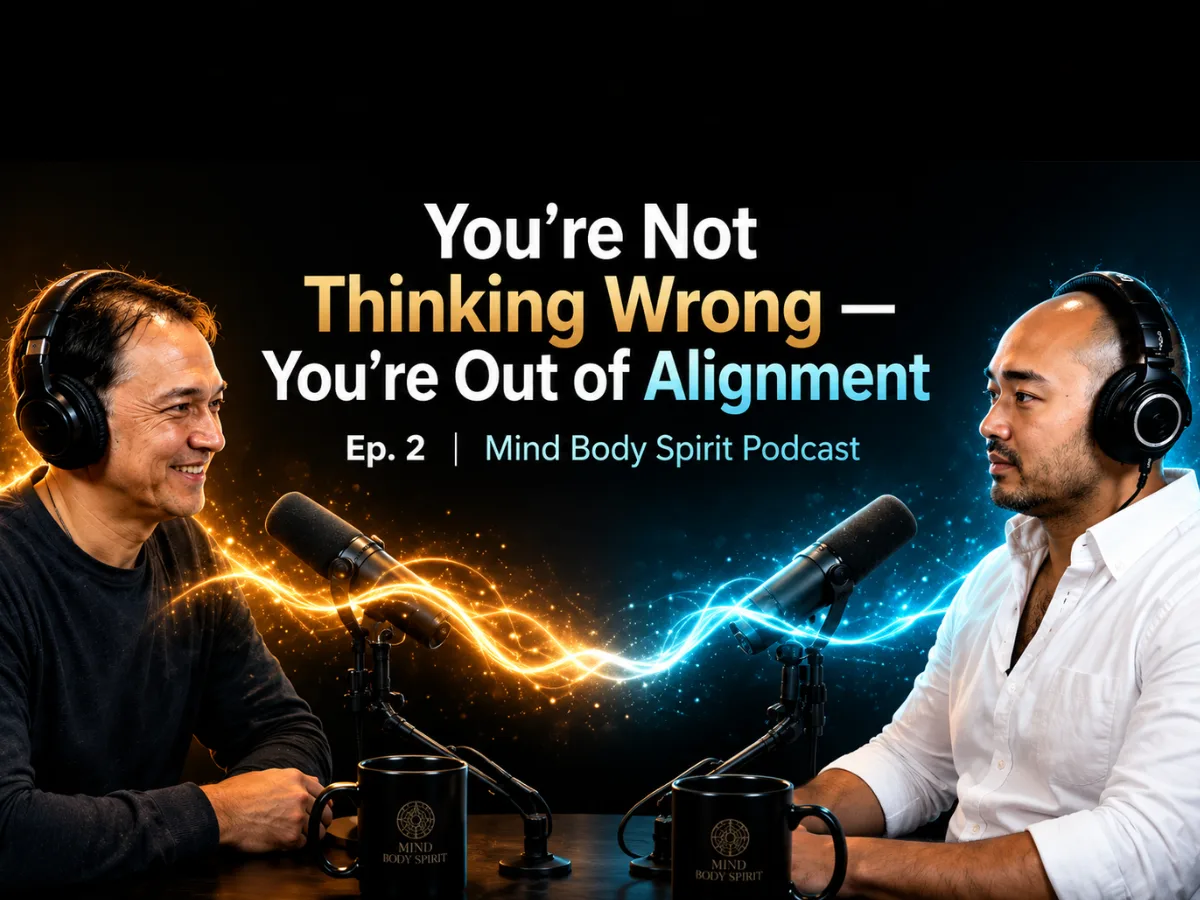
You're Not Thinking Wrong — You're Out of Alignment | Ep. 2 | Mind Body Spirit Podcast
Dustin DeFrates and holistic health expert Chris W. go deeper into how your mitochondria listen to every thought, word, and action — and how getting your mind, body, and spirit into alignment is the key to unlocking unlimited energy, better health, and a life you actually want to live.
New to the series? Start with Episode 1 on energy leaks and mitochondrial health.
Listen to Episode 1Episode Overview
What this episode is about
In Episode 2, Dustin DeFrates and holistic health expert Chris W. go deeper into the science of how your mitochondria listen to every thought, every word, and every action you take — and how getting your mind, body, and spirit into alignment is the key to unlocking unlimited energy, better health, and a life you actually want to live.
Episode Guide
In this episode you will learn
- Why your body and mind are always talking to each other
- How slouching, shallow breathing, and bad posture literally change your thoughts and emotions
- What mitochondria are really doing inside your cells
- What ATP is and why your body needs it every second
- What Reactive Oxygen Species (ROS) are and why they can be good or bad for your body
- How your mitochondrial DNA acts like short-term memory
- How stress signals can unlock dormant parts of your DNA
- Why melatonin is the most powerful antioxidant you produce
- How grounding, sunlight, sleep, and hydrogen water clear leaks
- Why creative expression is a biological need for energy
- How giving energy to others creates more energy for you
- How to direct your energy like a laser toward your goals
- Why mind, body, and spirit congruence is the foundation
Episode timestamps
- 0:00 — Welcome back: what this episode covers
- 0:34 — Body and mind are always linked
- 1:17 — Slouching changes your thoughts: here is why
- 2:41 — Chris's background: engineering meets wellness
- 3:41 — Dustin's story: 7 companies, divorce, and energy
- 5:24 — The body is energy at its core
- 6:35 — Brain waves, neurons, and Robert O. Becker
- 7:04 — The HeartMath Institute discovery
- 7:32 — How human energy fields overlap
- 8:40 — Why energy goes up and down
- 9:00 — The fundamental law: energy is always moving
- 9:54 — Mental flow of energy explained
- 10:40 — How thoughts and emotions affect physicality
- 12:06 — Making the mind-body connection both ways
- 12:51 — Introducing the mitochondria again
- 13:17 — Mitochondria as a quantum listening device
- 13:51 — The cell structure explained simply
- 14:57 — What the mitochondria actually does, step by step
- 15:36 — The five-protein chain inside the mitochondria
- 16:03 — The body's most efficient engine
- 16:45 — Energy leaks and the proton-electron gradient
- 17:06 — How thoughts create physical cell stress
- 18:21 — Seed oils vs. omega-3: your cell membrane matters
- 20:06 — Congruence: what the mitochondria really wants
- 21:32 — Reactive Oxygen Species (ROS) explained deeply
- 22:57 — When your inside and outside do not match
- 24:48 — The right cell environment for peak energy
- 25:31 — Energy leaks: what causes them daily
- 26:16 — Producing ROS: good signal or bad signal
- 27:00 — What is ATP and how does the body recycle it
- 27:43 — ROS deep dive: short- and long-term memory of cells
- 28:56 — Mitochondrial DNA vs. nuclear DNA
- 29:21 — The mouse experiment: generational cell memory
- 30:06 — How we only use 2% of our genome
- 30:58 — How stress can unlock better parts of your DNA
- 31:19 — Cold plunges, Wim Hof, and good stress examples
- 31:47 — Bad stress that accumulates all day
- 32:14 — Tactics to reduce stress and reset mitochondria
- 33:38 — The basics: good in, good out
- 34:04 — Grounding, sunlight, and sleep as energy reset tools
- 34:31 — Why melatonin is the most powerful antioxidant
- 35:24 — Hydrogen water and why it works
- 36:17 — Why oxygen is the most important element
- 37:27 — Human connection as an energy source
- 38:16 — Creative expression as a biological need
- 40:09 — Can you actually direct your own energy
- 40:52 — The rhythm of energy in and energy out
- 42:27 — Directing energy like a laser
- 43:20 — Small changes that compound into big results
- 45:33 — Giving back and how it powers your mitochondria
- 46:22 — Toxins that break your focus and energy flow
- 47:02 — Practical triggers to get out of a funk
- 48:07 — Introducing spirit into the conversation
- 49:13 — Better to give than receive: the science behind it
- 50:41 — Episode recap: what we covered today
- 51:41 — Steering your ship with focused energy
- 52:02 — What is coming in Episode 3
- 53:37 — Thank you and where to find more
Mentioned in this episode
- The Body Electric — Robert O. Becker
- HeartMath Institute — heartmath.org
- Dr. Joe Dispenza — heart-brain coherence
- Wim Hof breathing method
- Hydrogen water research
- Melatonin as antioxidant studies
About this podcast
Hosted by Dustin DeFrates — real estate entrepreneur and five-year wellness seeker — alongside Chris W. Breaking down body, mind, and spirit science weekly.
Transcript
Full editorial transcript
Open the transcript
Dustin: What if I told you that every thought, every feeling, and every action is literally reprogramming ourselves at the cellular level? And that science has been proving this all along. Well, that's how the mitochondria work. And that's how the body works. And our body is fundamentally energy. And that's what we're going to be going over in this episode. Uh so to highlight the differences between the mind and the body, I always tell people a story is that when you see kids jumping and smiling and laughing, they're always thinking good thoughts. And you can practice this yourself. You can be in a bad mood and if you start to smile, if you start to laugh, if you start to jump, all of a sudden your thoughts will get better. You might still be in a negative mood. You might still be not be quite feeling yourself, but you will start to feel better.
Dustin: And likewise, you can be in a great mood, but if you start to put your head down, you start to slouch, you start to breathe shallowly, it's very, it becomes more difficult to think these great positive thoughts about yourself because your your body is not in alignment with your mind. And so, fundamentally, the body and the mind, they're linked. There's this tether and they start to act upon what's in the mind will show up in the body, and what's in the body will also show up in the mind. So intrinsically we're always working towards congruence and that's one of the most beautiful things.
Chris: Okay. Um so then I think what I hear you saying Chris is that uh the the obvious one is you know when you're happy and you know when you're sad but the body is interlinking with these thoughts on an ongoing basis. Right. That's the basics. That's the basics. Everything that we do in the body that's aligned with those those thoughts that we have well it it's going to show up in energy.
Dustin: Yeah. we're going to be able to express that. So, anytime we take an action in our body, we're also able to change slightly our emotions. And any time our emotions change, it's going to subtly affect our body. And this is often times why you'll find people that maybe they're tired that day and they're going to just intrinsically start to slouch a little bit more. they're going to intrinsically start to maybe their eye contact drifts up a drifts a little bit or their chin starts tucking a little bit lower or or their spine isn't as straight. So, it could show up in so many different ways, but essentially the body and the mind, they're always listening to each other. They're always communicating.
Chris: Super cool. I can't wait to get into this topic today, Chris. Well, Chris, why don't you go ahead and uh introduce yourself? Tell me a little bit of background and why this is exciting or p a passion for you.
Dustin: Absolutely. So, I've always been into data and looking into trends. Uh, my background is industrial engineering. So, things like root cause analysis, diving in deeply and finding out how things really work, continuous improvement, looking to to always learn a little bit more about the body. And then my other my other background is in tech. So, machine learning, AI, learning how models work, being able to parse large amounts of data. So, I've kind of taken these two skill sets that I've had and really turned it inwards towards my passion, which is learning about how the body works. And once I learned how the body works, it led me to the mind. And once I learned a little bit more about the how the mind worked, it showed me that body, mind, and spirit are all connected. And so, that that's a bit about my background. I just kept asking myself, why does this work? How does this work?
Dustin: What is the purpose of us doing this? and I I have the attention span to be able to to go very deep on these topics. So Dustin, yeah, can you tell us a little bit more about yourself?
Chris: Yeah, it's beautiful. Thanks, Chris. Um I I've been on a uh on a journey and it's funny how you described um the path of the body first and then the mind and then the soul. And so that is that is that has been my path. Um I uh as a passion build companies. I love building companies and I currently run seven companies.
Chris: And so that takes a lot of mental energy and um and you know I'm going through a divorce and and that takes a lot of energy and uh a lot of people would potentially wake up in the morning and say oh crap this is what I have to do and there's it's overwhelming and so I have had to by force um first off lose 30 lbs um in in the body side of this mind body soul right so the first thing I did was I lost a bunch of weight and I started feeling healthier and my blood is able more blood is going to my brain at this point not all that fat you know and so um uh for the the body and then and then mind I started getting into these things what else can I do to you know everybody goes through cycles of emotions uh negative and positive and so um when there's a lot of stress around my divorce or whether there's a lot of stress around my businesses then it's easy to go down and so I needed tools in order to bring myself up and and get that energy to flow not necessarily because I have keep a lot here.
Chris: I need to find energy around me and and um so I've I've spent a lot of time doing that. So I guess my background is um I'm a real estate entrepreneur and um and I' I'm into these things as a uh way to increase enhance my own performance so that I can perform better around for for my team, for myself, for my family. Um, and uh, and and I can't wait to talk about each one of these individual topics, mind, body, and soul, cuz uh, we we've both gone pretty deep into these topics, and I can't wait to express that to our our listeners.
Dustin: Yeah, absolutely. So, we just discussed how the mind and the body are always connected and I want to kind of bring this back to just the simple statement that the body is electrical, the body is energy, it's always communicating. Now we think of the body normally to contrast that normally we think of the body as as a biological lump. It it is some sort of mass. Uh and we have different functions for different body parts, right? We're almost animalistic in that way. And I want to bring it back a step further and realize that everything in our world is energy.
Chris: This doesn't apply just because it's our body does not mean it's not energy. At the fundamental level, if we break everything down, everything starts to become electrons at the lowest possible level. And so our body is just electricity. It's electrons. It's energy. And there's several examples that we can use that that are easy to show this. So we have the brain waves and neurons. How our brain communicates with itself is it goes through different things called neural networks. And basically these neurons are firing off electrical charges. And so our our brain is electrical. Robert O. Becker he wrote the book the body electric. And he basically showed that the body responds to a DC current. So actually running a DC current is going to stimulate the body in certain ways and that the body responds to electrical signaling.
Chris: And he has a lot of cool work um regarding salamanders if if our viewers want to check that out. And then the HeartMath Institute, they found that you can actually measure the heart's electromagnetic field several feet away from our body.
Dustin: That's amazing.
Chris: And so it our body is not just our body, but we actually we're buzzing with energy. And just because this might be one foot away from my hand, we but that distance, that energy in between us, our body is actually affecting that.
Dustin: I understand that perfectly. And I, you know, I can feel that in my daily life. There's some people that resonate happy, good feelings. And, you know, I I give hugs. I give lots of hugs. And so, like, some people I'll give a hug and you're like, "Oh, wow. This is the most amazing thing in the entire world." And I'm and I'm getting more energy from that hug than than I had before I got that hug. And then there's other hugs where it's like, "Oh, well, okay. Good to meet you." You know,
Chris: or somebody uninvited into your space and and somebody's getting too close to you. It's like you start to feel that that affecting your energetic aura of your heart and and you yeah we we know this we've experienced these things.
Dustin: So then let me ask you so um when when when uh unexpected that would be let's say a negative energy an energy draw and so or you know you you think I have a bad thought and um that would be an energy draw. So I know that energy cannot be created or destroyed. So why is it that we are losing that? How do we lose that char? What is tell why why are we going up and down in the energy cycle? Yeah. So one of the fundamental laws of energy of an electron is that it's always moving. And we've seen this. We haven't been able to achieve absolute zero. We've we've tried with quantum computing, right? We need to keep these things very, very cold. And we've gotten very, very close. But we can't achieve absolute zero, where something fully stops. We've seen this in a vacuum where explosions of energy will happen even inside of a vacuum where there's supposed to be nothing but space.
Dustin: So, one of the fundamental properties is that energy is always flowing. And so, you're you're exactly right. It cannot be created nor destroyed. But however, it's always shifting from one state to another. And we we see this in the body. It might seem obvious. Um blood flowing. You have your organs which are always moving. Your heart is always beating. Your muscles might move in different directions. We also have this in in there's something called a mental flow. And I think the best way to examine this is kind of like what you were saying, alluding to earlier. You can be in a room, the room is completely happy, everybody is laughing, we're all having a good time and somebody, you can just tell right away there is just this negative energy as soon as that they enter the room and all of a sudden the laughter stops.
Dustin: And sometimes it happens the other way where everybody we're kind of all just moping around and then you see the exact person that you wanted to see walk through the door. Everything changes. Maybe it's a surprise and all of a sudden the energy is back. They brought so much positive energy with them. They are just feeding the entire room. Well, that's kind of this mental flow of energy that we're talking about. So, it's physical, it's mental, and that's kind of going to set us up to understand the mitochondria because the body, we think of our body, we typically think of our organs, our muscles, we typically think, okay, this does this, this does this, but we're not always thinking about how our thoughts, how our emotions, that's all energy, too. And that's all playing a part in in our physicality. Again, everything is always linked.
Chris: I love that. And so then the the the energy and the mood and the transfer of energy. Um I know that uh there's there's things people that would be considered an empath and you know people that are are tuned in maybe a little bit more. And so if if our listeners are you know especially I am especially sensitive to these things and so I'll I'll feel these things deeply and I'll ask friends do you feel it? like, "No, what are you what's going on?" But so there's there's people that are hyper sensitive to these things and um and attuned differently. So I'm excited to talk about um uh the link between the physical body like well how do you how do you pick these things up and and so if you're if the energy is going in and out, where is it physically going and why can't you know why why can't I just why can't I see it? You know, that's a silly question, but where is it at?
Chris: And and how does that work?
Dustin: Exactly. So and and that's part of what we are trying to explain today is we understand how how our thoughts, our emotions, what is going on on the inside. We see that there are physical changes. But what I want to do is really make the connection both ways. how our body and mind are always talking to each other and what is that pathway to give our listeners a little bit of insight and background and so they can use this powerful tool as well to make the changes that they want in their body. So I think it's it's important now that we've understood that the body and mind are energy. Now we need to understand like let's introduce the mitochondria here and and start to understand what this powerhouse of the cell is. we start to we we've all heard that term. And so what what a powerhouse of the cell do does is it's in charge of creating the body's energy. Well, hold on a second, Chris.
Dustin: Dustin just said that energy cannot be created nor destroyed. And that's exactly right. So the way I like to think of it is that it's actually all it's doing is it's a quantum listening device. It's taking energy from one state and taking it to another. And it's doing this many many many many times per second all the time in our body. So it's it's listening to our thoughts. It's listening to our actions and it's just responding based on what we've done. So we take the first action. our mitochondria listens and perceives all this and it's like, okay, based on what you've been doing, based on what you've said, let's make these changes.
Chris: Okay. I get that the mitochondria is a listening device, but I think that um I how like what is that? How does that reference reference that into the body structure somehow? Yeah.
Dustin: Yeah. Yeah. Yeah. So, maybe we should back up a little bit and talk about the cell structure. So basically we can think of a cell at a simple level as essentially you have a cell membrane. This cell membrane is made out of something called a phospholipid billayer. We can think of this as like fats and it's basically controlling what goes in and what goes out of the cell, right? And then inside of the cell we have water and salts. And then we also have a few other things like the nucleus, endopplasmic reticulum, ribosomes. Uh but for our purposes right now we want to be talking about the water and the salts. And that's essentially creating a current, right? Water being an effective medium to transfer energy. And then we have these cell salts which are basically ionic in nature. And they they have um they're either attracting or repelling different energies.
Dustin: And then lastly, we have the mitochondria, which I'm so fascinated by. But the mitochondria are essentially it is a structure inside of the cells, right? So they're very very very small and we have many many of them in every cell. And so what they are doing is they are essentially taking an electron and they're moving it through these five proteins and then at the end of it it's either going to produce ATP or this electron is going to go elsewhere and we call this a a reactive oxygen species and and and we'll get into that later, right? But you're essentially producing energy or you're producing a signaler that says okay m maybe we need to change how this is working because if we just keep producing ATP in this way it's not going to to work as efficiently. So backing up a little bit more now that we understand that there are five proteins in the body and these are highly coupled.
Dustin: It's a very fine-tuned process because any engine which is essentially what that last protein in the mitochondria is any engine we've struggled to create a 100% efficient engine. Well, the body has is beautiful in so many ways, right? And it has the world's most efficient engine, as I like to call it, right inside the body. Now, the issue is that if we have if we start to have impurities in the body, if we start to have toxins, right, if the water is perfectly tuned, we're sleeping the way we wanted to, we're thinking harmonious thoughts in the world, well, our mitochondria is going to respond by working very very efficiently and very, very well. Now, when we add these toxins in, all of a sudden, it's going to disrupt this proton and electron gradient, which this mitochondria wants to run through, right? The the energy always wants to flow.
Dustin: That was one of the properties that we talked about is that energy always wants to flow. And so once we disrupt it, right, if we create an energetic block and we we block this flow, right, either we don't have enough vitamins, we don't have enough water, we don't have enough cellular salts, all of a sudden that is when we're going to create that reactive oxygen species, and we'll we'll we'll get into that in just a little bit here.
Chris: So, I think I understand what you're saying. There's a uh there's there's a chain of events that happens within the cell. I think I'm using the right words, right? And so then in this chain of events is designed to just move the energy the ions the the flow of energy backwards and forwards and then and there's a positive state and a negative state. Is that a re a real conversation there? Is there is there ever a positive and a negative on that flow or is it all or a DC current? It goes one direction and that's it.
Dustin: Yes. So essentially um there is going to be a proton and electron gradient, right? And then basically it'll throw it'll flow through this. And so what actually happens is as electric flow as we have electricity flow one way we also have a magnetic current that um is created perpendicular to that and that's what actually spins this is that magnetic field is going to spin this. Um but yes it does take energy to separate these things and it's only going one way. It's going from the first protein to the fifth protein complex. And then we'll get ATP or energy as a result. And now this energy once we have energy, well, it's perfect because the the mitochondria are already in this water and salt solution. And now this energy can be effectively transferred out of the cell basically like a battery. And so the Yeah. So the battery is designed for the efficient flow of energy.
Dustin: The mitochondria is designed for the efficient flow of energy. I'm tracking. So then you also suggested stressors and so um I think we talked about it you know the the feeling that you have when someone has some you know a bad day and you can feel that around but uh tell me more about the uh the the stressors to how thoughts are linked to the mitochondria.
Chris: Yes. So we I I think a good way to explain this is we we can think of it like we would in a muscle because in often ways our body can explain more about our mind than than we can learn about our mind elsewhere. And so when we have some amount of stress, we're able to grow our muscle. Our muscles won't grow without some sort of acute stimulus. Now we're not overstressing it. We're not working out all day every day. We need some time to eat our protein and go to sleep and rest and recover. Maybe we want to do some stretching. But for an example, we we're basically uh giving it an acute burst of stress. Stress for a a controlled period, something we're controlling and at the same time very shortly and to produce a desired result. We don't perceive it as stressful because we're choosing to do it. And so often times our emotions can work in a very similar way.
Chris: And so our emotions and our mental stress and every every thought and action that we have, well, they're all tied together. And certain emotions help us produce certain actions. Certain actions help produce certain emotions. And so as emotions are going through the body, essentially what's going to happen at a deeper layer, and we're going to get get into this in later episodes, but uh the water is very attuned to sound and and your thoughts and your emotions. And so as your water starts to change, again, the mitochondria is very very fickle.
Chris: these proteins if everything isn't lining up perfectly right there there's going to be ROS these signaler molecules that basically are going to tell the nucleus tell the rest of the body that hey something is up we need to change in a certain way and so anytime you're in this state of fear you're in this heightened arousal you and and these um the these emotional states also require a lot of energy right it's it's hard to be very very angry when you first wake up. You're you maybe you're all groggy, right? Like it's it's easier to be angry when it's the middle of the day. Maybe you've had a coffee already. You are ready to to to be angry. You've prepped your body, right? And so as we prep our body for these different emotional states, we're going to have different emotional outcomes and and we'll kind of go into that.
Chris: Um, but I think it's important to first understand a little bit more about the cell and in in regards to uh how that actually works and I I've mentioned this reactive oxygen species. I think going into that explaining that uh for our viewers and then we can go deeper into once we've laid that foundation we can go deeper into what are the exact mechanisms and how this is working. And so, uh, we were talking about the cell membrane again, right? And so, that's where a seed oil, well, if you have a seed oil or or versus like a high quality fat like an omega-3, well, that's making up your cell membrane. And as we make up that cell membrane, we're going to have an omega-3 cell membrane is going to work much better in allowing stuff in and out that is supposed to go in and out. It's going to allow that energy to be transferred versus a seed oil. it gets oxidized very easily, right?
Chris: And so all of our cells, we need oxygen. And so as we're breathing in oxygen, well, it's going to be easier to oxidize these cells, right? And we talked about dehydration, we talked about negative emotions, which is going to affect the water of our cells. And so all of a sudden, you can start to think if we're jumbling up all of these things, all of these proteins which are supposed to be finely tuned, finely tuned and listening for for a stimulus. Well, if we're telling him, hey, basically we're in a chaotic environment. We're taking chaotic actions. We're taking actions. Our mind is saying one thing, our body is doing another thing. We're not congruent. The mitochondria wants everything to be congruent. Mhm.
Dustin: If you are wanting to be confident, if you're confident in your body and you feel and and you're taking up a lot of space, but in your mind you're very shy and very sheepish, well, that's going to create some stress. And the opposite, too. If you're confident in your mind, but all of a sudden you're slouching and you're you're acting unconfident and you're not doing things, you're not expressing yourself the way you need to be expressed, that's going to create a lot of stress, too.
Dustin: And so that manifestation so um I I I understand that and so when we talk about stress the let's talk about maybe some downline implications of what that manifestation is and and then I also just wanted to before we get into that I love the idea I was I was putting um D3 or you know it's a yeah vitamin D into my um mushroom coffee this morning and you know water and oil do not separate and I just kind of wanted to go back to just visualization of of the lipid acids right the lipid the fats
Chris: phospholipid billayer around the cell
Dustin: around the cell and then the water and the salts inside of the cell. So like you look at the oil on the water and it says oh well you guys don't mix very well and so it creates that that barrier right and then that barrier requires pressure I remember from some research right and so maybe go a little bit deeper about like how how that that that all holds together. Yeah, excellent question. Thanks for bringing that up, Dustin. So, yes, essentially this water inside of our cell, exactly what you're saying. It's separated by this this oil, right? And and that contains that's going to contain all of this water, all of this salt. And so, essentially, we want the right amount of water in, we want the right amount of cellular salts, right? And that's the purpose of this phospholipid billayer, allowing some things in, some things out.
Dustin: And so we have a certain water pressure, a certain cellular salt charge, certain vitamins and minerals. And if everything is in the right amounts, that's what our mitochondria loves. That's when it's going to be producing a lot of energy, it's saying keep doing what you're doing. Things are good.
Chris: Well, you made it sound simple because if there's if energy has to flow and there's a disconnect here and here, right, then energy is not it's going to have a hard time bridging that disconnect. So I can see um I'm excited to talk more about DNA and the the structure of DNA, but continue please.
Dustin: Yes. Yes. And it should be simple really. Our cells and our health, it's it's not as complicated as we want to make it seem at the fundamental level. Okay. We're talking we we have, you know, the cell membrane. We have water and salts and we have something that produces the energy that gets transferred throughout our body. So I like that you said that. It should be simple. It should be easy. Um yeah and and so we were going into yeah basically that if everything is finally tuned with within the body right the water pressure is right everything is right then then the mitochondria produc produces energy at a very high clip.
Dustin: Now the issue is well so many things because it's always listening it's attuned to even the smallest changes whether the room you're sitting in gets a little bit colder whether you forgot to breathe deeply for a few minutes right which I just did all of that changes our ability uh to produce energy and if we get these energy leaks right okay you don't have enough water we don't have enough salts okay you're in a stressful mood food, all of these things are going on. Your body's in congruent. What's going to happen is we produce those reactive oxygen species, which is basically like an electron. It gets off of that gradient that we were talking about and instead of producing ATP, it produces something called a reactive oxygen species.
Chris: Remind me what ATP was before we go back into the reactive oxy oxygen.
Dustin: ATP is essentially energy.
Chris: Okay.
Dustin: And so it's called adenosine triphosphate. What happens is the phosphate is going to break off. It becomes ADP and then your body sends it back to the mitochondria and this is how you recycle energy.
Chris: I understand enough to say I understand. Okay. And so then we have these stressors and the ROS the reactive oxygen species reactive oxygen. And so then go deeper into that. And so I heard you say earlier that that's not a positive or negative thing but if you always have that then something negative will happen downline implications. So go deeper into the ROS and and how that all plays into this cell.
Dustin: Yes. So our mitochondria is always producing these things called ROS. They're basically signalers and some of them can be good signalers and and often times oxidative stress gets a bad name and rightfully slow. Most of us are have way way too much oxidative stress. Now however they can, myself included. Now these things can um also be good for the body. They can also be signaling okay I think we can actually handle more energy right and then that that's where the mitochondria good or bad again it's just listening to what we're doing. So good or bad it's going to be sending off these reactive oxygen species. Now, what tends to happen is that we eat something, we we breathe a certain amount of air, something that's bad for us, and it creates all this stress, and all of a sudden, we're creating these ROS spikes, and we have too much without being able to clear it.
Dustin: And we'll go into different ways to be able to clear it because that's going to be very important for taking control of your life again. But if you have too much of this stress, all of a sudden, okay, it's your mitochondria has something called the mitochondrial DNA, right? And then in the nucleus of your cell, you have your nuclear DNA. And this is typically what we think of of when we think of our DNA is we think of the nuclear DNA, right? And so the mitochondria, we can think of it like as an epigenetic expression or in simpler terms, something like short-term memory, right? And if we have this short-term memory, well, it's going to go want to go talk to our long-term memory, right? Especially if it's a very important topic, right? You have something that's very stressful. Okay, I got to relay that on, right?
Chris: So, that's that's the mouse experience experiment, right? So, if uh passing generational uh knowledge, if the mouse goes next to the cherry blossom tree and gets shocked, then the next generation, I think it goes seven generations, remembers those shocks. Is that true? That's that's what you're that's what you're talking about is the memory of the cells. So there's a short-term memory and a long-term memory. The mitochondria being the short-term and it's pushing information to the long-term memory bank. And then tell me more about how that reacts. Yeah, we we can think about um our our our nuclear DNA, right? I'm just going to say DNA going forward here, but our nuclear DNA, we can think about it. We're only using about 2% of our genome.
Dustin: Wow.
Chris: And so at any one time we have about 98% that's unactivated.
Dustin: Unlocked.
Chris: Unlocked. Now some of these might create a worse state for us. We we we can unlock a a genome where where maybe it contains disease.
Dustin: Yeah. Maybe grow scales. Right?
Chris: But there there's also aspects of our genome in which we can live much healthier lives. And so, but it needs some sort of stress to be activated. And that's why I I want to stress that the the ROS, right, these reactive oxygen species, they're just signalers. They can also be used to activate parts of our genome that are essentially going to give us upgrades, right? Just like as you work out a muscle and you provide it with the right amount of stress recovery, then it's going to be able to grow.
Dustin: And likewise, when we create a little bit of stress, and we'll talk about different methods that we can do this, right? But short-term stress, things like cold plunges, things like Wimhof breathing, right? And we inherently know that these things are good for us anyways. And if you're asking, well, what are some examples of bad stress, right? Well, we we overeat. Maybe we're eating polluted food. We're we're shallow breathing for eight hours a day. We're sitting with a slouched posture. All of these things create slightly worse states. And if we're staying in that slightly worse state for the majority of our day, right? And then we're only doing something to mitigate the stress, maybe, you know, maybe we have a five minute um gratitude session at the end of the day or or things like that. And those things are wonderful, but we've also accumulated all this stress throughout the day.
Dustin: And we and we need tactics to be able to reduce that stress and to help our mitochondria function in the way that we want to help it direct the energy. Again, if it's just a quantum listening device and it's always listening to every thought, every word, every action, well, then we just need to create the right thoughts, words, and actions that align with who we want to be, align with the genome that we want to express.
Chris: Does that is this all making sense?
Dustin: Yeah, I was just going to say that that sounds so simple when you just put it into that last sentence, right? And so that's that's really what it is about. So, from the perspective of um the science is amazing. I think we're going to populate some of the research articles and um at the bottom of this uh episode, but um the science is amazing and and I'm excited about uh learning these um practical applications or things that we can do. And in the future episodes, we're going to start talking about some of these things that you can do. And so, um for the flow of energy and the the crap in crap out, right? That's the that's the basic the nature of it, right? So, like there's there's common sense to having bad stuff in and and not being able to put out good stuff. And so, um I guess I guess my question is is we we have these stressors no matter what.
Dustin: And so then the the as the stressors accumulate, being able to release those things, you're actually suggesting don't wait till the end of the day, but there's practices that you would potentially follow individually throughout the day in order to release different stressors. Is that fair?
Chris: That's fair. And and again, the energy is always moving. So, one of the most some of the most effective ways we'll we'll go deeper into these, but just briefly covering them is so grounding is going to be a great way again, you're connecting your charge with the earth now, right? You're completing that circuit. And so, that's going to be a way to allow some of this energy to escape, right? the sun is going to be a great way that gives you energy, right? And and when when you're given energy, right, well, that directly helps the mitochondria. It doesn't have to produce as much if you're also getting some from the sun, right? If you're in a dark cave, well, that's going to be a little bit tougher, right? But if you're in a dark cave, also the mitochondria adjusts because sleep is one of the best ways to get rid of this all the stress.
Chris: So melatonin is actually going to be the most efficient antioxidant. And the the more I learn about melatonin, the more exciting it is because it it's just absolutely incredible. It does so many things for the body. And it it's the most efficient antioxidizer. And so it's going to scavenge all of this ROS and say, "Okay, understood this was a stressful day. We don't really need this. This doesn't need to affect our long-term memory, right? like this doesn't need to go into our DNA. And so when we're sleeping very well and we're producing our melatonin and melatonin is going to be a a very important aspect. And when we produce it internally versus taking it from a pill, then it's able to scavenge all of these free radicals, all of these um reactive oxygen species that we don't actually want long term. So grounding sunlight, drinking fresh water, right?
Chris: Even better if we're adding in hydrogen water, right? That seems to be a big trend going around, right? Well, the reason why hydrogen water works is because it's it's allowing you to reduce a lot of this RO stress that that you put on your body.
Dustin: I'm tracking. Okay. So, then I I remember I remember seven of them that I've read a lot or I I remember mentally I remember seven. So, I was sleep, uh, water, uh, rest, um, good nutrients, uh, what am I missing? Breath. Yeah. So, yeah, I mean, there's many things that we need for life, right? Many things that we need at the end of the day to be able to produce energy uh, for mitochondria. So, number one being air. We need oxygen. Oxygen attracts a lot of electrons, right? It's one of the most electrogative uh elements outside of florine. And that's one of the reasons why florine can be so damaging too is because it's the only element that is more electro negative than oxygen, right? It's going to pull electrons instead of going to the oxygen, they're going to go to the florine, right?
Chris: At the end of the day, that's why it can be damaging for a lot of people.
Dustin: Uh but air
Chris: is florine fluoride. Is that the same
Dustin: same thing?
Chris: Okay, got it. Thank you. Um, so in the air, right, we need air. Well, then what's next? Well, we need water, right? We need the medium to be able to transfer this energy, right? So, oxygen is going to act as like this this energy transporter. This energy, it it's going to attract a lot of the energy. Then we need the water, right? Then we need sleep, right? We need some way to repair all of this energy. We need food. Um, we need connection with others.
Dustin: Hugs.
Chris: It could be hugs. It could it could be uh a connection with another person, but it al also be a connection with this table, right? It could be a connection with the room that we're in. It could be any any time where you feel connected, right? Uh we're going to need food because again, we need certain certain salts, certain amount of energy, right? We we require certain proteins uh for our for our DNA and our mitochondria. We require certain amount of fats for to make up the cell membranes and and different minerals, right? Magnesium, potassium that we're also going to get from our food that are going to go into the cell salts. And one thing that we that we all need that we don't always talk about is creative expression. So if you're producing all of this energy, this energy also needs to go somewhere. It needs to be expressed in some ways.
Chris: Well, a lot of this is going to go towards expressing yourself, your your bodily expression. It's going to go into your mindset. But we also need some sort of activity because our body produces so much energy. We have this bounding amounts of energy. And I always liken this to to uh you'll see children and they will move in certain ways and children are full of energy and they will move in certain ways that you just don't see adults move. They are crawling, they are skipping, they are jumping, maybe they're walking backwards for no reason, right? Whereas once you get to an adult, you're all about conserving energy. You're like, I'm walking to this place and I'm walking at a comfortable pace. I'm not doing an Irish jig as I'm going. Right? But sometimes when you are in a very energetic state, right, as an adult, you you might break out into a little spontaneous dance.
Chris: You might uh express that energy in a certain way. And so that's what I'm talking about here is when you have a lot of energy, the body is going to need to express that in some sort of way, in some sort of creative way. For some people, it might be art. For some people, it might be um business and entrepreneurship. For some people it might be dance. So we all have some sort of unique expression that that our energy aligns with. Well, and so that is one point that I wanted to talk about too. And there's so many benefits of for the body as well when we're doing something that we love and we're we're in that state. Well, again, our mind and our body, we're all congruent. But that's that's another quick way um to help heal your mitochondria.
Dustin: Okay. I liked I liked the congruency. And so then we we went through I think we got did we get through all of them? The uh wind breath uh uh sleep nutrient.
Chris: We got on all of them. Okay, good. So um now that we know the body enters energy and and the mitochondria responds to the moves uh we make physically and mentally um can you direct the energy? So like you just suggested that we have a lot of energy. We can expound a lot of energy. I guess before we get into directing the energy if you can if you if you have to get rid of the energy, you have to replace the energy. Right. So that's that's give me maybe a little bit more about the replacement of energy before we go into directing the energy.
Dustin: Yeah, I'm glad you brought that up because that's a very important part of the cycle, right? So energy is always flowing. There's always this rhythm, right? We always have inhale and exhale. We we are drinking water and we're also releasing water when we go to the bathroom. So energy is always coming in and energy is always coming out. And whether that's expressed physically or mentally, right? Because we mentally is going to be a big part of that too, right? We we need to read something. Okay. Well, if we read a lot, we're also going to need to write a lot or we're going to need to create some sort of other way to express that. Otherwise, all of our memory, all of our charge is going to become stagnant.
Chris: And so, one of the quickest ways to refresh the body, right, is to get in fresh energy sources, right? That's where we might go outside and take in fresh light. We might take a deep inhale, which is oxygenating the body, bringing in fresh fresh air. We might drink from a very clean, pure water source and that's bringing in all this fresh water that can be used instead of having this water that's been sitting there and it's been stagnant. It's been accumulating maybe some toxins in it as well. Okay. Now, our body can utilize this fresh water. It can utilize that fresh air. It can utilize the the sun. So the energy flow, energy in and energy out must always be in balance.
Dustin: Okay, I get that. And then Okay, so that's it's fun like I'm I'm imagining like X-Men, you know, being able to, you know, use your energy through your eyes and, you know, cut a a hole in that couch right now. Right. So the directing of energy. Um, so tell let's talk more about the directing of energy. What what does that mean and how do you do it?
Chris: Right. Right. Yeah. So the mitochondria again, they're just the they're just the listeners, right? They're just taking us from one state to another. And it's always important to bring it back to the fundamentals. So if we're just going from one state to another, okay, well, we want to direct this energy to the state that we want. When we want to direct any form of energy to the state that we want, it's going to pass through the mitochondria. Well, again, we know that it's listening to our listening to every action that we take. It's listening to our environment that we're in. It's listening to um our thoughts and our words that we're speaking. So, if we can start to put all of these pieces together, right?
Chris: And there's bigger examples that we can use, there's smaller examples that we can use, but at the end of the day, any change that you want to make is going to follow that same process is that you need to start changing some of these physical actions that you're doing. You need to start changing even just slightly how you speak to yourself. Uh you're going to need to change to new emotions, new environments. Everything is going to need to slightly change a little bit. Now, moving to a new environment could be as simple as picking up this pen and moving it 2 in over. It doesn't have to be a total renovation. Okay, I need to go to Hawaii for 3 weeks now, right? Okay, it can be some sort of small change,
Dustin: right? A physical action could be as big as going to Hawaii like we just mentioned or it could be, okay, I'm just going to sit up a little bit straighter. I'm going to keep my chin and eye level a little bit bigger. But all of these things are going to start to align and our mitochondria is always going to start listening is always listening. And then all of a sudden that's creating this positive loop, right? where you're creating a little bit of stress in the way that you want, right? It it's going to take a little bit of energy and the body wants to conserve energy. It's going to take a little bit of energy to make these changes, but again, it's a good stress and your body can handle it. And all of a sudden, it starts to react by changing those proteins inside your nucleus. And everything that you do that starts to align with where you're going, right?
Dustin: you can start to to like you were saying like a laser is a very focused point of energy, right? And so if I do one action and that's going to focus my energy in a little bit more and then all of a sudden I change my environment to be a little bit more about how I want it, that's going to focus the energy in a little bit more. And all of a sudden now I'm going to start breathing the way I wanted to, drinking the water that I wanted to, exercising the way I wanted to. All of a sudden, these changes are starting to get more and more concentrated. And the more and more aligned that we can be in the body, the mind, and the soul. What we were designed to do, what what brings us the most passion and joy, how can and giving back to others is is is another way that the mitochondria absolutely loves. And so there there's so many parts of the body that it just aligns up with being a good human.
Dustin: and and and then it it's like it rewards you.
Chris: I love that.
Dustin: It rewards you by by getting a more and more focused energy because again it's a listener. We're just telling it this is how I want to be.
Chris: And and often times we don't think we have as much control over a situation as as we actually do because the energy is always there. We just need to direct it to where we're going. And the more that we can do in in any regard, right, physical, mental, any sort of actions that we're doing, whether it's breathing, drinking water, all of these things play an impact and all of these things start to funnel that energy to exactly where we want. And so we're going to talk about, okay, what are the things that also bring us off course,
Dustin: right? Because there's so many, like we were mentioning, toxins, okay, like what what do those toxins actually do? Well, well, they're they're breaking up that flow of energy, right? If we wanted that concentrated flow and all of a sudden, okay, you got a bunch of breakages in this flow. Well, all of a sudden, you're not going to get as strong of an energy to to go walk that path of life that you're excited to walk. Detractors. I like that. So, so then what I'm hearing is that um mind, body, and soul. And there's a couple triggers. So like it just for the practical application if you're in a funk if you're if you're in that thing.
Dustin: So walking outside and getting a little bit of sun but um reading a book uh going to church uh going helping giving giving someone a hug bringing someone breakfast uh doing any type of activity that puts you into an alignment that creates more energy is is a benefit. And so then in the mind, body, soul space, right, the exercise or reading a book or or going to church. And if if you don't feel like exercising right this moment, then go outside. But like if you don't feel like going outside, go to church. And all of these things work together. And if you can get one thing to work a little bit better, then I think you're suggesting the other things try to catch up because there's an an attraction charge. Is that fair?
Chris: That's absolutely fair. because there's an abundance of energy always in this world and there's an abundance of energy that we can use and direct to where we wanted to go. So like you were saying that and we we've explained that the mind and the body are always connected. Let's get dive into a little bit about spirit. So when you give back to somebody, when you give a little bit of energy, and that's the exact energy that somebody needed, that somebody needed to be told a compliment, maybe that they were doing a good job, that you appreciate this about them, or or even just telling a cashier, right? Like, oh, I really appreciate how how well you're doing. All of a sudden, you're creating a situation where in terms of spirit, you're adding more energy to the world. You're adding more energy to your environment, okay? and your mitochondria. Let's bring it back to the mitochondria.
Chris: How do they come into play? Well, they're always listening and all of a sudden they're perceiving an environment in which energy is being given. And so now they know that they're going to be able to also receive more energy. And this goes kind of there's so many applications to this, but essentially as you are giving more energy, the world is also going to be able to give you more energy. And and so that makes us feel better. Our mitochondria inherently know this. And it's better to give than to receive is what I just heard. That's a biblical uh Yeah. So then you give and you get back and there's a multiplier is what I my understanding of it, right? It's not a necessarily a onetoone. You could give this much energy and then get back this much energy. Is that fair?
Dustin: Yeah. There there's an abundance of energy, right? So we're not necessarily concerned about the the quantity or exactly okay I produced 44 ROS right well the point or or how many units of ATP of energy that I might have right now we're always producing as much as we need as much as we've signaled to right as much as we've given uh to ourselves right and so as we start to give to ourselves and even if we start to uh we could consider working out your bicep a form of of giving attention and energy to your bicep. Right? So in a way everything in this world starts to become giving. Everything starts to okay I'm going to give to myself. I'm going to give to others. It becomes a beautiful cycle where everything does become giving. I love that.
Chris: Very difficult to receive.
Dustin: I love that so much. So that's that is the that's the increase of life energy. And so we're going to go deeper into that in podcast or in episode two. And so is there anything else that we should talk about related to the mitochondria to wrap up this uh episode?
Chris: Yeah, let me just give a brief recap for our you for our listeners so that they can understand some of the main points. So we understand that the cell in the simplest form is a way to contain and express and move energy. Our mitochondria are always listening and slightly directing this energy and they produce these signal signal molecules called ROS that essentially they will transform our DNA. We have a lot of dormant DNA to become more of who we are telling it to be. And again, that's that's an important part. We're not we're never the victims. We're always telling our body how it wants to react, right? We we'll get into different examples there. Um but after that is always listening to the mind, the body and even the spirit. All of them are always listening and always working in conjunction.
Chris: So if we want to start to direct our boat and steer our ship in a certain way, well, we need to start concentrating our energy in a certain way. We need to start focusing it in a certain way. And this is what we call focus, right? and we're able to start um using all of our actions, all of our words, all of our emotions, they all start to align in a certain way. And then that's when we're going to be able to steer our ship. And so I think in episode two, we're going to be going over, you know, what gets in the way of that, right? Like cuz this all makes sense on a conceptual level now hopefully, but on a practical level, what gets in the way? What's breaking up our focus? Why are we getting distracted? Right? Like what? Our phones are a huge distraction. The our food can be a huge distraction.
Chris: Everything in our world, you know, why is everybody not living the exact life that they want to live? What is breaking up that focus from from the mitochondrial perspective, from the mind and the body and the and the spirit?
Dustin: It's all connected. So why are we just not always going exactly where we want to go? Where we're telling ourselves, okay, we want to go here. We have these grand visions for ourselves, but what is actually preventing us from getting there and what are some tools that we can use? Say if we have a bunch of damage already and we want to get ourselves back to a baseline state, what are some techniques that we can use? We understand the science now. So I episode two, we're going to be going into what are the applications? How do we actually make these changes? And how can we focus our energy in such a way where it's like we're laser focused like what you were saying. We have these laser eyes exactly where we're going and nothing is going to keep us from getting to where we want.
Chris: Well, that Chris, thank you. That's uh it's a that's a lot and I'm really excited to um uh allow our listening audience to digest this. Listen, if you're interested in any of the um the the science articles or the things that we reference, then you'll be able to find that in the episode and um and Chris's contact information and my contact information will be somewhere around here. And so, uh thanks so much, Chris. Appreciate your time and looking forward to uh our next series.
Dustin: Yeah, I appreciate you Dustin. Thank you.
Transcript adapted from the Mind Body Spirit Podcast, Episode 2. Full audio and video available on YouTube.