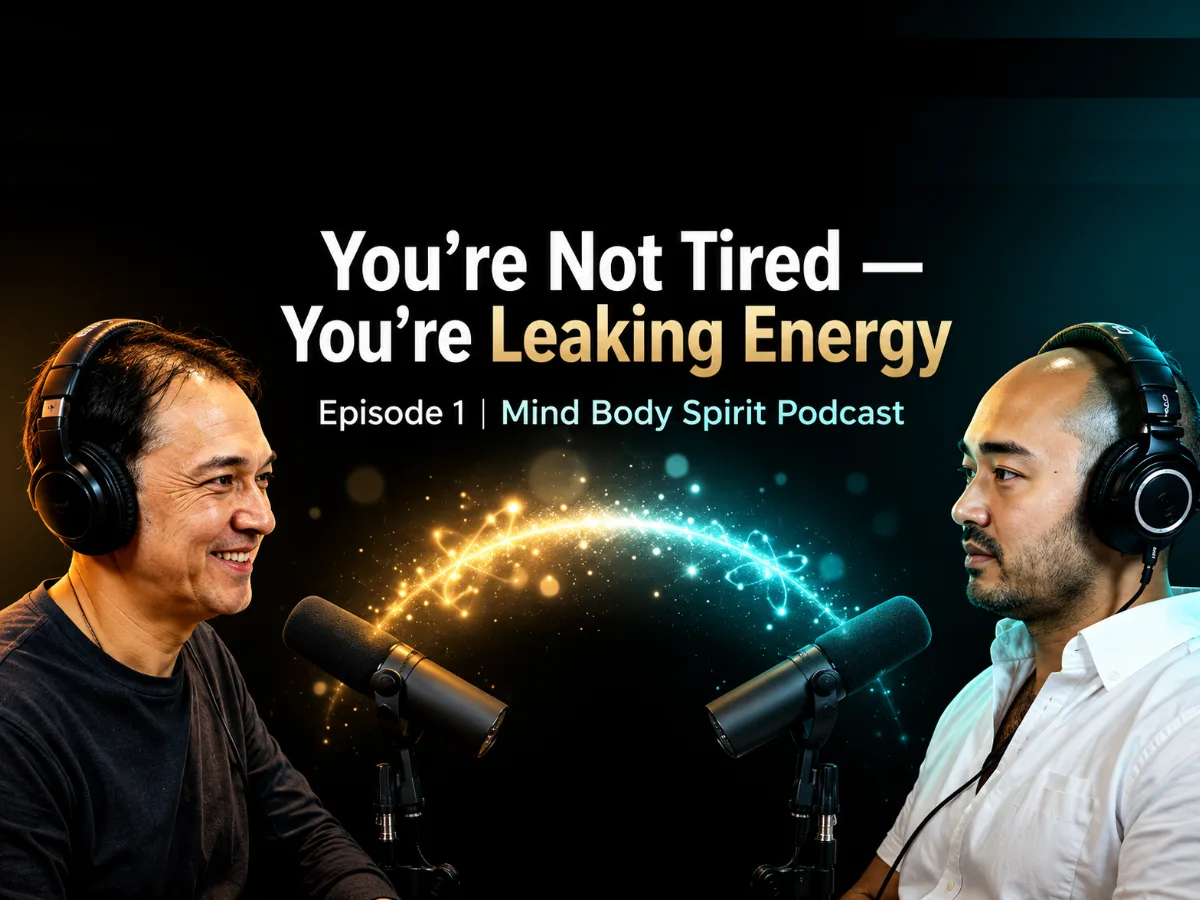
You're Not Tired — You're Leaking Energy | Ep. 1 | Mind Body Spirit Podcast
Real estate entrepreneur Dustin DeFrates sits down with holistic health expert Chris Wuehr to uncover why millions feel drained, burnt out, and stuck — and what is happening inside your cells right now.
Episode Overview
What this episode is about
In Episode 1, Dustin DeFrates and Chris Wuehr unpack the real reason so many people feel drained, burnt out, and stuck — and why it often comes down to what is happening inside your cells, not how much rest you are getting.
This conversation connects mitochondria, electrical signaling, telomeres, and the placebo effect to show how thoughts and emotions physically shape cellular energy — and how fear, anxiety, and misalignment become silent energy leaks that age you faster.
This episode will change the way you think about energy, aging, emotions, and your body.
Episode Guide
In this episode you will learn
- What energy leaks are and why they silently age you
- Why mitochondria are the key to energy, mood, and longevity
- How emotions physically stress and damage your cells
- Why fear and anxiety are among the biggest energy drains
- The science behind why positive thinking can heal the body
- What telomeres are and how to slow cellular aging
- The seven pillars that boost energy: breath, water, sleep, light, nutrients, exercise, and relationships
- How human connection works as an electrical energy exchange
- Why giving without expectation can create more energy in the body
- The link between mitochondrial dysfunction and Alzheimer's, Parkinson's, and diabetes
- Heart-brain coherence and why it matters for daily vitality
- How energy practices can help reverse the feeling of aging
Episode timestamps
- 0:00 — Welcome: Meet Dustin DeFrates & Chris Wuehr
- 1:17 — Chris's story: reinventing himself through health
- 2:13 — Why mitochondria control everything
- 2:31 — The human body as an electrical system
- 4:01 — How ions and brain waves signal the body
- 5:01 — How energy moves between people
- 6:15 — When someone walks into a room: energy explained
- 8:18 — What mitochondria are really doing
- 9:55 — Energy leaks: what they are and why they happen
- 11:18 — How fear and anxiety drain your cells
- 12:02 — The placebo effect and your mitochondria
- 12:35 — Telomeres: the aging clock inside you
- 15:16 — Psycho-Cybernetics and the success mechanism
- 16:28 — Emotional toxins vs. physical toxins
- 18:29 — Eye contact, touch, and energy exchange
- 21:09 — Is human energy unlimited?
- 22:11 — Fasting and how the body recharges
- 24:18 — The seven ways to boost your energy
- 24:59 — Breath: the primary energy source
- 26:02 — Mitochondria and disease: the real stats
- 27:41 — Chronic stress as the root of disease
- 30:29 — Heart-brain coherence explained
- 34:22 — Water: why quality and flow matter
- 36:13 — Light: sunlight, fire, and screen exposure
- 37:32 — Nutrients: what to eat for more energy
- 40:32 — Exercise: training your organs too
- 42:00 — Emotions: the final energy multiplier
- 43:06 — The will to live and longevity science
- 44:22 — Dustin's grandmother and the power of purpose
- 47:03 — Meditation and breathwork: real results
- 48:01 — Closing thoughts and what is coming next
Mentioned in this episode
- The Body Electric — Robert O. Becker
- Psycho-Cybernetics — Maxwell Maltz
- HeartMath Institute — heartmath.org
- Inner Balance app by HeartMath
- Dr. Joe Dispenza — heart-brain coherence
- Canyon Ranch — Tucson, Arizona
About the hosts
Hosted by Dustin DeFrates — real estate entrepreneur, father, and five-year wellness seeker — alongside holistic health expert Chris Wuehr. Each episode breaks down the science of body, mind, and spirit in a way that is honest, practical, and useful for daily life.
Transcript
Full editorial transcript
Open the transcript
Dustin: My name is uh Dustin Frees and we are here with Chris Wur and I am super stoked about uh what we're talking about today. Um I guess a little bit about me. I'm um a real estate entrepreneur and I always make the joke that if I wasn't running seven companies, I'd be drinking. I I need to keep my brain entertained. I need things to stimulate me constantly in order to feel good about life. And I'm excited to have this conversation with you because for me personally, I've been on a spiritual mind, body, soul journey for the past 5 years. Uh uh I went to um um Canyon Ranch in Tucson, Arizona. And um I had a uh a spiritual experience on Sunday morning on a 9:00 a.m. uh meditation. And and after that, I I went full force trying to figure out what just happened in my brain, why that happened, and what I could do to have that happy feeling over and over and over. So, Chris and I have been friends for some time, and um I'm excited to uh help Chris extract some of this brilliant information that he has in the brain. So, Chris, go ahead and maybe give us a background. Yeah. So, my background is that I've had to reinvent myself so many times. Whether it's been health issues, whether it's been making simple changes, whether it's learning how my emotions have worked, I've always been deeply introspective. I've wanted to learn more about myself. And the more that I learned about myself, the more that I started to realize that the body isn't separate from the mind. The mind isn't separate from spirit. And the body, mind, and spirit, all three of them are connected. And I always have a saying that if you go deep enough on any topic for long enough, you will find divinity in it.
Chris: And so for me, I've gone so deep on so many different topics. And now I want to be able to give back and share that wisdom and also be able to tie back how the body, the mind, and spirit work together and what are some practical applications that our listeners can also use to improve their own lives.
Dustin: That's beautiful, Chris. Well, I'm excited to get into it. So, uh why don't why don't you kick us off? We're here to talk about um a lot of our conversation is going to be related to the mitochondria, but maybe you could give some background on um how we get to or why the mitochondria might be important for our daily habits and and life.
Chris: Yeah. So, the first thing we need to understand is that the body is an electrical body. And so we have electrical signaling that controls all of our functions in our body. And Robert O Becker has uh some great work in the body electric. And he basically was studying salamanders. And he noticed that depending on different currents, they were able to regenerate themselves. And the human body is actually very similar. If we have the right electrical signaling, the body can heal itself. If we if we are in tune with the right electrical signaling, we'll have better thoughts and we're we become more in tune with our own divinity. Let me see if I can bridge that. So, um Robert Obecker uh is doing a study on salamanders. Salamanders are the animals that can reproduce their uh body parts naturally, but you're suggesting that you can accelerate that with electrical stimulation. Is that is that the idea?
Dustin: That's the idea. Yes. And and one of his big findings was that the body has a DC current, a a direct current.
Chris: A direct current. Okay. Uh we I could go down a rabbit hole on that one, but okay. Yes. Okay. So then so then when stimulated, the salamanders were able to reproduce their tail or their leg faster than the alternative. And so I think we're introducing the theory that electrical charges within our body allow us to do other types of magic like growing a new tail. Is that fair?
Dustin: That's fair. Yeah. and understanding that the body really like electrical currents do play a big role. We have different ions in our body. These different charges create different uh different signaling in the body. Our brain waves that's how our neurons communicate and we have neurons in our brain and our gut and our heart all over the body. And so these are vitally important to signal what the body needs to do. It's vitally important to signal how our thoughts get translated. So a lot of the body it comes down to electrical signaling which makes sense. The electron is the smallest piece of reality and at the end of the day the electrons are we're made of electrons and they control our body. We're subject to the laws of electricity.
Chris: Okay, I'm tracking. So I we we have a bunch of notes and I'm trying to make sure it's so easy to go down rabbit holes on these things. These are things that we've both been studying for a long time. But Chris, you're a subject matter expert here for sure. So let me make sure I don't get off topic. Uh tell me so I the um I think we were going to talk about the energetic exchange right and so the when when you go ahead and tell me a story maybe about um human interaction and how let's say emotions or that electrical exchange between human interaction charges or attracts or dis detracts uh from the ability to communicate and human exchange.
Dustin: Yeah. So a practical example and you can see this every day is everybody can be laughing and joking in a room and as soon as somebody with a very negative energy enters the room there's a difference. There's a shift. You can feel it. We've all felt it before. But everything is energy and even something as simple as opening up a window to the fresh air, opening up uh a door can completely change the room. And so and and likewise the opposite can happen when a very positive person enters a room. A room can be kind of dead and then all of a sudden all all of this energy we feel good. We're getting energy from that other person. Typically we will feel better when we are absorbing energy from another person. And this all comes down again to the electrons and as we're going to talk about the mitochondria.
Chris: I tell my 8-year-old and my four-year-old every day, Diego and Andreas, uh you make your own energy, right? And so I I know that I am personally affected very heavily by other people and I am absorbed into other people's and their emotions and I care deeply about that feeling and I want everyone around me me to be happy. But in the theory of uh you make your own energy uh that let's talk a little bit about how that how that manifests or maybe I could tell a story first. Um,
Dustin: yeah.
Chris: So, uh, I am going through a disgusting, terrible, nasty divorce. It's really, it's And I I was served a civil lawsuit on my birthday and, um, I I was things were threatened to keep me away from my kids. And so, I have gone through some of the most complicated lawsuits that could ever be created based upon agreements, you know, that's that some people may or may not with uh, hold to. And so despite these terrible things in my life and for the past 5 years, I've been in a practice of of trying to find the peace the not necessarily in myself because the peace in myself is hard to find in some of these really tumultuous times, but the peace outside of myself and tapping into energy um in practices like meditation and chiong and tai chi and and um some of the the spiritual ual work, some of the psychedelic work and and these these things that have allowed me to shift my energy, maybe temporarily, maybe permanently, but I think what we're talking about is that every time you're able to shift your energy a little bit, your body has a memory of that. And you should or could be better off, happier, you know, more energy um by teaching your body that in the in the previous process. Is that fair? or help me understand how um my goals of being happy despite traumatulous times allows energy to be to function.
Dustin: Yeah. So what we need to understand is that energy is always flowing regardless. So whether on the outside of our bodies and our minds, whether on the outside everything can can be chaotic, but also at the same time you can be creating a center within yourself where the energy is flowing very coherently where everything is is creating your ideal state because we're always creating in the moment. We're always creating in the now. And our mitochondria absolutely reflect this. And so it it might be a good uh transition point now to kind of give a brief background of the mitochondria. And the mitochondria are essentially we can think of them as the quantum electron processors. So we understand that our body is electrical in nature. And so at the end of the day we need something to process this flow. And that's where the mitochondria come in. And they are known as the powerhouses of the cell. And what is exactly a powerhouse is it it basically distributes the energy. It creates an electron and proton gradient. And essentially these electrons now can flow in between this gradient. And so that is how everything that we intake uh whether it be sunlight, food, water, air, it all has to get funneled through the mitochondria. And then essentially the mitochondria are going to create something called an reactive oxygen species RO. And essentially these ROS are electrons that got outside of this gradient and that is a signal. It acts as a signaler to say either something is going really good. It c it doesn't have to be a bad thing. Not all stress is bad. It can be a good signaler. But often times when something is going wrong, especially in modern society right now, all sorts of things can be going wrong. Uh we have these literal energy leaks where these electrons are leaked out of our cells. So we have less and less energy and as we age that's why you'll notice we have less and less energy to to do as much as we can whereas a child can find entertainment and attention in anything and their mitochondrial health is exceptional.
Chris: I think I'm tracking. So then um in in my example of being able to be happy on a daily basis, the child doesn't have all these outside influences. And I think that fear is one of those things, the ego or you know the the the the nervousness or anxiety or the things that many of us live with that's actually holding down our ability to create energy within oursel is I think what you're you're suggesting. Is that true?
Dustin: Absolutely. So while we focus on all of these external factors such as food, what is the right diet, I need to exercise this way, what we neglect is the psychological stress
Chris: and the mitochondria very well reflect this and there's many studies and we and we can link to some of those in the notes. Um but some of them such as the placebo effect, we know that the placebo is very very effective. And that is simply thinking that a medicine is going to produce some sort of outcome. And when you tend to think that that outcome is going to happen, the way that our energy works, the way that our mitochondria works is they're listening to that. and they will literally direct these different electrons and your body will become healthier through those thoughts. And likewise, when you are under extreme amounts of fear, anger, some of these more destructive emotions, they're literally destructive to that electron proton gradient and that electron flow, and you're completely disrupting the energy in your mitochondria. And there's also studies that measure that and that show that when you when you have these emotions, it's one of the biggest energy leaks that you can have.
Dustin: It's what ages you the quickest. And the mitochondria will signal to something called the telomeres. And the telomeres are essentially showing they you can think of them as a a marker for aging. And so as our telomeres shorten via signaling from the mitochondria, um we start to age. And so the mitochondria control all of this. And if if we're not actually losing energy because again, you need some sort of electron, you need this ROS to act as a signaler to actually tell the telomeres to shorten. Well, if we're we're in these positive states, and that's kind of where that spiritual connection comes in. And if we remain in these positive emotions, these positive states, our mitochondria, the physical body responds.
Chris: I think I'm tracking. So, uh, to to kind of, um, you're a smart guy, Chris, and I'm going to try to make I'm going to try to visualize a couple things. So, the telomeurs, if I if I understand this correctly, are are tools within the cell to recreate the cell, to regenerate the cell. And if I understand um phys's biology, human biology specifically, all I think every seven years, you do not have the same cell in your body. Is that somewhere close to is it seven years or 9 years, something like that?
Dustin: Yeah.
Chris: Yeah. Cells turn over all the time. Yeah.
Dustin: So then the telomeirs are are the the the arms or the legs inside of the cell that pull new cellular matter, right? and the length of the telomeres that is how long it's going to be able to pull new cellular matter. Is that is that fair?
Chris: Yes.
Dustin: So then what you're suggesting is that um the mitochondria has an electrical capability of triggering those regenerative cells uh to say, "Hey, continue regenerating. You're cool." Or, "You're not very cool. You're going to need to stop regenerating." Is that is that a summary? Yeah, that's that's a fair summary because everything comes down to that electrical signaling. So the body can't really do anything without some sort of energy flow.
Chris: And so most diseases, I mean pretty much all diseases come down to a lack of electrons, a lack of energy. And when we're producing high amounts of energy, our body can heal itself.
Dustin: Our body can reproduce the way it it needs to reproduce. And then there was something else that I heard you say in in the placebo effect. So um you know there's we're getting technical and then we want to also kind of bring it back to the non-technical and in the end um if you believe it then it is true is is some you know the theory of a whole bunch of quantum sc right what you're suggesting as a placebo effect. If you believe it then it is true and your body will act as it's true and then it potentially manifests itself as being true. So, so there's a book that I loved um that actually kicked off some of my journey called the uh psychocybernetics. I don't know, are you familiar with psychocybernetics? Yeah. And so, um he suggests the success mechanism. And so, it's basically being able to say, "Hey, I know where that finish line is. It's right there in the future. And I know I've seen someone get to that finish line before. Therefore, I can get to that finish line." And if you have that belief inside of your body, then god damn it, you will get to that finish line because you know how to do it. And so that seems to be what you're suggesting in the placebo effect and and the mentality is that that fear signal creates stoppage and blockage and you will have a very hard time running your body with stoppage and blockage, right? But the feeling that things are cool, that things are going to be cool or are cool in the future, um allows your body to signal to itself, hey, everything's cool. Live as long as you possibly can. Is that that's a simple summary? Yeah.
Chris: And that is that is you fear is our biggest block versus uh often times we we understand physical toxins. We understand if that if we eat contaminated food, if we drink contaminated water, if we're breathing air that's of very low quality, we understand how this can be a blockage. And what I want our listeners to understand is that our own emotions, if we're not allowing the emotions to be used in a positive way, that it affects our mitochondria on a physical level. Many times we think we can hide our thoughts in our head. We can be thinking poorly about somebody. We can be angry in our minds. Well, this is going to show up. It It's going to show up in cellular stress. You might just being in the bad mood. It's going to reprogram you. The mitochondria are going to create more stress. And by definition, you're going to have more of that stress in the future because the mitochondria are listening to our thoughts. It's it's acting upon the electrical signaling that we're producing. Yeah, that's amazing. And and just it this is this is the business side of my journal and this is the emotional side of my journal. And so on the other side, a meditation encouraged me to uh write love letters to those that I have the largest conflict, which happened to be my ex-wife and my father-in-law at this point, you know, and so um I wrote down all the reasons why I love these people. and and when I the next day I had a completely different energy about, you know, how I'm approaching some of these complications that I'm going through in life, you know, and so it's exciting to hear you describe that because it does change the energy flow and we're going to get into some of these things in the next episodes, but the the connections between me and you. Actually, before we go into the connection, yeah, we'll go into this. So the connections between me and you is an electrical charge. And so that seems to be when somebody walks into the room example, right? Tell me tell me more about um well if you like is let's talk about the electrical charge between two individuals.
Dustin: Yeah. So we exchange energy in many different ways. So just being in proximity towards somebody can be a very powerful way to share energy. But we also have these natural ways that we share energy such as eye contact, physical touch, kissing, and sex.
Chris: And so these are four of the main ways. And then obviously as we go from eye contact to touch to kissing to sex, it gets stronger and stronger. But we see this in many cultures. In many cultures, if somebody is looking and having the wrong eye contact with somebody, it can be considered disrespectful. And it can also be considered disrespectful if you're if you're not making eye contact with somebody. Um, but we all know this on an inherent level as well. And we've seen somebody you can make eye contact with somebody somebody that you love and it it's just so energizing. You feel great. And likewise, when somebody has ill intent, you you can you feel that in the energy of their eyes. And so as you as you go up this scale, you you you you exchange energies in different ways. And so the more energy that you can give to somebody, typically that's going to feel better because we all we all our bodies selfishly want energy and it makes us feel great. And that's actually one of the biggest love mechanisms is how much energy can you share with another person.
Dustin: That's beautiful. I mean that's you know uh talking about love life and the pursuit of happiness that is some of the things that I've come to in my dating life is um um it becomes about uh everybody has positives and negatives you know from the other person's perspective especially right and so um it's about it what negatives you're willing to tolerate within your own persona right but then more so it's about what you're willing to give on an ongoing basis and at what you're suggesting is any type of giving whether you know different love languages uh gifts or time or touch or these types of things but those gifts is the exchange of energy and that will prop up or promote someone and and create uh create new you know so okay let's say let's say we gave I think we missed a topic that I thought was super important um so we're if we are giving our energy um is our energy unlimited right and so if I go into a room and I say, "Hey everybody, my name is Dustin Freddy's and I'm so happy and everybody gets energy from my excitement. Am I losing energy?" Um, and how do I maximize the amount of energy that I have in my body?
Chris: Yeah. So, this is very important and we have an unlimited amount of energy in the world that we live in. And in fact, an electron contains ju just a small amount of space in this world contains more energy than we would ever need to power the entire planet a thousand times over. And there's new research that is coming out and and showing this. Exactly. Like the quantum field, the energy of the quantum field. So to answer your question is we we can never give enough energy. oftentimes we're not giving enough. Even if we feel like we're giving a lot of energy, but if we perceive that as as draining us, then it will drain us.
Dustin: But if we're giving without an expectation of return, the energy is always there. And the more that we ask for energy, the more energy that we're going to get.
Chris: I love that. Giving without the expectation of anything in return. And so there's so much psychology on and that's what we're really talking about is how the how the emotions are bridging to the physical reality. Go ahead.
Dustin: And I want to relate that back to reality because we see this all the time with the body and the way that the mitochondria work and the way that the body works. So when you fast all of a sudden your body is now better prepared. It produces more stomach acid. It is now better prepared when you do eat food to completely absorb all the nutrients in the food. Now, if you just ate a big meal, you you try and add different food to it. All of a sudden, the digestive system, there's different bacteria, they're not digesting, you get bloating, you you get backed up, it's not as good. When you fast from oxygen, when you deny, when you breathe a little bit slower, the body responds by actually increasing the size of your endothelial cells, your blood vessels get expand and get bigger. your ability to produce oxygen and to transfer oxygen throughout your body gets greatly enhanced. And so that's kind of the idea of when when you give without an expectation of return, when you are not tied to an outcome, when you know when you can see the finish line, all of these things start to come connected and start to come back to the body because you you're you're giving the body the nutrients that it needs. You can see that you you know you're going to get food. you know that you're going to get air, but in the time you're also giving it the ability to rest and recover and to prepare for what's coming in advance. I'm tracking. Yeah, it's uh there's there's a couple relatable stories that I'm going to avoid telling, but um I think that I think that uh what I'm hearing you suggest is that you have an opportunity to create energy. uh that our energy is unlimited but you need to create space for recharging I guess is one way to describe the the eb and flow of energy right so you can you can give give give give give give give give give give give give give give give give give give give give give give give you need to recharge and I think we came up with um the seven things that actually uh can create more energy right and so maybe I can rattle these off and you decide which ones are most important to talk about you you said breath and so let's go briefly into breath. What um what I I maybe I can tell my own story. I had a meditation um recently and I found that when I was thinking in my logic brain, I was holding my breath and when I was thinking about things that were emotional, happy, you know, uplifting, I was breathing, right? And so, uh tell me more about breath and how that inter interacts with your energy. So oxygen is what we're primarily breathing. And when we breathe in oxygen, oxygen is very electrogative. And so it has the ability to create a lot of energetic flow in the body. And we need this. And so every cell needs this oxygen. Every cell needs all these electrons. And so when we breathe deeply, we're able to give our mitochondria the electrons that they need. At the end of the day, it comes back to the mitochondria. All this electron flow, it comes back into our body. And so, like you were mentioning, breath is one of the it's the most important way that we get energy. And there's also many others. We need water, we need sunlight, we need exercise, we need food, we need relationships, and we need sleep. All of these things are are vitally important. And if we can focus on those areas, we can we can really create our mitochondria and set it up for success.
Chris: I like that. So the mitochondria, so that bringing it back to there's I got a statistic that I remembered I wanted to share. Uh mitochondrial dysfunction is implicated in a wide range of diseases including Alzheimer's disease uh estimated to affect over 6 million Americans, Parkinson's disease affecting over 1 million Americans and type 2 diab diabetes affecting over 37 million Americans. Studies have shown that the mitochondrial dysfunction is a significant contributor to aging. So we talked about we talked about dysfunction and the telomeirs and being able to recreate the cells. And then I think what we're really saying, you know, in in if your blood has to serve too much excess fat, right? Then your mitochondrial is serving the fat as opposed to the brain cells is the as opposed to or let's try to bridge a couple of those things. So why would mitochondria create a bridge to diabetes?
Dustin: Yeah. for example. So any any disease that we're talking about it it's it's a lack of energy created from the the mitochondria we we have to understand that they create the ATP and if we have enough ATP it can go to the right areas and our organs they all function in a certain way. Now to answer why why does it create diabetes for example and we can often blame it on sugar we can blame it on on these different things but at the end of the day that's affecting the mitochondria we got to go to the root cause is it's affecting the mitochondria in a certain way to not produce enough energy. So very often times it's we're creating some sort of chronic stressor.
Chris: A chronic stressor being some sort of toxin, some sort of lifestyle habit or even like we were mentioning fear, anxiety, doubts that are creating a lot of energy blockage that our mitochondria cannot now function as well as they need to function to create the energy that it needs. and it's going to prioritize energy going to different places.
Dustin: Okay,
Chris: your heart is going to get the priority of the energy. Your brain is high up on the list, right? Your lungs are high up on the list. And so as we create less and less energy, we have less and less energy to to share with the rest of our body. And this is very often times why things like our skin health is very reflective of what's going on inside of our body because our skin is going to get less prioritization than our heart, our brain, uh our metabolism. And I think I hear what you're saying. Um there's there's not necessarily a direct link between this mitochondria and that disease, but then the body is not able to perform from a downline perspective. And so disease or disease comes in when the body's energy can't be distributed to the appropriate places to make sure disease, cancer, breast cancer, any type of cancer doesn't start forming, right? Because you need energy in order to fight the cells that are the bad the good guys and the bad guys, right? Um is that is that the theory? Is that it?
Dustin: Yeah. And and when in regards to specific diseases is very often times we're also creating specific stressors. M so a a very easy example to think about is how our muscles work is we're actually going to stress our muscles in such a way a beneficial stress. So the body again we have beneficial stress as long as it is a low enough intensity. We want to be stretching ourselves to a certain level of degree. Right now what happens is our recovery isn't good enough. So I if you're lifting weights and and your bicep is growing and you're feeding it with protein, everything's working as it should. Now in disease, I could be doing that same uh stressful activity of weightlifting from the bicep curl that I was doing. And so likewise, we have so many stressors that maybe we're not sleeping well enough. We're worried about bills. All of these things could be showing up in our lives and and we're not even noticing these energy leaks. We're not um realizing the points that we need to make.
Chris: Energy leaks is something I think we should go to. We need to take a break here, but uh let's go into energy leaks next. And um and uh I'm excited. Thanks, Chris. Let's keep this going in a few minutes. Chris, um before the break, we were talking about uh the the there's seven things that allow um energy to be increased within the body so that you can give more energy so that you can get more back energy back. Right? So, I'm going to I'm going to rattle these off. The top seven things that you can do um make an assumption that all of the science is there and you can do the research yourself and all these things are absolutely true because I'm certain they are. Um but the seven things are in in ranking order. breath, water, sleep, light, nutrients, food, uh exercise, and emotions and relationships. Right? So, uh we talked about breath and and I I'll maybe bring up this is um this is Joe Dispensza is a guy that I follow. I like him a lot, Dr. Joe Spispensza. And um he has an association with the HeartMath Institute and there's an app called it's called uh Inner Balance. And so this thing here, if anybody can see it, um you you press this button and a little blue light starts flashing and it hooks up to your phone and you you attach this to your ear. And what my goal here is is heart coherence, right? And so my my job is to figure out how to match my head space, my breathing to my heart, right? So if you can get your mind, body, soul, you know, um breath, heart and brain all functioning in the same wavelengths, then you can improve your energy flow of energy. So can you take can you talk briefly on why that is?
Dustin: Yeah. Why specifically that that breathing is able to sync the the brain and the heart?
Chris: Yeah. And well, why why the sync? Let's make an assumption that that's true. So the the goal is to do meditation and breath work in order to sync the brain and the heart, right? The breath and the heart. But what does that do? How does that create more energy in the body?
Dustin: Yeah. So anytime we are creating a a coherent flow, right? You mentioned Joe Joe Despensza and he always talks about well heartbrain coherence and what heartbrain coherence is is essentially doing is that all of these electrical signaling is is they're acting incoherence instead of when you have very jagged waves and you're creating all of this dissonance that this energy can't flow as smoothly. It's going to have to jump through so many hoops. It's going through hard mediums. It it it has to travel through the blood. Everything takes longer. And so when we are in coherent, when we are in congruence, and you'll notice this too, not just with the mind, the the the heart and the brain. But you'll also notice it when your emotions and your actions and everything that you are is in congruence. It's incoherence. That energy just flows. And and people can sense this when you are thinking one thing. You you you're in an absolutely terrible mood mentally, but but you you have a this this fake smile. I people can sense that a mile away. And and so everything that we do, the more coherence that we can create, whether it's in our heart, our brain, with our breath, with our light, everything starts to become how in congruence can we become?
Chris: So it's just signals. It's just your one one body your but brain will signal your heart will signal your breath will signal that everything's cool or not cool. So it's basically what we talked about in the beginning of the episode.
Dustin: Right. Right. Everything starts to everything starts to be be one. Yeah.
Chris: You start to unify yourself
Dustin: with the divine. You start to un unify your body. Everything starts to become one.
Chris: I love that. And and I I read something that um you know everyone's carrying around water these days. You know 20 years ago people drink Diet Coke, you know. So like now everybody has a bottle of water. So let's talk about how water uh or or making sure that you're drinking good water um helps that uh energy.
Dustin: Yeah. So what's what's important to understand is that water is able to hold certain charges and these certain charges can you can also think of them as memory. And there's different studies on this. There's different work. I won't necessarily go into that on on this podcast. But the important thing to remember is that as water water needs to flow in and out of the body as well. And so if we're not constantly renewing the water within ourselves, well, we're we're we're just recycling old water. And just like you wouldn't want to be showering in bath water and then shower in that same water again and then shower in that same water again, it's going to create a lot of toxins. You're not going to get as clean. And that's why we need to do things like sweat and go to the bathroom and get rid of water. So I want to make that point is that water is also needs to go out of the body. It also needs a flow. And then when we're replacing it like like you mentioned, we're we're drinking this water these days. When we have a high quality water source, right, it's like we're we're now showering with this fresh water. And so that's why a good wa water quality source is important because now all of a sudden our body can cleanse itself again. It c the water can hold more electrical charge, more energy, and so we're basically energizing our body with better water. We're getting rid of the old,
Chris: in with the new.
Dustin: So I I won't go through all of these points individually. Some of them are a little bit more obvious. You got to have good sleep. And uh we won't go deep into that. I I in another podcast episode we'll kind of go into practices and things that you can do to get better sleep. Um light uh guys um there are so many studies related to light and I encourage everyone to Google and look these things up but uh just briefly let's let's highlight why light is so critical for the mitochondria specifically.
Chris: Yeah. Well, light is energy and so if we are inputting good energy into our body, good natural energy, things like uh sunlight is obviously a uh a very important factor for human health. And so when we get sunlight, sunlight is naturally attuned to the mitochondria. The mitochondria are naturally attuned to the sun. It's a two-way connection. And so that that's a very beautiful way that we we are attuned to. Another natural source is fire. Fire is also going to be very very beneficial for the body. Uh the body is able to use fire light in so many different ways. Now when when we are um under any artificial lights, they're not as tuned. We don't have those same frequencies and we we don't have the spectrums that we don't see the the infrared and the ultraviolet rays and we're just getting bombarded with these blue lights, these green lights. And it's not to say that they're necessarily bad, but in our modern society, we're we're definitely overtuned to them. We're bombarded with screens. And so, we just have to be careful and and use light as a tool.
Dustin: I love that. Nutrients and exercise. And so, um I don't want to talk about uh eat good food, eat healthy food and and eat a variety of food. For sure. MCT oils and avocados and these healthy fats are critical for the mitochondria. Is there anything that you want to touch on uh related to what like if somebody, you know, let's not say they're eating McDonald's every day, but what is the highest level things that you should be putting into your body in order to increase mitochondria specifically?
Chris: Yeah. Well, we we every food has a different purpose. So, for example, many fruits are going to be very hydrating. Different plants are going to give you um maybe different ions that you need, things like calcium and magnesium. So everything is designed to what what does your body need and if we give our body what it needs then then it's awesome but at a very high level plants fruits uh and animals those should be your main sources nothing that is um synthetic man-made different chemicals. So then basically what you're saying is get as close to the original source of the the cow or the plant, you know, don't do a bunch of to it to um uh ruin its nutrient qualities. So processed foods, stay away from processed foods. Eat as close to whole foods as possible. the closer that you can get to life, right? A a a fresh vegetable, a fresh fruit, um a fresh animal, the closer you are to actual living life, the typically the better it is going to be for the body.
Dustin: Yeah. And most people don't know this, but your apples are sometimes 6 months old and worse, and the degradation of the cellular structure of those nutrients is destroying the the nutrients,
Chris: right? So, a six-month apple, it's going to be worse than a five-mon apple, going to be worse than a fourmon apple. And then obviously the best apple is going to be the one picked directly off the tree in your backyard that's already attuned to the soil environment, everything that you are putting yourself in. I had a stat in here that's fun to talk about here. Uh uh the V2 max. Well, we'll get into that later, but um the your your body is degenerating by 1% uh a year after the age of 30, right? So then that's the same thing with the apple. That's the same thing with these living organisms that you're just generally degration happens unless you can reverse that energy flow. Yeah.
Dustin: Yeah. And the beautiful part is and we'll we'll go into this on later episodes is that you can absolutely reverse that energy flow. You can reverse age. Uh you can always gather more energy. And in fact, if we're living a very harmonious life, then aging is going to pretty much stop. Tony Robbins says that if you're 40 years old today, then you will live to 140 as long as you maintain a healthy lifestyle. And so I want to see my kids kids, you know, so I'm going to do everything in my power to figure those out. I'm excited to continue these conversations. So then we had uh nutrients. Um exercise. I won't go we won't go deep into exercise cuz everybody kind of already knows exercise is important. I think the one important thing on exercise is that we very much understand exercising the muscles. But what we don't understand is that our lungs need exercise. We need to be inhaling deeply, exhaling deeply at least a few times a day. We need to massage our our liver needs a little bit of movement, right? Whether that's through and and we naturally get that through exercising our muscles. When we're jumping, when we're running, when we're doing these activities, hanging hanging upside down, we are also exercising our internal organs. When we breathe deeply, our diaphragm is creating a little bit of movement inside of our core, inside of all all of these organs that are within within us. And so that's just a very important because when when we have poor posture, when our back is not straight, when when we are not breathing as deeply, our internal organs aren't going to get as much
Chris: exercise as they need. And this shows up. I see this all the time. It's very very common to see people's core. We have more more and more bloating, more and more intestinal issues, more and more sexual dysfunction. And all of these things um can be traced back to a lack of a lack of energy flow,
Dustin: trampoline for the lymphatic system. And so yeah, I I agree. I I can't wait to go into all those things. And so then the last one that we I wanted to touch on, we we went into it, but the emotions or the feeling of energy or going into a room and um and uh connecting or not connecting and the positive exchange of so I I I love the idea that um do all of these other things. There's always a level to unlock, another level to unlock in life, um, in pursuit of happiness and health and wellness. But, um, it's it's exciting to be able to suggest that all of these things, the ones that we, you know, are supposed to already understand like nutrients and sleep and, you know, exercise, but emotions and putting yourself in a positive environment has such a massive massive opportunity to make or break you. Um, we talked about I I'm working on some I'm building real estate communities and we have different types of communities. people that are um you know on the beginning of life or lower income level and then people that are very successful and want to experience the things that um they have the ability to afford and then people that are in that um you know at the end of their their life and so towards the end of their life uh people that don't have connection to let me give a statistic uh there women that have an age at the age of between 35 and 40 live some 10 years long and have a child uh lived some 10 to 15 years longer than women that had a child, their last child was somewhere around 25, 30, whatever that was. And so those statistics or having the will or the desire to live gives a a chase of energy ch the uh the ability to find something in the future is the success mechanism from the book psychocybernetics, right? So knowing that I'm going to be around to see my children actually makes your body decide it wants to be around long enough to see your children's children's children. Yeah.
Chris: Absolutely. Yeah. And it kind of goes back we we'll dive into the actual mechanisms behind this but the more we push, the more that we ask for, the more that we desire, the more that our body is also going to adapt to that beneficial stress. And so absolutely if a woman has an increased will to live an increased desire for whatever reason and and maybe it's the kid maybe it's something else it could be maybe a passion that they have.
Dustin: That's fair.
Chris: But as they are creating this more desire to live that the body will respond by also giving you a body that is more capable of living.
Dustin: I just got goosebumps thinking about that topic. My grandma was the the most blessed soul in the entire world and her passion was helping other people. So, she was the first person to bring a casserole to, you know, someone uh who had a baby or any of these different life events within her church infrastructure. But then as uh her body aged and she had the inability to get in and out of a car as easily, I just watched her health instantly degrade from a beautiful, wonderful, happy person to the quite the opposite very, very quickly within two or three years, you know. And so that's just a certainty that these things are true. And I I hope that our our listening audience uh you know explores these deeper. We're going to do we're going to do a bunch of these and and we're going to go deep into the science behind why these things are true. I like to understand the everything. I don't believe anything unless I can say, "Yep, that's that's my new truth. Once you see the truth, you can't unsee the truth." And so we've I've do dove deep into some of these topics and I'm excited to dive deep in these topics with you. Um, so the next seven episodes, six episodes, we're going to go through and actually dissect why some of these things are absolutely true. Um, is there anything else that you would like to add to uh, you know, highle conversations?
Chris: No, that all makes sense. And I think there's so many interesting stories that we covered on and I'm excited to dive in and and give people maybe some more reasoning and and understanding and then that way they can apply it's like a universal truth. You can apply this universal truth to whatever problems that you have and you can start to see and start to detach from your own problems and and dissect it in a logical in a logical way and understand how your body, mind, spirit, like you're saying. It's like why why did her health, you know, we we all kind of intuitively understand that, but then it's like okay, if we see ourselves slipping as well, how do we how do we stop that as soon as possible, right? like there's so many applications and and and really we're always kind of fluctuating in in a different way. And so just giving our our our audience tools and applications and and different stories and and showing people how do we apply this knowledge because it will get kind of technical at times, but also relating that back at the end of the day all I want is our users to be able to use this information, our listeners to be able to use this information and improve their own lives, right? because if you can't improve your own lives with this information, then it's then it's really not good. So,
Dustin: I have the privilege, you guys don't have the privilege of knowing what the six episodes are. And some of the stuff is just it's it's it's it's mind-blowing. It's mind-blowing on how fast you can create um improvements in your body. And so, like people in meditation, I mentioned meditation a couple times and it's a pain in the ass, you know. I don't I don't I don't want to spend 30 minutes, 10 minutes, 2 minutes breathing, doing breath work.
Chris: Breath work. Kundalini yoga, that's a pain in the ass, you know. So, I don't I don't want to There's a there's a Sunday service uh at Buddhabella that I love going to. It's at 11:00 a.m. But it's it's a lot of work. It's just like a workout just fully with your lungs. And so, um I guess what I'm I'm saying is that those practices have allowed me to see the direct benefit in my own personal life, right? and and being able to go through like these tumultuous times that you know um divorce, financial struggles, all the above that um I wake up happier with more energy every single day than I ever have in my entire life and I'm 44 years old. I feel better than I ever have in my entire life and and it's because of these practices. So, I'm excited for people to, you know, um see bits of the truth or understand the science behind the truth so they want to see what practices can get them into that truth.
Dustin: Oh, that's so beautiful. Oh yes, we've be we've become addicted to versions of ourselves who we were yesterday, who we were one week ago. And to create a new change, that can be one of the scariest things we go through. And our body, it doesn't want to experience fear. It's naturally going to to shy away from creating those new changes. So, um, yeah. Yeah, it's beautiful that you were able to make those changes and feel better. And hopefully everybody can feel that way, too.
Chris: It is beautiful. Well, thank you so much, Chris. Appreciate your time and look forward to our our next round.
Dustin: Yeah. Thank you, Doug.