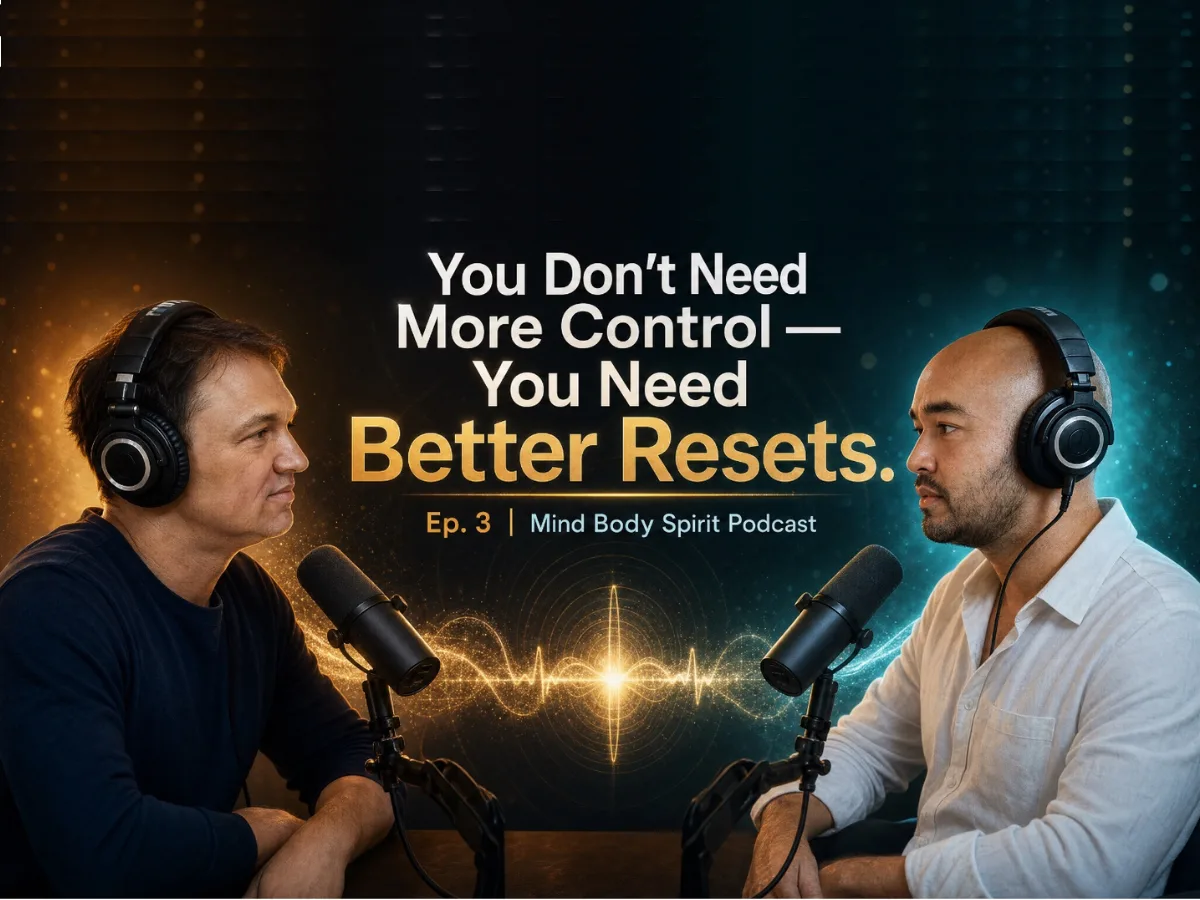
You Don't Need More Control — You Need Better Resets | Ep. 3 | Mind Body Spirit Podcast
Dustin DeFrates and holistic health expert Chris W. get real and practical about the tools that reset your mind, body, and spirit when life gets hard — and the science behind why they work at the cellular level.
Missed the last episode? Episode 2 covered mind-body alignment and how mitochondria listen to every thought.
Listen to Episode 2Episode Overview
What this episode is about
In Episode 3, Dustin DeFrates and holistic health expert Chris W. get real and practical about the tools that reset your mind, body, and spirit when life gets hard — and the science behind why they work at the cellular level.
Episode Guide
In this episode you will learn
- Why ROS can be good or bad for your body
- How chronic shallow breathing weakens your mitochondria
- Why controlling your breath controls your stress
- What box breathing is and exactly how to do it
- How heart-brain coherence changes your energy output
- Why cold plunges and sauna create a natural high
- How 18 hours of fasting puts your body into repair mode
- Why morning sunlight is free energy for your cells
- How grounding completes your body's electrical circuit
- How neuroplasticity works and why you get stuck in loops
- How to break a negative emotional trigger in real time
- Why the first three times of anything new is the hardest
- How proactive gratitude reduces reactive states faster
- What the heart's magnetic field does to every cell
Episode timestamps
- 0:00 — Welcome to Episode 3
- 0:32 — Quick recap of ROS from previous episodes
- 0:53 — Good stress vs. bad stress: the key difference
- 1:41 — How chronic stress silently weakens you every day
- 2:30 — ROS is like fire: useful or destructive
- 3:11 — Breath is your most powerful daily reset tool
- 4:01 — What deep breathing does inside your cells
- 5:47 — Box breathing: step by step how to do it
- 7:48 — How rhythmic breath creates heart-brain coherence
- 8:42 — Dustin's breathwork story at Massage Envy
- 9:50 — Fight or flight and desk stress: the daily mismatch
- 10:39 — Wim Hof and using hyperventilation as good stress
- 13:02 — The immediate natural high you get after breathwork
- 13:55 — Stacking great moments signals safety to your DNA
- 15:04 — What is coherence and why does it matter
- 16:10 — Mitochondria in every organ talking to each other
- 17:00 — Dustin's story: sick, stressed, and stuck in a funk
- 18:14 — Dr. Joe Dispenza: healing the body through the mind
- 19:02 — Heart rate variability explained simply
- 19:39 — The Inner Balance app and HeartMath tool
- 20:21 — Jagged vs. rhythmic heart waves and your health
- 21:05 — Adrenal body type and living in fight or flight
- 22:03 — Breathwork plus coherence equals a faster reset
- 22:23 — Cold plunge story: sauna, breath, and ice protocol
- 23:41 — Why cold plunges work at the mitochondria level
- 24:50 — Strategic stress builds your long-term capacity
- 25:46 — Meditation forces the mind and body to sync up
- 26:10 — Twenty push-ups can completely change your mood
- 27:01 — The slingshot effect: drop down to shoot back up
- 29:28 — Fasting and the gut as a powerful repair tool
- 30:55 — Eighteen hours of fasting triggers repair mode
- 31:41 — Fasting creates new mitochondria and stem cells
- 32:52 — Morning and sunset sunlight: ten minutes minimum
- 33:43 — Grounding: how to send stress into the earth
- 34:10 — The nuclear electrician grounding story in Arizona
- 36:49 — 24-hour fast once a month on the full moon
- 37:58 — Neuroplasticity: how your brain rewires over time
- 39:08 — How we become addicted to stressful scenarios
- 40:22 — How mitochondria reinforce every neural pattern
- 41:03 — Become aware of the emotional trigger first
- 42:17 — One new action breaks the negative cycle
- 43:13 — The jungle path analogy for rewiring your brain
- 44:17 — One breath, one push-up, one small step is enough
- 44:35 — The first three times rule for any new habit
- 45:23 — There is always something to be grateful for
- 46:29 — Dustin's six-year personal transformation story
- 47:28 — The fight-or-flight trigger with kids story
- 49:26 — Why the impulsive response feels good but costs you
- 50:11 — Thirty push-ups and the anger simply dissolves
- 51:36 — Diego's rubber band hack for reactive states
- 51:57 — Name it to tame it: the science of happiness
- 53:24 — Practice new responses when you are calm first
- 55:23 — The stoplight gratitude practice
- 56:38 — The heart's role in cellular health and coherence
- 57:29 — Follow your heart is real science, not just a saying
- 59:02 — The magnet analogy: heart energy aligns every cell
- 1:00:15 — Gratitude and heart breathing create positive spiral
- 1:01:07 — Thank you and see you next episode
Mentioned in this episode
- Inner Balance app — HeartMath Institute
- Dr. Joe Dispenza — healing through the mind
- Wim Hof breathing method
- The Daily Stoic — Ryan Holiday
- The Science of Happiness
- Intermittent fasting and mitochondria repair research
- Morning sunlight and red light therapy studies
- Grounding and earthing research
About this podcast
Hosted by Dustin DeFrates — real estate entrepreneur and five-year wellness seeker — alongside Chris W. Breaking down body, mind, and spirit science weekly.
Transcript
Full editorial transcript
Open the transcript
Dustin: Chris, thanks so much for coming again. Uh we are here in episode three of our uh podcast and we are talking yet first episode we were talking about the mitochondria and energy and and how it works from a scientific flow and then we were we were specifically talking about um reactive oxygen species RO and and and how the triggers of of emotions and and positive and negative effects create these ROS and and affect the flow of energy in the body. Right. So, picking up from there, let's uh we're going to go into our what's what's what's next? What are we talking about next?
Chris: Yeah. So, to give a a slight recap for our listeners, ROS uh being the reactive oxygen species. And essentially, that is the mitochondria's response to who we are being in the moment. So, they're listening to our thoughts, our words, and our actions. And so last time we kind of explained uh the different mechanisms in which uh the mitochondria worked from a cellular biology perspective and now we're kind of going into more practical tips that we can use every day that our listeners can apply. And so I think it's important to remember that the ROS is uh it can be good or bad. And so when we have a slight amount of stress, right? And when we proactively choose that stress, and this can be things like exercise, fasting, cold plungings, we're getting ready to stress our bodies in a way. And we call this hormetic stress. And this stress is actually going to be good for our body.
Chris: We're in a state adapted to the stress that we're putting on our body and we have the ability to recover from it. Now, where the ROS gets bad is often times we are chronically day after day stressing our bodies and it can be even be something like shallow breathing, poor posture, um chronically bad diets. All of these things, while they don't necessarily hurt us as much in the short term, all of these things start to add up day after day after day and they start to wear on us and our mitochondria just gets slightly weaker, slightly weaker each and every day. So that that's kind of a recap of of the ROS. Um, and I always liken it to like a fire. And so if you have a fire in your home, especially in the winter, which we just got through, it can be nice and warm. It can um it can cook your food. It can do a lot of different things.
Chris: Now, if it gets out of the fireplace, if it gets out of control, all of a sudden you have a fire where you don't want it, okay? All of a sudden, house comes crashing down. All these bad things. And if you put it out right away, just like in your body, if you have a little bit of stress, it can be a good thing, right? Your body adapts.
Dustin: You get your kitchen remodeled after the fire.
Chris: Exactly. Exactly. But um all all jokes aside, that that is exactly how the stress works. So, uh we can go into some of the practical ways in which we can manage that. The first one being and and we'll kind of always come back to this like in episode one that the breath is just so important. And so some of the different ways that we can start off with breathing is simply breathing deeper. When we control our breath, we also control our stress. And that's something that our listeners can can start to remember. How often am I actually controlling my breath? And many of us will find out we're we're unconsciously holding our breath. we're breathing shallowly, we're not uh using our diaphragm when we're breathing fully. Um there's no control, maybe our pace, maybe our inhales and exhales aren't balanced. So, there's so many things that that can go wrong.
Chris: And and that being said, when we use our breath in a good way, it's actually going to be the most beneficial the fastest five minutes of good breathing, even a few deep breaths can completely change how how stressed you are.
Dustin: That's a super interesting. And so then um I I wonder if you can't go into a little bit of the science just on that. So just what is what is that trigger in the what is the what is that trigger inside of your body when you take a few deep breaths? Well, when we take the deep breaths, we're basically allowing our mitochondria, which was chronically looking for energy, right? And when when when we chronically don't have enough energy, right? We we'll call that stress, for example. And we're just allowing our mitochondria to rest and repair a little bit to actually go into helping the body into okay, what are the the good adaptions that I can make? And you're basically, you know, it's like if you hold your arm out with a weight uh for 10 minutes, you just want a slight little break, right? And that's what these deep breaths are going to do.
Dustin: They're just going to give us a chance to, okay, I'm going to reset. Okay, now I can go another 10 minutes, right? maybe I just needed a one or two minute break. And that's kind of the exact same process that's going in with our mitochondria. They're working so hard all the time. They're stressed out and they just need a little bit of a break. I mean, they're very very adaptive, but we also have to give them the chance. So then I don't want to push too hard on this one, but is there a chemical signal or is there a signal from the breath or like tell me why the breath actually does reset the ROS or or the mitochondri gives the mitochondria that that reset. What does that do?
Chris: Yeah, exactly. So we we need the electrons from oxygen. Thank you.
Dustin: And and so that's exactly that's the mechanism uh that we're going to be using because all of our cells need the electrons. We get the electrons from the oxygen in the air, right? and we we create energy with it. And then we also exhale the CO2, the carbon dioxide and and so that's just the way that our body's cycle is going to work. That's the way our mitochondria needs. It's it's the most important input.
Chris: That makes plenty of sense and I appreciate that. And so the breath work and there's there's uh I don't know if we're going into breath work and all these different practices now, but there's so many different breath work practices. And so I like how you said that you don't have to go into, you know, for most people meditation is a pain in the ass. you know, it's like uh I don't want to do that. I can't do that. I my brain blah blah blah, you know, but like when when you reframe uh meditation as breath work, you say, "Oh, well, all right. I guess I can breathe." You know, and so I liked how you, you know, communicated that you could just do that in just a few breaths, but um what are the what are the what are the uh opportunities? Let's focus on breath. And then I think we have a couple other things that might do the same similar type of process or procedure. So, let's do breath first.
Chris: And so um what types of breath work is the best as opposed like let's say worst case do a few deep breaths and it'll help you but what is what else what other practices do you like for this uh specific purpose on the ROS?
Dustin: Yeah. So there's many things that we can do. So if we can get into the state of deep breathing and and just have that be our natural default like that is the best. However, a as we both know, so often throughout the day, we're we're going to go unconscious of our breath. And so, when we remember bringing ourselves back to deep nasal breathing can be great. Um, but but as far as some other methods, right, we can do a meditation with breath work, right? Box breathing is a very common and very effective used uh all throughout the world.
Chris: And box breathing, let's go, let's go deeper. I know box breathing but tell us more about box breathing.
Dustin: So box breathing is essentially you you are going to inhale for a certain count let's call it 4 seconds
Chris: and then you are going to hold your breath for 4 seconds and then you are going to exhale for 4 seconds and then holding at the bottom for 4 seconds. And so you you start to time up your breath. You start to give your body a consistent and rhythmic energy versus when we are sporadic. When we are inhaling too quickly, too slowly, when we are exhaling less, we start to create a a discoherence within our heart, within our lungs, within our brain. And when we when we give it the um consistent energy that is consistent with box breathing, right, and air being our most consistent energy source, we can start to see just how powerful that's going to be for the mitochondria. We can start to see how powerful it instantaneously shifts our body and our mind.
Dustin: I love that. Uh in my own practices, I have found something recently actually. Um, this was just two weeks ago on a I do a I I do a breath work on a on a massage table at Massage Envy and so I'm you know my poor mass is you know I'm going she's getting and it does some really magical things. Um, but what I found is that when I am breathing, when I'm not breathing, I'm able to be very analytical or I can, you know, my my my science brain is really triggered and I can do a whole bunch of things mentally inside of a non breath environment, but then when I switch over to a breath environment, I tend to not be able to think about um, you know, all of those analytical things or the stress and all those things. So I imagine that's there's some kind of a reciprocal relationship between your physical activity and what your brain is still able to do.
Dustin: Is there do you have anything to say about that?
Chris: Yeah, absolutely. If we want to put ourselves in a hyperaware state and we we can use that. Let's say we are in fight or flight, right? We are in a fight, we're running from a bear. Uh these might be extreme scenarios, but you're going to want to be breathing heavily and you want to be getting as much oxygen in as possible. uh because you're in that state of hyperarousal in which stress can be a good thing.
Dustin: Now, where we fall short is we often times maybe we're just sitting at our desk. We had two cups of coffee. Our adrenal system and our body is is needing this oxygen and it's it's it's craving this oxygen and we are just completely unaware of our breath. We're not in a calm state even though our environment is telling us, hey, this should be fairly safe. Sitting down in an office, this should be a great time to repair the body. And instead of having that time to repair our body, we're actually stressing it out even further. And then our body just never gets a chance to rest.
Chris: And so you're absolutely right. There is that inverse relationship. when we want to be in that hyperaroused state, we can also uh start to hyperventilate, right? We we we could use that uh to our advantage as well. And that's actually part of the Wimhof method is we temporarily uh hyperventilate ourselves and that actually stresses our body and it can be a good thing in short doses, small doses.
Dustin: Yeah. Yeah. Yeah. That's an interesting thought and I'm sure in future episodes we'll talk about some of the spiritual connections that you can tap into with breath work but I've had some amazing experiences. So outside of you know there's I always have to communicate with employees in future speak. Ah, that's too future speak, you know. And so when we're talking about ROS and, you know, stacking the problem and I was actually talking to a a guy um my my good friend's dad, uh he was carrying two lawn chairs to watch a soccer game and going from his house to um the soccer field, which is, you know, less, I don't know, maybe 100 yards. He he had to stop and sit down on the lawn chairs that he was carrying because he couldn't do it.
Dustin: And so like he he described to me he's 75 78 years old and he described to me hey listen when you're your age I did not do what you're currently doing which is you know uh not allowing poor habits to stack so that I can you know maintain my body as long as I possibly can be healthy at 80 years old. Tony Robbins says that um a 40-year-old could live to 140 with um you know some of the scientific techniques and and strategies that we are now aware of. And so just just watching um my my friend's dad not be able to make it to the soccer field and have to sit down in the middle gives me indication that these things are critical. Yeah,
Chris: they're absolutely critical. And I I like what you said here. We we have the capabilities to be the healthiest humans that we've ever been. Um but unfortunately our average our baseline is also dropping lower and lower as well. Uh so so it's kind of this paradox in which we have access to many different things u but we're also losing the connection to our breath to our hydration to these things that might be readily accessible and free to us and we don't know necessarily how to use them and so that that's an absolutely critical example when we don't use something we definitely use it. So then yeah, it's what I what I'd like to communicate then is that in in future speak this is good for you and you will um help your body and live longer, live healthier, have more energy if you do some of these practices.
Chris: But even in immediate um you know immediate speak when I get out of that massage envy breath work session that I do you know it's a deep tissue massage with with all my breath work. And so when I get out of there I I feel like I can take over the world. I mean, I I I'm happy. There's just so many positive things pumping through my body where I can go into my next meeting and people look at me and like, "How much caffeine have you had?" None. You know, I just feeling really great. You know, I don't necessarily explain every time that I was just on a massage envy table doing, you know, 60 minutes of highintensity breath work, but that is what I'm doing. And so yeah, breath work is an amazing thing both for the long-term um effects and and then even in that short term like the buzz, the high that you get from the breath work is real and it feels great. Yes.
Chris: And that I think that brings up an excellent point is that anytime our mitochondria are always listening to the now moment. So when we do something that is beneficial for our mitochondria, it's also beneficial for the mind and the body in that exact moment. And that's actually what creates the long-term effects is we're just stacking great moments, coherent moments over and over and over again. And our mitochondria then sends that signal to our DNA. It says, "Okay, let's maybe adjust this protein. We're in a safe environment. We can start to repair different proteins. We can start to activate uh different parts of our genome that are going to be healthier, more uh coherent with our lives. And we're if we're living in chronic stress, it tells our DNA like, hey, we're not ready for this situation. You know, we're we're just barely surviving.
Chris: We got to send all of our energy just to put out the fires.
Dustin: I love the breath work and and and breath work is a part of it. And we're going to go into a couple other things that are related to breath work that also help the mitochondria or give it that positive opportunity to not be negative, I guess. But uh let's talk about you mentioned coherence in relation to breath work and and so why don't you go deeper into what coherence is and then I got this cool tool for the audience that um has helped me a lot.
Chris: Yeah. So coherence is basically when so we mentioned that the mitochondria they're basically these quantum listening devices. And so coherence is just going to be how do we communicate that information across our heart?
Dustin: You hearing that feedback? Do you hear that?
Chris: Yeah, I can hear it from out here. Is that
Dustin: Oh, okay. That was
Chris: It should be fine for you guys.
Dustin: It should be fine. Okay, I can Okay. All right.
Chris: Do you want to go back into Yeah. Okay. So, that's exciting. So, the breath work is uh uh an easy at home. You know, it doesn't have to take a whole lot of mental energy to breathe, but there's techniques so that you can breathe better, brea do it better than your, you know, just a traditional a few deep breaths. But then you mentioned something that I find particularly interesting with the research that I've done. Um coherence. So, why don't you go a little bit deeper into what coherence is and how coherence and breath allow each other to operate together and then I've got this nifty gadget that we'll show to the audience. Uh, yeah. Yeah, absolutely. So, the essence of it is our mitochondria are those quantum listening devices that we mentioned in episode one. Well, they're located in each and every one of our organs.
Chris: So, our brain is going to have mitochondria, our heart is going to have mitochondria. And so for example, if we y use those two, when we have consistent energy across our body, it allows our organs to actually in in essence talk to each other. So all of a sudden our thoughts, our feelings, our actions, our words, everything can start to be aligned. And when everything starts to be aligned, we create that pinpoint, that laser energy that we were talking about in which our whole lives can change. And that's going to be directly reflected in our DNA and our ability to change and and our energy output in our mitochondria. And so when we're in coherence, everything's moving smoothly. Energy is moving throughout the body. Things are talking and we're we're starting to be more of who we want to be.
Dustin: I love that. And I just give you a practical application before we go into this example. But um you know just in the past uh Monday and Tuesday um I might have been sick. my kids are walking around with boogers flying out of their nose. So, you know, I couldn't be sick. But I was also going through a, you know, very difficult divorce. And so, um, uh, I was in a funk and I didn't want to admit it to, you know, I'm a strong dude and I run a lot of companies and a lot of people look up to me for their, you know, um, jobs and and livelihood and so I have to perform to a top level every single day. But I could not get myself out of that negative flow. And there's just, you know, it just felt like everything was coming down at one time. and and it really wasn't. But I was sick internally.
Dustin: And so that physicality with all of the other stress, it just created chaos and I couldn't I I was shocked at how poorly I was performing, you know. And so I think that's kind of what we're talking about is um if if one thing is off then there's lots of different ways to try to trigger um putting yourself back on track. Right.
Chris: Right. So coherence and breath work is one of those things and we'll talk about more of these things but I'll I'll explain this one. Um there's a guy named uh Dr. Joe Despensza and and he spends a lot of time you know his famous story everyone's kind of got a cool story when especially in the that realm where he his entire body was shattered by a car accident and he was you know paralyzed from the I don't know how deeply he was paralyzed but he was paralyzed and he um studied all the body systems and understood that where he was broken and he focused his attention on bringing energy into those areas and just believing that his body was going to heal those areas right and So that's slightly difference than what coherence is.
Chris: But to pivot into this, he um promotes this gadget where you turn this thing on and um I won't actually do the full thing, but you turn this thing on and it starts blinking and you attach this to your ear and this is reading your your heart rate, right? And your heart rate variability is what you're trying to uh tamper with, right? and you're trying to make your heart rate variability in in a stressful environment, you're going to go, you know, you're going to you're going to have a different a variable heart rate than the variable heart rate is not ideal. So, let's go into what coherence is as it relates to the heart math tool. This is you guys can find this. This is a heart math institute, I believe. And um um there's an app called Innerbalance that marries itself with this. And so, you can watch uh the inner balance graph and you can see that you're in coherence or out of coherence.
Chris: So, let's go deeper into what that is.
Dustin: Yeah. So, uh what Dustin's referring to is essentially heart rate variability is is the timing in between your heartbeats. So, our heartbeats naturally have a little bit of timing, a little bit of u difference in between each heartbeat. And what we want is a nice rhythmic graph between the two. And so difference between the heartbeats can be a great thing, but we want it in a rhythmic way versus like what Dustin was saying, if you have an erratic graph with a lot of jagged edges and sharp declines and accelerations, it it's not going to be as good for the body and and you're creating an energetic field. Well, energy moves in waves. We want it to move just like the waves. And so when we have that jaggedness in in our body, well, our body isn't able to get into a rhythm. And when our heart's not in rhythm, our thyroid's going to be out of rhythm, our brain's going to be out of rhythm.
Dustin: It affects the rest of our body. That makes sense to me. And I'll just kind of comment for me. Um, there's different body systems and, uh, the adrenal body system is one of the multiple body systems. And so I won't I don't know. Do you know the other ones? Adrenal and there's I think four primary body systems. Uh okay. So the adrenal body system is is uh it's it uh designated by round face collecting you know fat around the the tire tube you know kind of area. And so another another thing related to that is that often times that body system is pushing more cortisol than many other people's body systems. And so I felt internally personally that I was constantly in a fight orflight mode, overly reactive, overly and then I go into this heart rate monitor and as jagged as they could possibly be.
Dustin: And then you know, but then you compare that to other people and other people can get on this thing and say, "Oh, okay. They're they're just naturally in that flow." And that's the type we talked about that on the first the first episode that when people are in coherence, you can feel the energy. you can feel that they are at peace with themselves which allows you to feel more at peace, right? And so um that opportunity to uh get out of that fight orflight mode with the breath, right? The opportunity to use coherence to exude um you know positive energy and bring other people to a positive level is is huge. Yeah. And so we talked about breath work as a way to get into that positive state.
Dustin: um coherence and breath work together accelerates the process of getting into that positive state and my favorite is cold plunges and so I don't know about I have a lovehate relationship as many of us do with cold plunges but my favorite is cold plunges so maybe I can tell a story about cold plunges first and then you can kind of discuss why that science exists similar to um you know getting out of my massage with the breath work um I will get out of my cold plunge I I used to have a cycle at my last house where it would go um sauna for 20 minute meditation and breath work in the sauna and then I would go into the cold plunge immediately afterwards and I'd start with as long as I could hold my breath underwater with my head fully submerged and then I'd flip around and I'd do 2 minutes um you know under uh 2 and 1/2 minutes and and in that I would read um there's a a book called the Daily Stoic and so just to keep my brain away from how terrible it is to be in that cold water I'd read a passage out of the Daily Stoic and And then I go back and then I go into the steamer um and you know warm up and get my full you know like expand and contract the cells, right?
Dustin: And then I'd go back in the cold plunge and I'd reverse the cycle where I'd go here and then the last 30 seconds I would put my head under water and then I'd go back into a cold shower with a steamer. And so that cycle I get out of that and I feel like a new man every single time. And so um let's go into what that does from a science perspective. Why do I feel like a new man? And even new man is is almost uh uh isn't exaggerated enough or isn't enough of the truth because I'll come out and I'll just have more energy. I'm just I'm just on fire, you know? And again, when I'll go on a p not a podcast, but like a a Zoom meeting, Google meets, whatever, and then I'll meet with my team and they're like, "Dustin, what is going on?" Same thing. So, tell me what's going on.
Chris: Yeah. So, essentially our mitochondria, we we always want to be improving and so they're just listening to the now. They're not necessarily listening to who you were previously and who you were who you are going to be in the future. And so if we can start to put ourselves in the average person's shoes and that they're just always in a chronic state of stress. And so the body is naturally not going to want to do cold plunges, hard workouts, deep breath work, meditation, all of these things that are going to stress our body even more. Right? That's part of the reason why we have these lovehate relationships because our body is already stressed out. It's saying, "I don't want to be stressed anymore than than what we already are." And this is where kind of our mentality comes in. And we know that it's going to be beneficial for us. And we we know that.
Chris: And so that is where we're able to put a strategic amount of stress. And then our body starts to increase its stress capacity. It says, "Okay, well, this was this was good." And then as soon as we get out of that stress, right, you get out of the cold plunge, you feel amazing. That um that first sip of water after the sauna is going to feel so hydrating. We start to appreciate and actually get more energy from some of these more routine tasks because we're not we're not in that straight state of extreme stress that maybe we were in a cold plunge or in the bottom of a heavy squat and now just standing feels great, right? Our blood's rushing throughout our body. we have a bunch of nutrients and our thoughts our thoughts are now calm
Dustin: because all of our thoughts needed to go to the stress and that naturally puts us in a state of coherence and so that's one way of where we have we put our body under so much so much stress our mind and body naturally have to sink to deal with the stress and now all of a sudden afterwards we start to feel great
Chris: and meditation is kind of where we go so deep into the mind that the body is forced to comply as well. And so if we're able to get deep enough into the body, deep enough into the mind, we can kind of force the coherence in a way uh simply by being as present as we can be.
Dustin: I love that. I like that you brought up exercise as part of that because you know that um a lot of people the the breath work you know cold plunge never you know so like like um if you're in a difficult situation doing 20 push-ups will also do the same thing right is that is that fair any type of pulling yourself out I liked how you framed that if you're um thinking about negative things all of your energy has to go into those thinking about negative things so if you can just figure out a way to reset that um then you can stop thinking about negative things and your body chooses or will naturally flow into more positive um things to consider. Right.
Chris: Exactly. So we feel good when we're improving. We feel good when we're kind of on an upward trajectory and we feel poorly when we're on a downward trajectory. Now often times the downward trajectory is so slow and drawn out it just feels bad. But sometimes if we bring ourselves into that downward state, we go into the push-ups, we go into the squats, uh the breath work, whatever it might be, whatever method we want to use, and we temporarily bring ourselves into that lower state. All of a sudden, we're slingingshotting back up. We're into a a an elevating state. And even just the the small act of improvement is what can set set an entire mood in the right direction because we're constantly listening to the now. So, if it was slightly better than it was before, all of a sudden, our stress tolerance skyrockets.
Chris: And where it gets worse is when we just don't know how far we're going to drop in the spiral. I don't know what's coming next. Our mind starts to predict. Our mind starts to see a huge fall coming in front of us because it starts to extrapolate this pattern. And so we can kind of play mind tricks in a positive way with with push-ups, squats, exercise, breath work, and kind of trick it into, okay, well, we're starting to feel better than we were 2 minutes ago when we were in the cold plunge or the deep set of squats.
Dustin: I had a mentor, just kind of um another other ways to help trigger these things. I had a mentor that uh every once in a while he would just close his eyes and um just start breathing. And you know, I didn't ever realize what that was. it, but you know, he he's a beautiful soul, you know, and taught yoga to prisoners and, you know, travels around the world, genius, all these things. And so, um, he would just close his eyes and and spend a couple minutes, you know, I didn't know that he was breathing that, but that's definitely what he was doing. And so, you know, I I want to encourage everybody that there's so many different paths to be able to create that um that pivot in in mentally, physically, you know, mind, body, soul is what we're here talking about, right?
Dustin: So um there's you can do it in the mind um um meditation in the in the brain go and read you know learn something that excites you and and soul read the Bible you know meditation spiritual work anything that you want. Yeah.
Chris: Yeah. A couple other ones here uh that I think are important to mention right is fasting right you you mentioned through the mind and and and through the body. Well, also through the gut. When we when we don't eat, we're also forcing a certain amount of stress on the gut. And likewise, after a stress or after a fast, we start to repair. We start to produce more stomach acid. We start to absorb more nutrients. we allow our gut and our colon and our liver and our kidneys to all kind of cleanse themselves and have time to repair versus when we are constantly eating food, constantly overindulging and and creating a lot of stress there. Um some other ways that are free for everybody. We're all about kind of free uh is always better, right? If I don't have to pay for it.
Dustin: Before Yes, before we go because each one of these are so critical and and everybody has so many blockers. Like I was talking to my dad and I do 24-hour fasts unless I work out, right? So if I'm working out then it's really difficult for me to get through a 24-hour fast. But if I'm work if I'm not working out then then I won't eat for 24 hours. And um you know my dad who eats you know for the past 70 years breakfast, lunch and dinner and then ice cream or maybe scotch at night, you know, and so that's just the schedule. And so your body doesn't need food three times a day. It it's not necessary. Your body isn't used to that.
Dustin: So um maybe go into a little bit of the science of so you when you don't have food in your gut then your energy isn't flowing into your gut you are able to leverage that energy elsewhere but then you also suggested that there's the opportunity to repair the the cycles. So maybe go deeper into the repair process in in intermittent fasting.
Chris: Yeah. Um so the mitochondria basically have two states right they have fight or flight and then they they have what we can consider as a repair mode right and so to start repairing and regenerating the body typically for most people that takes about 18 hours of fasting
Dustin: to get all of the food out of the system and start to put the mitochondria in um what we call oxfas and it's basically the repair mode Mhm.
Chris: And so the mitochondria will start repairing. They'll start getting more and more energy. They'll start sending more and more energy throughout the body. And if they're not having to send it into digestive processes, which are very, let's say, taxing and energy intensive for the body, even though they produce a lot of energy as well, it takes a lot of energy to digest the food, right? It takes a lot of energy to think, to to work out intensely. All of these things take energy. Now, when when we're in that state, we're able to start to produce more mitochondria. That way, when next time we get stressed, we actually have more stress capacity. We have more ways to channel our energy, and it's also going to repair a lot of the damage because it's finally having a chance to.
Dustin: I love that. Okay, let's keep going. Let's So, we got breath work. We got co coherence and breath work. We got exercise. Um um
Chris: intermittent fasting. What else do we have?
Dustin: So some of the free methods that we can offer our listeners here is going to be morning and sunset uh sunlight.
Chris: And basically when the sun is below 30° you're not going to get a tan and you're also not going to get a lot of the UV damage that uh some listeners might be concerned about. Right? So, uh, if you get morning sunlight, sunrise, and sunset, this is just going to be beneficial for the body. It contains a ton of red light. We've heard a lot about red light, and red light therapy with with the LED lights can be great. But if that's too expensive for you, you can also get out into the sun completely free, 10, 20 minutes, and it it covers your whole body. And that is so beneficial for the mitochondria. you're essentially sending free energy into the body. So, when we're in a low energy state, we're stressed out, we don't have enough energy to deal with the environment that we've put ourselves in. Well, we can get we can start to do deep breathing, we can start to get out in the sunlight.
Chris: And uh at the same time, our last method here is going to be grounding, which is essentially going to complete a circuit within your body with the earth. So the earth has a bunch of alkaline earth metals in it, things like magnesium and calcium. Our body is naturally going to just discharge some of that charge into the earth. And we're essentially completing an electrical circuit. And if you have excess stress that you need to get rid of, well, you can literally send it into the earth.
Dustin: I love that. I uh another story um I was uh I spent a lot of time camping and there's always interesting people and and you know the there was an older guy um camping by himself and it turns out he was from South Africa. and he's lived this amazing, beautiful life, but he is a electrician at a nuclear power plant. And so his job is to make sure that the electricity doesn't bridge into the nuclear power and create explosions somehow, you know, and so um the sensitivities of electricity is a critical function. And so we were uh this is the hot springs in Arizona and his strawberry area. And so we're walking underneath these power lines, which is often times how they create the trails cuz they had to blaze the trail for the power line in the first place to get to the places.
Dustin: So we're walking underneath the power line and he would go by and he'd touch the a metal pole every so often and and you know, and being a naturally curious person, what are you doing? He's like, well, I'm grounding myself. And so he's suggesting that the energy from the overhead um power lines is creating this, you know, charge inside of your body and that creates stress in and of itself. And so him touching a a grounded metal pole allows him to get rid of that energy without taking off his shoes and touching the earth. Right. So that's that's a similar process I assume.
Chris: Yeah, absolutely. If you can touch anything that anything metal, it can be with your hands, it can be with the side of your head, it could be on your back, right? It can be uh there's these copper shoes, right? You can just wear copper shoes. So there's so many methods in which you can ground and even just touching a metal object that's grounded to the earth is is going to be extremely beneficial.
Dustin: That's all you need. So it's fun. God gave us everything that we needed a long long ago. So you don't have to spend, you know, I don't know, those red light beds are not cheap. A few thousand dollar on one of those red light beds. You just have to go outside in the sun. You don't There's plenty of cold water. or maybe not in Arizona, but there's lots of cold water sources and and lots of, you know, all you got to do is push-ups and sit-ups, and that's a workout, too. So, everything's free um to get to where we're at, which is awesome.
Chris: Um All right, cool. So, we got uh I think that we covered the majority of the big ones that uh Yeah. Is there anything else that we should consider on the um reset of the mitochondria energy cycles?
Dustin: Yeah, I would just say just as far as repairing them. So, uh, to give our listeners maybe some practical examples that they could model after if they want to. Uh, so the first one here, we have a 24-hour fast once a month, right? And if we time this up with the full moon, I won't go into the benefits of why that might be important, but a 24-hour fast once a month best with on a full moon. And this is going to create new mitochondria, new stem cells. It's going to repair our mitochondria. Um, red light therapy as we were talking about. So, the sunrise sunset. Um, I would recommend about 10 minutes. And if you can do more, awesome. It's just going to accelerate your healing. But 10 minutes is about the minimum that we want to shoot for. We also have um grounding for about 10 to 20 minutes as well.
Dustin: And that that's kind of about the amount of time that I would recommend for people because not only are we discharging, which can happen very quickly, right? We can touch a metal pole very quickly. We can discharge a little bit as well, but when we actually ground to the earth, we're also absorbing some of these different nutrients and some of the ionic energy that is out there. So, just setting an example, 10 to 20 minutes of the red light, 10 to 20 minutes of the grounding, and then a 24-hour fast once a month. That's how we would actually apply some of those practices.
Chris: Makes plenty of sense to me.
Dustin: Yeah.
Chris: Cool. I like it. What else we got to talk about? I'm kind of scrolling through our notes here. We got some uh Yeah, these the loops. You want to go into neuroplasticity?
Dustin: Absolutely. Yeah. So,
Chris: we our our brain and our neural networks, so it's not just in our brain. We have neural networks throughout our body, but the way that our brain rewires is that it takes time. And I think this is part of what we were getting towards. And and when we do something good in the moment, are we going to last the entire day, right? When we get into a bad mood, why doesn't our body just completely crumble? Right? So, we have some sort of bodily memory, and we can call that our DNA. And so when our when our body is in a certain memory, we start to get into different habits and different scenarios and they start to repeat because our brain is looking for the same responses the same way it used to deal with something. It starts to understand what is coming next even if it's a stressful state. Many of us, that's how we get addicted to stress is we do something stressful one time.
Chris: We're like, "Okay, at least I know about that." But if the brain doesn't see the path next and it thinks the fall could be catastrophic, well, I'm going to avoid maybe the short-term stress, right? And so, it kind of creates us a scenario. We're stuck in these loops. Oftentimes, we're addicted to stress. We're addicted to scenarios in which we don't want. So how do we break out of that? And so the the first part is we need to understand that we have these triggers. So something happens and we are going to feel a certain emotion and then typically based on that emotion we we create some physical response, right? And and this can happen in a variety of ways. But the then the second part is the brain starts to fire on these pathways again
Dustin: and those neurons and those pathways they get stronger and stronger and so it becomes easier and easier to make the same decision even if it's a bad one right and it's the same way with good habits right uh then our body has a response our mitochondria starts saying okay well these these neurons are firing these thought patterns are happening these emotions are happening. Here's how I need to adjust. The mitochondria starts to reinforce and send those signals back to the brain, back to the heart, back to the different organs, and it starts to reinforce all of those patterns as well again. And the loop just goes on and on. So, how do we necessarily break through that is we have to first start to become aware of that emotional trigger. As soon as we can become aware of feeling like I felt disrespected, I felt betrayed. I felt uh not not worthy, right? And and all of these are very common.
Dustin: And then we might start to do things, well, if I'm not worthy anyways, I might as well just eat this food. I Why would I work out? I it it doesn't make sense to the brain. And as soon as we do that one time, okay, well then brain's firing. It's starting to wire. And so if we can start to become aware of it, that that's the very first thing is that okay, just because I'm feeling this way, because n emotions will naturally come and go, right? If we feel guilty about something, well, all that's telling us to do is maybe we just need to say sorry about to somebody
Chris: and then we don't feel guilty anymore and we let that emotion flow. Now, if we just stay in that emotion, oh wow, I'm feeling guilty. And so now I'm doing another thing that makes me feel guilty and now I'm acting upon it. And now I feel even guiltier because now I've done two things.
Dustin: Well, now we start to see how it becomes a loop.
Chris: And so becoming aware of it is the first part. And then the second part is going to be critical is because our brain is not necessarily going to be wired to see the solution right away. And so what we have to do is get that positive spiral going again. And what I always recommend to people is if you become aware of emotion that you don't want, that you don't prefer, do anything rooted in a new emotion. And that can be taking a loving breath. It can be saying, "Okay, I respect my body to maybe sit up a little bit straighter. Maybe I am going to do one push-up." anything, any action rooted in a new emotion is going to snap you out of that cycle and it's going to create a new cycle because now you have a new stimulus, a new emotion to work with and that's going to start to forge a new path. And the example that I have for people is you can imagine you're in a jungle
Dustin: and your tribe has always had a certain path, but maybe it's not the path you prefer. Maybe they're walking down the path of shame or guilt or or fear or some, you know, scarcity, whatever lower emotions, right? Exactly. Like, don't go over there. It's not good. But
Chris: but maybe you know that there's a new path that you want, right? like I I want to feel more love in my life. I want to feel more joy, excitement, whatever it might be, right? We we each have our own choices. Well, because our path is already carved out for us, even though it has a lot of snakes, we're like, "Okay, this is better than uh going through a new path that might have even more snakes or might have snake." Who who knows what it is, but I got to take my machete and start cutting things. I might as well just walk this path that's already been walked. And so as we start to cut down the plants, it just gets easier and easier every time. It's going to be hard the initial time. If we want to feel more love and we're used to feeling guilt, we're not going to feel much love in that first breath. We're not going to feel much love in the push-up.
Chris: It's almost going to feel why am I even doing this? But as we start to do it more and more, it starts to build up more and more and we start to we start to ingrain those circles as well. The first time we do a guilty action, we don't feel much guilt. May maybe feel a little bit, right? And so if we can get a strong positive response, we can re rewire it quickly. But even just noticing a small positive change, a small change in throughout your world, right? And that's why we take some action. All of a sudden, our our brain can start to create this compounding effect. And the more that we do it, it just builds up over and over again. And we're actually going to become more capable of feeling love, more capable of feeling excitement, more capable of uh being energetic like like you were mentioning earlier, Dustin.
Dustin: That makes so much sense. And so um again in practice there's all kinds everybody has something that they can be grateful for. Even if it's that you're you know alive at the very moment in time. Even if you're dying of cancer you can be grateful for being alive at the moment in time or grateful for what you've done in order to produce children that can will you know take you your p your yourself on to the next you know generation to generation. So there's always something to be grateful about. And so, you know, naming off three things when you're in that negative cycle and and there's there's all kinds of ways to try to re-trigger that. So, I appreciate that you're describing those just the simplest things of saying, "Okay, change your thought.
Dustin: " You know, if you can change your thought into that one push-up or if you can change your thought into the most loving memory that you have of your children or your spouse or whatever that might be or, you know, a cuddly moment with your parents long ago. All of those things will put you into that state nearly immediately as long as you can do that a couple times and you can do that more often. And and I can tell you with my personal experience, I I went from a very negative, you know, lots and lots of stress in my daily life and into making sure and then going into meditation and doing all these different practices that I currently do and and I am a completely different person than I was, you know, six years ago. I walk around with a smile on my face and you know I think I mentioned it pre I'm going through a complicated divorce and so that thing doesn't even touch me.
Dustin: It's sometimes it does sometimes I get a little stressed out but I'll do my push-ups my whatever else it is. And so so just the natural order of who I am now as opposed to 5 years ago. I am able to get into that positive state so much faster than than when I would get into my funks a while ago. Yeah.
Chris: Right. And if we if we stay practicing that, if we stay walking the path of gratitude, well, the path of gratitude isn't going to have the plants. It's not going going to get overrun. It's going to be easier to return to it when we need to versus when we're first carving that out or we haven't practiced gratitude in a long time. And so that's where if we're able to root that in our everyday practices, we're always able to return because there we got to forgive ourselves. we're always going to get off the path. It's just how often, how quickly, and how strongly we can return back to the path.
Dustin: I'll give you one more example. It's uh, you know, my fight or flight. You know, my children, I have a four-year-old and an 8-year-old, and you know, I'm I'm used to being in control. I am in control of lots of lots of things. And so, I control lots of companies. I control lots of things. And so, um, I do not control my children despite despite my desires. I do not control what they do. And so they'll, you know, do something that I perceive as stupid, but they're four and eight years old, right? But that that perception of it being stupid will create this negative reaction. And and that goes back to my parents, you know, like I'm I'm just following the lead of what I had been seeing all my life where if I do something stupid, you know, I get barked at. And so then I can I can I'm seeing myself barking at my kids the same way I was barked at when I was doing something stupid.
Dustin: And I and I dislike that strongly. and take that comparison in into my ex-wife and you know her reactive state and is just very there is no reaction. She's able to see something that stresses me out and not have that reaction. So as I kind of see the difference between how she communicated with my children in those stressful moments and how I communicated my children, I know what the right path is and I'm not on the right path. So um like for those for those triggers um I know that the fight orflight mechanism is so fast and the reaction is so fast it's very difficult to create the bridge to get from this fight orflight to something that isn't so reactionary. So is there any in the moment that very second you know when when you feel that trigger come on what what what would you do in that situation?
Chris: Yeah. Well, it it's it's about becoming aware of it because if you can become aware of it, like we were talking about that next step is ju just doing anything. Maybe it's one deep breath.
Dustin: Yeah.
Chris: Maybe it's just moving your hand in a in a circle. Anything to break you out of that that negative loop because when when you're in that negative loop, you just want to take an impulsive action.
Dustin: It feels good. It's what's going to give you the best dopamine hit because it's the path of least resistance in your brain when you're in that state, right? When we're in a meditative state, like there's no way we would act in that way, right? But when we are in that state, the path of least resistance which feels good is going to be me maybe yelling at the kids or acting in such a way almost like a I showed them but then we feel bad about it later or we have the consequences or we're like wow I didn't re that wasn't really me and so yeah exactly like we were talking about if we can become aware of it then we can start to root any change right that that's where you do the one push-up and it's it it it's not what you want to do in the moment, right? And if it's not what you want to do, do 30. By the time you get done with 30 push-ups, you don't really want to react in that way anymore.
Dustin: So, it's just about creating. Do I need a strong action, a strong positive action to balance out if you if I was in a strong impulsive negative state? Well, I'm also going to need a strong positive action to help balance out maybe that negative state that I was in. And maybe it's maybe it's a 100 push-ups. Maybe I need to step away uh completely from the situation as soon as I notice it because I know I'm going to do something bad. And over time, that's just going to get less and less. It's just going to get easier. But those first few times, those and I've found it's about three times. The first three times is the hardest for anything. You're going on a run, you don't want to run. you're going on a cold plunge. Maybe it's one of your first three times. Like these things are going to be hard, but if you can stop yourself by that by the time that fourth time,
Chris: it's so easy.
Dustin: I love that. What else do we have to talk about here?
Chris: That is uh let's I think that's it for the brain. If we want to kind of go into
Dustin: Well, let me let me go. Yeah. Heart. So, we we're talking about neuroplasticity and there so there's the the the ways to change that pattern. So, um you know, Diego, my 8-year-old, actually suggested we were talking about how um he also has those reactive states. And so, someone at school or you know, I think he's taking a meditation class actually. And so, he had suggested that, oh, maybe I could, oh, Diego, what what can you do when um you are in that state? Me trying to teach myself by teaching him, you know. And he said, oh, well, maybe I could have a rubber band. and I could snap that rubber band. And so I want people to understand that there's so many different ways to try to reset that trigger. But there's a book called um the science of happiness and and as you name it, tame it is is one of the principles in that book.
Dustin: So if you can name it, then you can actually do something about it. Alcoholics anonymous, you know, if first step is to admit you have a problem and once you've admitted you have a problem, then you can do something about that problem. So I love how you framed that. there's a whole bunch of different ways to be able to to create that uh another new path. And so I also have um um there's there's uh a series of psychedelics that also will help accelerate that process of rewiring pathways. And so, um, you know, there's there's a a series of legal psychedelics that I have done that, um, that, uh, have allowed me to come out and recognize almost instantly that I do not have some of the same perceptions that I had previous to some of these experiences almost immediately. A couple of them were life-changing, you know, and so,
Chris: absolutely.
Dustin: Um, there's many different ways. you know that I think I want to just continue that that is one of the paths and I don't want to stress that as the primary path that turns off a lot of people and turns on a lot of people but there's just so many different ways to psychologically to to rewire the pl neuroplasticity.
Chris: Yeah. And I think that kind of brings up a larger point which psychedelics would fall under is that when you are in a calm state and you want to make that change, you know, maybe you're impulsive when the kids uh make a big mess or or they spill a bunch of liquid on on the carpet or whatever and you know that might trigger you or or they're acting out, whatever it might be. We can start to practice this in a calm state. Hey, um, you know, maybe you just got done with a meditation and you can start to visualize the positive aspects that you like about your kids and it's we don't have to wait until we're in a negative state to start to feel grateful, to start to feel like maybe I should do a push-ups. We can access that state anytime we want. Psychedelics being one potential way in which we we amplify that. But visualization, the breath work, all of these things.
Chris: When we're in a calm state, we can start to think about these old patterns, we can start to think about this is how I want to act. We can even start to visualize oursel getting mad without the emotion and just visualizing and practicing in our mind the new pathways and the new techniques that we want to enact. And that puts a little bit of memory in our body. So even times when when we do get triggered, we've already practiced it, right? It's like it's exactly what we do in sports. We have a bunch of practices and then we have the actual game and we feel ready for it. But if we don't practice, well, our games are going to also be a little bit more consistent. We might have to rely on on impulse control. We might have to rely on on heavy self-recognition.
Chris: But if we're if we're practicing these things already and then also reminding of ourselves of all the things that we're grateful for because then we're naturally just the the reaction is just not going to be as impulsive when we're proactive.
Dustin: I love that. Uh my ex-wife um used to have a practice, maybe she still does. Um but uh I tried to implement it and I during when I'm driving I got too many things going on in my brain because I'm usually going to the next thing, next thing, next thing. But um when she's driving at the stop lights, she practices uh whenever the light is red, she'll go through and do a series of grateful um what am I grateful for? And so it's just another just super simple thing that you can do at home for free, you know, and um you just you're at a stoplight and you start thinking about all the positive things and and so I love the fact that you don't wait until you're in that negative state in order to try to change that negative state that you can get yourself to that point where the negative states become reduced faster, accelerated reduction um by practicing gratitude. I love that.
Chris: Right. It's it's kind of like the person that waits until they're hungry to eat and well they're always going to be overeating. But if we we if we eat proactively, maybe you eat an hour or two hours earlier than you wanted to eat and and maybe you proactively use smaller portions, well, all of a sudden it's much easier to to stick to maybe the diet that you wanted to stick to because you were proactively uh taking care of the problems.
Dustin: Love that. So the heart's role, I think that's the the final thing that we wanted to talk about. Tell me more about the heart's role in this. Yeah. So the heart, we can think about it as as producing a magnetic signature on all of our cells. And so that heart rate variability that we were talking about, this is basically going to create a a a way uh to communicate with the rest of our cells. We're creating this magnetic field and that has so many benefits uh throughout our body. We can talk about uh the coherence. It optimizes brain function. there's emotional balance and um Atkinson and Thomasino had a had a very interesting study on this. Um, but as as far as that, it's just it's just going to be correlated with with our best intentions. And we we can always say follow your heart. And I heard that so much. Listen to your heart. Follow your heart.
Dustin: And I never knew what that meant as a kid. But when we actually place attention on our heart, when we feel our heart, when we start to breathe into our heart, the cascade is incredible on the body, we start to get elevated emotions. We our our breath starts to become more coherent. We start to think better thoughts, right? And this is a big one for many people because we live in a state where we're constantly stressed out. We're constantly looking for things outside of us. We're overstimulated in every sense from eyesight to sounds to uh the smells, the the air that we're breathing, the touch we have, our bodies are drained. And so just reminding ourselves that the heart can help lead the way. And we can start to allow our heart to guide us into those emotions because it's going to be very powerful.
Dustin: Even the act of putting our hands on our heart in an impulsive time or or in a meditative state, it just allows us to take stronger and more coherent actions with who we actually are. And we're amplifying that energetic magnetic field that's actually all around us.
Chris: I I uh I don't know, you have the science and I have the practical application, I guess. And so I have been told by multiple uh teachers, mentors in meditative states that Dustin, your biggest issue is that you're not leading with your heart. You're not, you know, they literally say, Dustin, stick out your chest and you will be perfect. Everything will be great, you know, and so that leading with the heart and and knowing that that is you, if you can think of that as a magnet and and the first thing that you want to do with a magnet is have the magnet be attracted to something else. So the closer you can get the magnet to other people, the the faster you will be able to come into the coherence and that that that peace or the you know allow the waves of the energy to to be to be have a net positive effect. Right.
Dustin: Right. And and we have all this all these metals, right? We'll call them cellular salts in our body like we discussed in episode one. And so if we have a strong magnetic field, well, we put a magnet on say a bunch of nails, well, they all start to face the same direction. They all start to become coherent
Chris: and we're able to now now our brain's able to function clear, right? The signals move faster. Now our thyroid starts to be able to produce more thyroid hormone. It starts to affect each and every organ throughout our body. And that's part of the reason why gratitude and actually feeling our heart and breathing into our heart, it creates that magnetic field. That magnetic field then affects everything else. We start to have that positive spiral, but that's exactly right. I appreciate how you brought up that magnet. It's it's it's aligning all of those salts within our body and it one of the coolest phenomenons. Love it.
Dustin: I think we covered all of my notes here today. Are we anything else that you want to add to that? Uh well, as far as kind of a preview to episode three, we'll kind of go into we kind of mentioned on today we had uh the DNA being the cellular memory that kind of holds on to things and make sure things don't shift too quickly. And then we can also go into kind of the science of vibrations. There is a lot of maybe hippie or woo woo talk out there. Let's be high vibration. and let's have good vibes. What does that really mean? And what's going on in ourselves? So, that's what we'll be talking about next time,
Chris: episode number three. Looking forward to it, Chris.
Dustin: Yes. Thank you, Dustin.
Chris: Thanks so much.
Transcript adapted from the Mind Body Spirit Podcast, Episode 3. Full audio and video available on YouTube.