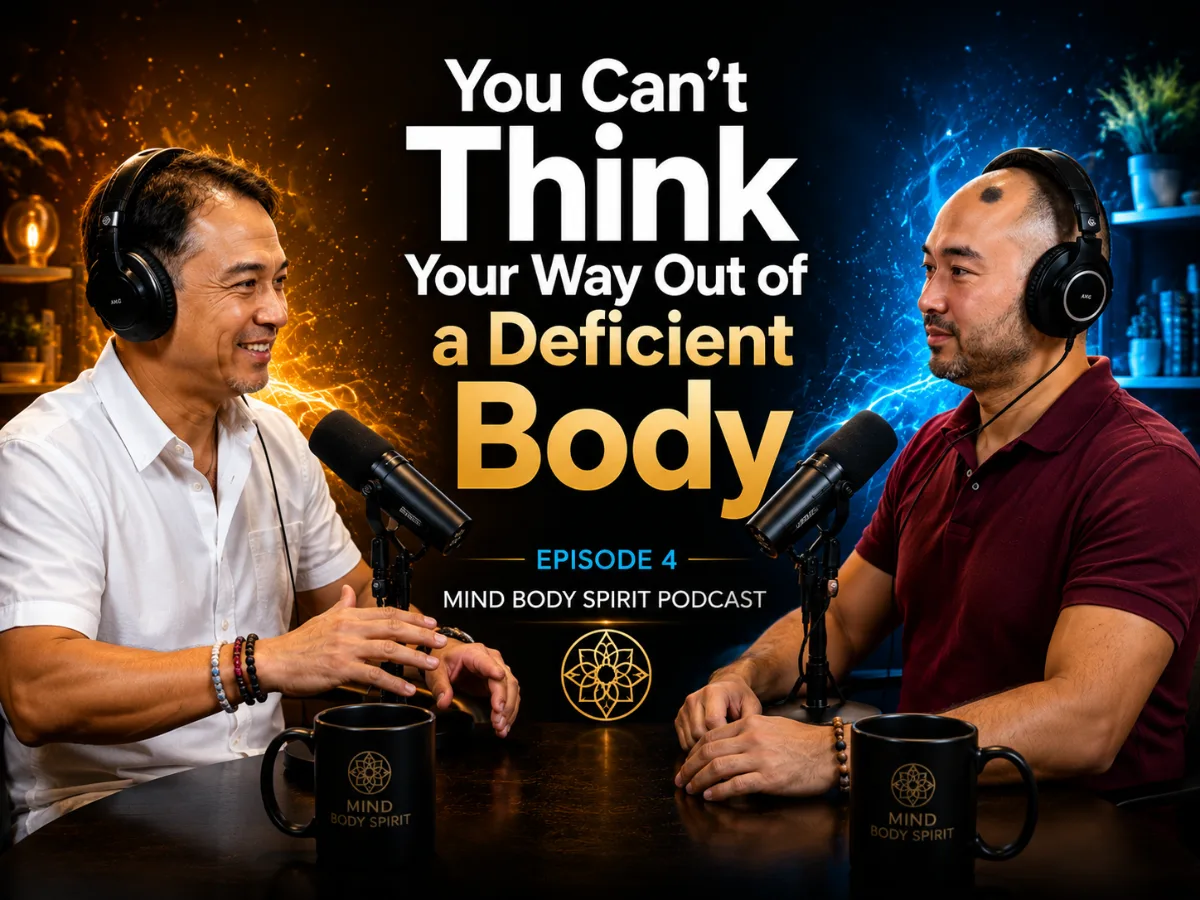
You Can't Think Your Way Out of a Deficient Body | Ep. 4 | Mind Body Spirit Podcast
Dustin DeFrates and holistic health expert Chris W. break down the minerals and vitamins your body needs to think clearly, feel balanced, and stay in coherence — and the science behind why your body cannot function without them.
Missed the last episode? Episode 3 covered practical reset tools for mind, body, and spirit.
Listen to Episode 3Episode Overview
What this episode is about
In Episode 4, Dustin DeFrates and holistic health expert Chris W. break down the minerals and vitamins your body needs to think clearly, feel balanced, and stay in coherence — and the science behind why your body cannot function without them.
Episode Guide
In this episode you will learn
- Why coherence starts at the cellular level, not the mental one
- How your cells use minerals to send electrical signals
- Why magnesium deficiency causes anxiety, brain fog, and poor sleep
- How mineral deficiency breaks your heart and brain connection
- Why your brain cannot rewire without the right building blocks
- What choline and DHA do for memory, attention, and neuroplasticity
- How B vitamins act as the chemical copilot of your brain
- Why potassium is your heart's natural pacemaker
- How sodium, calcium, and potassium fire every single heartbeat
- What heavy metals do to your brain's electrical flow
- Why thoughts are electrical and emotions are magnetic
- Why sound baths and crystals work at a scientific level
- How to stop being a victim and start troubleshooting your body
Episode timestamps
- 0:00 — Welcome to Episode 4
- 0:14 — Quick recap of coherence from previous episodes
- 1:24 — What breaks coherence at the cellular level
- 2:15 — What coherence means between your heart, brain, and gut
- 3:00 — How coherent organs fire together and make decisions easy
- 3:50 — The heart as master pacemaker keeping every system in rhythm
- 4:34 — Your cells are electromagnetic receivers: here is how
- 5:28 — Think of your cells like ocean water holding electrical charge
- 6:40 — Why minerals matter more than vitamins and nobody talks about it
- 7:09 — Dead battery analogy: you cannot have energy without minerals
- 7:29 — How mineral deficiency is a hidden root cause of anxiety
- 8:46 — Why taking a multivitamin may not be doing what you think
- 9:04 — Medications that strip your body of essential nutrients
- 9:24 — Get tested: know your mineral and nutrient levels
- 10:37 — What happens at the gym when you are properly mineralized
- 11:12 — Procrastination, laziness, and brain fog are often just deficiencies
- 14:00 — Magnesium: how it binds to ATP and powers every organ
- 15:00 — Why most people are chronically low in magnesium and vitamin D
- 15:28 — Grounding barefoot and why the earth gives you magnesium at night
- 16:17 — How magnesium deficiency leads to emotional chaos
- 17:14 — The person who knows what to do but cannot make themselves do it
- 17:54 — Willpower works, but minerals make everything effortless
- 22:56 — Magnesium and ATP: what adenosine triphosphate actually is
- 24:25 — Choline and DHA: the two brain nutrients you need to know
- 26:10 — Heavy metals in the brain: how they block electrical flow
- 28:05 — Synaptic plasticity: why a mineralized brain fires in new ways
- 29:49 — Acetylcholine as a volume control for the programs you want
- 30:54 — B vitamins and methylation: DNA repair and neurotransmitter production
- 31:17 — The sous chef analogy: how B vitamins keep your brain in rhythm
- 34:19 — Moving to the heart: how the heart maintains coherent rhythm
- 36:40 — Heart minerals overview: potassium, sodium, calcium, and CoQ10
- 37:07 — Potassium: the natural pacemaker that resets your heart every beat
- 40:31 — Herbs and spices: nature's multivitamin for potassium
- 42:16 — The rubber band analogy: sodium, calcium, and potassium every heartbeat
- 43:35 — What we call heart disease might just be chronic mineral depletion
- 45:18 — Stress burns through your mineral stores faster than anything
- 47:44 — CoQ10: the electron transporter that powers your heart mitochondria
- 49:07 — Vitamin D: how your body collects and stores energy from the sun
- 52:06 — Vitamin C: building collagen to protect your body's wiring
- 54:07 — Vitamin E and selenium: the shield and the fire extinguisher
- 1:00:32 — Thoughts are electrical: how neurons fire and produce your thinking
- 1:01:00 — Emotions are magnetic: how the heart shapes how you feel
- 1:03:30 — Racing thoughts vs. brain fog: overcharge and undercharge explained
- 1:05:34 — You are not a victim when you know what your body needs
- 1:07:32 — Low ATP equals low willpower: why energy runs everything
- 1:09:20 — Sacred geometry: the most efficient structures for holding energy
- 1:09:40 — Honeybees vs. wasps: coherence vs. chaos in nature
- 1:12:15 — Sound baths and crystals: the real science behind why they work
- 1:15:12 — Thank you and see you next episode
Mentioned in this episode
- Magnesium and ATP mitochondria research
- HeartMath Institute — heart-brain coherence studies
- Heavy metal testing — functional medicine
- Vitamin D and sun exposure research
- Grounding and earthing research
- Dr. Joe Dispenza — Breaking the Habit of Being Yourself
- Omega-3 DHA and neuroplasticity studies
About this podcast
Hosted by Dustin DeFrates — real estate entrepreneur and five-year wellness seeker — alongside Chris W. Breaking down body, mind, and spirit science weekly.
Transcript
Full editorial transcript
Open the transcript
Dustin: Okay, we are on episode four. Thanks for coming and hanging out again, Chris. Uh, we have a exciting episode today. We're talking about um coherence and and what makes that coherence tick, right? The science behind the coherence. And so, welcome to episode four. And um and and I think we're going to just get right into it. We're talking about um Go ahead. What are we talking about?
Chris: Yeah. So, last episode we talked a lot about coherence and how that affects our body and emotions and and staying in a calm state. And today we kind of want to go over, okay, what are the minerals? How does our body influence it? How does our heart, the physical organ work? How does the brain work? And start to piece all this together. So, if we can understand our physical body, then we can also understand our emotional and spiritual bodies as well.
Dustin: Okay, that's interesting. And well, I'm excited to hear more about it. And and so I think that uh for this episode, if you're interested in learning how to um increase the performance of your body systems and there's certain inputs and outputs, just like we've been talking about, you know, the inputs being exercise, diet, and all those things, but today specifically, we're going to talk a lot about um the the what is inside of a diet or what's important inside of that diet. So maybe we can just get right into some of those things.
Chris: Yeah. Yeah. And kind of the most important question we're going to answer here is is we can all get ourselves into coherence. Maybe we got done with a sound bath and a sauna or a gym session and we're feeling pretty good about ourselves. Uh but we also understand that if we are dehydrated, we drank two or three too many coffees, maybe you smoked a pack of cigarettes, how exactly is that affecting us? We know we're not going to necessarily have as harmonious thoughts, right? And so that kind of brings us into the first part of today's episode is what exactly is coherence from that physical cellular level. And it's it's really just going to be is there cross commmunication between all parts of our brain? Is there cross communication between our heart, our thyroid, our brain, our gut?
Chris: All of these things if if they're in discoherence they're we're not going to be able to make great decisions. We've all had an experience where our gut tells us one thing, our brain tells us another, and our heart wants to drag us in a third direction. Yes.
Dustin: We're like, "Oh, wow. Well, my brain says this, my heart says this. I don't really know what to do. I'm not in coherence."
Chris: And often times, we just kind of pick one. Well, follow your heart. Follow your gut. Think about it. Right? And instead of getting in coherence and then everything starts to get aligned and the decision is easy. It's instant. we don't even really need to think about it. U that that's kind of the power of coherence. So it's when everything's talking together, those coherent patterns, everything's firing and the communication between your organs and your cells is working very efficiently.
Dustin: So you said heart, brain, thyroid, gut, right? Are those the major body systems?
Chris: There there's definitely more, right? We can be talking about your your muscular system. You can be talking about your lungs and your breathing. Um, but it's all connected. It's all connected. And the more systems that we can connect together, it it just becomes more and more harmonious because ideally we're just one living system, right? Made up of all these separate systems working in absolute coherence. And we're and we'll kind of we'll be talking about that as well, how the heart is kind of the master pacemaker, keeping the beat of the drum, keeping everything in coherence. But often times our heart when our heart's out of out of rhythm, well then every other part of our body is going to get out of rhythm as well.
Dustin: Makes plenty of sense to me. It's cool.
Chris: Yeah.
Dustin: Please tell me tell me more.
Chris: Yeah. So that's going to be the difference between chaos and clarity. It's kind of like that entropic model of reality. We're always going to try and want to reduce entropy and and reduce the amount of chaos that we have going in our lives. So that naturally feels good. And when our heart is beating in coherence, it's naturally reducing the entropy of our entire body. So we can think of the cell as like an electromagnetic receiver and every cell has a membrane potential. And essentially this is the difference between uh voltage between the inside and the outside of the cell. And we need ions to do this, right? We need things like sodium and potassium and calcium. um to balance the charges inside and outside of our cells and we have that like electrical voltage.
Chris: So so that's kind of important and we can think about that um as allowing the current to flow between not only inside of your cell which is very important but also allow that voltage to to to travel outside of the cell to start to communicate with every other cell in that organ. And then same thing, we we we need our organs talking to themselves, but then we also need to send that signal outwards and we start to get a more and more complex system. And so we can kind of think of this as like ocean water. The ocean water is always going to be salty and it's it's carrying all this potential energy and all of this charge, right? Versus something like a a still bowl of water. Uh it looks dead. it doesn't have as much of the charge is not as alive. It's not being pul there's no tides in it, right? And so these salts can kind of help with that electrical charge.
Chris: Same thing in in like a storm cloud. You have all this electrical static electricity built up. Well, we we need the ions in the air to actually transfer that as well.
Dustin: Okay, I'm tracking.
Chris: Yep.
Dustin: Yeah.
Chris: So, yeah, we can think of our cells as these tiny oceans. We need water, but we also need the ions and the minerals to hold the charge to pull the water in different ways and to allow the energy to flow. So things like potassium, sodium, calcium, magnesium, all of these regulate our our our signal flow between our cells. When we have enough electrolytes, we're able to cross communicate in a better way. And that's why it's so important to to get enough of these vitamins and minerals and and especially minerals. minerals don't get enough focus in in today's today's world. We love to talk about vitamin C and vitamin D and of course the body uh doesn't make these naturally. So we do need to ingest them. But equally as important is all of these healthy earthy minerals that we need to to cross communicate not only with ourselves but each other and every cell inside of our body.
Chris: I like think about it. I like thinking about it like that because, you know, if we're just talking about I know like talk about a a battery or a magnet or just the the elements that you need inside of a battery in in your car is the basically minerals, right? And so it's fun to consider that um as as you want energy to flow or as you want a consistent charge to go through your body, that is impossible if you have a dead battery. And so I'm I'm excited to talk more about that.
Dustin: Right. And that's that's often a large cause of anxiety is we're just missing these minerals. So the body wants to fire off a response,
Chris: but we don't have the minerals or it's acting slowly or now there's not that communication, right? Like we were talking about, we have that disconnect between the heart and the mind saying different things. Well, often times we can also attribute a lot of that to
Dustin: just not having the proper minerals in our body, right? Yeah,
Chris: we we told ourselves we wanted to be stressed out with caffeine, but then we're also trying to make a calm decision for our kids.
Dustin: There's it's it's not incoherence anymore, right? So, we need to tell our body, here's the minerals that are going to be calm, and now I can link that up with my thoughts. Now, I can link that up with my emotions. Now everything's synced, and now it life just flows. It's easy, and it literally flows electromagnetically as well. So Chris, you're a smart guy and we're going to have smart people listening for sure, but um there's also the element of people just not knowing, right? And so when when people don't know the downside effect of these things, you know, there so like before we get into some of these individual um requirements for those positive and negative charges, uh you know, taking a multivitamin may not be doing what you think it it's doing, right?
Dustin: And there's and a lot of these um a lot of these um drugs that are being prescribed are stripping your body from a lot of these the nutrients and the minerals and things out of your body. So it's very valuable before we go into the individual nuances to actually know. So there's tests that are available for these types of things, correct? To check your nutrient levels, your mineral levels and and figure out where you're deficient in these things, right? So, I' I'd encourage you guys as you're listening to these things to not just blow it off and say, "I'm taking a multivitamin, therefore I'm cool." You know, you're you're going to want to know your body system and everyone's body systems are different and and people are deficient or overly charged in many of these things,
Chris: right? And and that's an excellent point is because we're all going to be different. like I I can stress my body out in a different way and maybe I feel good because I have the vitamins and minerals that I need to to be able to do that, right? We can think about somebody who's maybe hitting the cold plunge and working out intensely. They have all this mineral and ionic charge. They are able to stress their body more, right? And that's one of the things I always tell people if they're trying to get in good shape or in better shape, just try rehydrating and remmineralizing your body because all of a sudden instead of feeling tired and weak at the gym, you give your maximum effort and it feels easy. There is no inongruence, no u incoherence between your brain and your muscles, right? They want to naturally give effort if they're mineralized properly.
Chris: And they naturally don't want to give effort. If if there's no minerals to give, if there's no ionic charge, everything's going to feel very hard.
Dustin: You're going to get through one set of a workout. You're going to be like, I just don't want to be here. And and it makes sense because the body doesn't want to be there. It's not in a state ready to accept stress.
Chris: Yeah. Well, I appreciate that, Chris. That kind of got us off track on just, you know, that popped into my mind. It may have um you know family and friends that absolutely believe that are they're healthy and that they're getting these things just by popping those multivitamins, but they don't know that alcohol is stripping their body of all these things or they don't know that, you know, some of the some of the drugs that they're being prescribed are stripping vitamin B and all these other things out of your system. So I
Dustin: Exactly.
Chris: Before we go too far into those things, I wanted to kind of clarify that don't blow by these things because you don't know until you know. and I had I had a series of tests and um there's certainly luckily I'm a very healthy guy but uh there's definitely things that I am deficient in and I have been working on and we'll go in we'll get into these as I go into the stories. So basically what you're saying is the minerals um potassium chlorine these these are all creating um the capability for you to be in coherence right so the things that we've talked about in episode one and two and some of these physical out exterior things that can help you stay into a flow state or that there's also all of the charges and the interior state of that flow state right is that
Dustin: exactly yeah okay exactly
Chris: and so if we think about it like okay we can do all of thing all we can do everything through our spirit. We can do everything through the present moment.
Dustin: But we often times we can't choose our biological
Chris: uh responses. We can always choose how we respond to the response. How we but we can't choose that first signal.
Dustin: Yeah.
Chris: And so often times we're just reacting to that first signal and then that's creating another loop and that's creating another loop and then it becomes harder if we don't have the right minerals, right? It becomes harder then rewire our brain. Then we get stuck in these stressful loops. And because we're stressed, we make decisions that keep us in stress, right? You're going to eat foods that don't have the minerals and vitamins, right? That that's actually how our brain works is we just start to attune to who we think we are.
Dustin: Yeah. I It's funny that you just said that. I had a few tequilas last night and so just you know the sugar that my body says you get the sugar in your body and all of a sudden you want more sugar and I'm not going to continue to drink tequila all night. So, I'm go and I look for the, you know, my kids jelly beans or whatever, gummy bears. So, I'm like eating all these gummy bears because I'm trying to, you know, replace what my body is trying to mirror into, right? It says, "Oh, you have this now. You want more of this." Right? Is that kind of what you're saying?
Chris: Exactly. Exactly. And you're you're oh, you want to be in this state. Okay. Here's a good option. Oh, you wanted to be stimulated from sugar. Here's another good option. Oh, you don't want tequila. let me go look for the best possible solution. But we're not telling it, oh, I want to be in in coherence and I want to be this happy, healthy, you know, just purely coherent being. No, in that moment, we wanted to be the the the stimulated being, right? and having the sugar and that doesn't always uh work out to our benefit long term, you know, and and there's nothing wrong with with making decisions like that in the short term versus to to berate or belittle anybody for their decisions. It's just
Dustin: okay, if we want to get back in coherence, it just starts with that next decision always.
Chris: Yeah. And you know, Yeah. Yeah. Keep going. I'm
Dustin: Yeah. So let let's talk a little bit about the minerals of the brain because the brain is so important and if the brain doesn't have enough minerals we tend to think of brain fog we tend to think of laziness we tend to think of procrastination but often times these are just mineral deficiencies
Chris: right we can help a lot of people and I I think that's very important for a lot of our listeners we never want to beat ourselves up you're not lazy you're not you're not just a procrastinator or whatever but maybe you're chronically deficient in some of these minerals that allow you to act in in in a in a different and new pattern.
Dustin: And so we can start off with magnesium.
Chris: And magnesium, as we talked about in the mitochondria in episode one, magnesium is what actually binds to the ATP. It's what takes that energy from different spots, right? So the mitochondria produces it. And then how do we actually get that energy elsewhere? Well, we got to have magnesium come in. And so most people are magnesium deficient to a high degree. Most people are vitamin D deficient is another big one, right? Those are two that most people don't get enough of.
Dustin: And magnesium, we also get it when we connect to the earth barefoot. This is one of the reasons why grounding can be so beneficial. The earth naturally has a lot of magnesium and actually the ratios fluctuate. So at night it will actually produce more magnesium and it aligns with us getting a little bit more tired at night and sleepy. And so even living in coherence with the earth, right? Not only are we talking about our body, but now we're talking about how can I live coherently in society, but also how can I even live coherently with the earth. So we start to see how how spirit kind of starts to connect all of us. We start to become a team instead of this competitive environment that we find ourselves in. And so magnesium deficiency is one of those things that's going to cause a lot of competition.
Dustin: It's going to cause things like greed and lust because we don't have that energy to kind of overcome that initial response.
Chris: That's deep. Okay. So uh the cellular function flows and the lack of flowing of the cellular function is um formed by deficiency deficiency um um the ones that we're talking about here magnesium and what was the other one that we just went
Dustin: vitamin D
Chris: D vitamin D and magnesium okay so then these two deficiencies will create a negative downside effect being things like depression and um yeah the The inability for your body to be incoherence will then create those downside effects of having ups and downs or mood swings or being in a funk or whatever those things are. Yeah.
Dustin: Exactly. Exactly. And and and we see it in the person that is like, I know I want to lose weight. I know I should do this. I know I should go to the gym at 7 a.m. I know I know maybe I know I should drink more water. But then they find themselves in the morning, okay, instead of reaching for the water, they reached exactly for the Red Bull and maybe the vape pen, right? And they told themselves they were going to go to the gym, but now they're like, "Oh, now I'm tired and stressed and now this feels like a lot of work."
Chris: Yeah.
Dustin: Right. And and it's tough to get out of that state if we're just trying to use purely willpower. Willpower will always work. It's kind of like that brute force method. Sometimes we have to go through pain and suffering with the brute force as well, right? Like that workout
Chris: might be terrible. If we get through that first initial one, awesome. But but as society, we often tell people to to go in that hardest route. Oh, you just got to stick it out. You just got to want it. You just got to you got to go for it. And that's absolutely true. But like, let's also help ourselves wi with the vitamins and the minerals. let's help our body help us instead of having our body fight against us. And now it's like we're we're dragging our feet through mud instead of sprinting downhill.
Dustin: You're just saying work smarter not harder. Yeah. So like
Chris: absolutely
Dustin: right. You you go faster. You you it feels easier. It's effortless. If if you talk to any high performer, it's not like they hate doing what they do. Often times it lights them up. It gives them energy. it's not taking away their energy and they're thinking about how can I solve the problems versus somebody who's maybe first starting out and they doubt themselves and and and their body is in a in a discoherent pattern. Well, all of a sudden it's going to be very difficult for them and they're going to doubt themselves and their their progress is going to be much much slower.
Chris: That's it's interesting. So, you know, work smarter not harder. So know, you know, build up your building blocks, make sure that your building blocks are there, and then then do some of these practices because you're either in coherence or you're out of coherence. And you're either incoherence within your body state, you're or you're in coherent or in or out in your body state, in or out of your mind state, or in or out in your spirit state. Right.
Dustin: Exactly.
Chris: So it's interesting.
Chris: So just like in a in a business analogy and so we were we have we had I have a deal that I'm actively working on actually and I am not a subject matter expert on the real estate use case for this thing and so uh what I did first was I went to my investors and said I am so excited I know for a fact I got a really great opportunity here and all my investors are like okay let's hear about this really great opportunity but I don't I'm not really a subject matter expert on what that great opportunity is so I didn't have the work done prior to this and now I'm creating more imbalance in these conversations because though I know that I have a good deal, I don't know about this piece enough to be able to say with absolute certainty and so though these you know both of us feel like the both the investor capital partners and me are like kind of balance teeter tottering and and out of balance trying to figure out okay well you know that it's kind of here but right
Dustin: if I would have built the building blocks before I went and started this action and this action then I would have had significantly more success.
Chris: Exactly. And those building blocks are like those minerals. If we just kind of place those minerals now, we have that spiritual idea. Okay, let me go to the gym. Let me get in really good shape. But if I didn't put those mineral building blocks, I get to the gym and it it feels hard. It feels forced. My maybe we have a side pain. An injury starts to show up. The world is going to give us different scenarios and it's like, do you really want it? And of course, we can keep pushing through it, but if we just placed a little mineral building blocks and all these helpers along the way, which would kind of be like maybe bringing in a subject matter expert who knew exactly about that specific type of real estate because you could see the cross talk between your spirit and and the spirit of the deal. Um, but but the body of the deal, there was a little disconnection there. That's interesting.
Chris: Thank you for sharing.
Dustin: Yeah. No, that's fun. I I love I and it just it in sales we say act as if and I love how you just described like the act of deciding I'm going to have a banana right now will trigger the future, right? You know, see looking into the future, you're looking to be the person that you want to be, not necessarily the person that you are. So, if you're eating a banana allows you to get in the mental state of who you want to be, then you will create that attraction. And you will get your own body in alignment and things should become easier in the in the gym and and daily practice.
Chris: Exactly. Exactly. And if we and if we take it back to the gym, because I think it's easier for people to understand, okay, most people work out in some capacity. Maybe it's not even in the gym, but at least some of us, we we walk and squat and do these different things. So, if we're in a deep squat and let's just say we finished off 50 air squats, we are going to have a deeper connection with our quads than if we were laying down and and just thinking about it, right? So, there's that mental component, but also that action component. And when we take more action, that allows us to get in more coherence because now we're combining that bodily aspect. And if we combine the the minerals, we're going to have even a deeper connection within our body, which also starts to affect our mind because okay, we we were able to do them faster or with more weight and now we feel good.
Chris: And now our mind naturally has that mind body connection more, but simply because the body was kind of leading the way. And at different times we'll need our spirit to lead the way. At different times, our emotional body will lead the way. And so if we can amplify all of these. So magnesium, it binds to the ATP. So if we want more energy in an organ, one of our organs isn't functioning properly, we need more magnesium. And our brain being one of those organs that requires a tremendous amount of energy. So magnesium is certainly very important for preventing all these neurons from just chaotically firing. And that could lead to the mental fog. It can lead to the anxiety. And anxiety being my spirit tells me go go do one thing and and my brain's just not even functioning with it, right?
Chris: Like that that's just anxiety is often times just a disconnect between what we want to do and what we think we can do.
Dustin: Certainly.
Chris: And then we have the sleep disruption, right? That that's going to be um magnesium. It's very good for uh sending all this energy, especially for repair. When we're in a stress state, we're not in a repair state, we're in a performance state. And then when we go into sleep, magnesium is going to be essential for sleep. That's often times we we can't sleep very well because our body's like, I want you to sleep. You just don't have the minerals to actually repair at night. So, what is the point of going into the state? You have no minerals. You have no hydration. of course you're going to toss and turn because
Dustin: it's it's signaling to you there's that dis there's that incoherence again
Chris: so that's magnesium
Dustin: and then tell me before we can move on ATP we defined it in the last in a previous episode but tell tell us ATP and that binding process so what is ATP
Chris: so ATP is basically it's called identenosine triphosphate
Dustin: uh so you have an adenosine molecule and you have three phosphates that connect to And basically when it gets to the area that it needs uh the area that needs energy in the body, it becomes adenosine diphosphate. One of those phosphate bonds breaks off and that actually releases the energy, right? And so that's how it works. Uh and magnesium acts as kind of that that binder,
Chris: right? How do how do we actually move this ATP molecule, right?
Dustin: That's amazing. Thank you. Okay.
Chris: Yeah. And so next up for the brain we have choline and DHA and and so choline it builds into acetylcholine. And this is kind of the neurotransmitter of attention and memory. And and in just a second I'll go in a little bit deeper on on choline. Uh and then DHA dosaexoninoic acid is is basically we can think of that as like an omega-3. And this omega-3, it's going to allow our um neuronal membranes, right? We talked about the cell membranes in in our last episode. And that's going to allow and increase flexibility. So, it allows things to go in and out quicker. And it also keeps keeps things out that we don't want in. If we keep in if we if we have a toxin and it's blocking this electrical flow, we have this huge heavy metal, right? and it's blocking the flow in between our membrane and the inside of our cells.
Chris: Well, okay, that's why that's how it leads to a lot of the things like memory loss.
Dustin: We're not actually losing the memory, but we're just we're getting in a state of incoherence where our electrical flow or electrical charge is being drawn to this heavy metal instead of going where it needs to go in the body. So in the brain which is completely electrical, you could start to imagine how a heavy metal in the brain start it can can start to affect your performance extremely poor.
Chris: Huh. That's super interesting.
Dustin: Yeah. So you're going to have decreased receptor sensitivity, decreased flow in between your cells. But with DHA, it it it all moves faster, stronger. Your receptors are more sensitive. I don't want to go down the rabbit hole of heavy metals, but just all my all of my, you know, we'll stay away from those topics right now, but heavy metals is something really important. And so, I have lots of friends that have lots of uh degenerative diseases or or um conditions where their body is not able to expel those heavy metals. And so, I didn't recognize that as as as an effect on the brain. But also something that you can have tested and especially in today's modern environment, it's very valuable to know if your body is retaining heavy metals for that perfect reason. Yeah.
Chris: Right. And then that's where and we'll talk about this in later episodes too, but I think getting the knowledge out there of what's actually going on in the body is so important. But for heavy metal specifically, okay, we can start to take something that's going to chelate to the heavy metal and get it out of the membrane. And then we can also start to increase our our fatty acid intake. Things like the extra virgin olive oil, things like fatty fish, and all of a sudden those heavy metals, they just won't even stick around as much. But yeah, there's definitely a lack of wisdom in today's society. We often just want to address the problem instead of looking at the over overarching theme of what's actually going on in our cell. Why is that detrimental?
Dustin: Yeah. So that's DHA and it also works with sunlight to convert this photonic energy into electrical signaling
Chris: and that works with the eye and the pineal gland. Um it also converts into melatonin but that's kind of DHA in a nutshell.
Dustin: And both are essential for synaptic plasticity. Basically the ability for our synapses to change and and fire in new ways. a good healthy brain with enough minerals and enough vitamins, it can fire in new ways. It can start to rewire itself. It can start to optimize. But when we don't have enough minerals, okay, we got to have we have to take the path of least resistance because we simply don't have the tools and the building blocks in the mineral and vitamins to be able to to fire in a new way. Our brain wants to think in the new way. Okay, we should go to the gym, but we don't even have the vitamins and minerals to rewire that new pathway. So, it becomes hard. Something shows up during the middle of the day. The car your car won't start anymore. Like the your brain and the world will find a million different reasons to go to to not go to the gym when you can't build on a new pathway.
Dustin: So, that is choline and DHA. uh they create the physical structure of communication in your brain and without them the wires in your brain as well as the signals they'll both degrade and that leads to things like poor memory, slow thinking and disconnection. And we can start to think of acetylcholine a as if it it's a volume control on the TV. So if I'm watching a program that I want to watch and it's really interesting, maybe I want more volume, right? Maybe I want to listen to it. If my TV is always on and if it's a program, it's commercial. It's an annoying commercial. I don't want to listen to the song. It It's something that I don't even prefer or want in my life. Well, now I need to tone turn the volume down. And that acetal choline basically helps us. Okay, it's a program that I want that's beneficial. I said I wanted to go to the gym. Let me turn that volume up. Right?
Dustin: I said I didn't want to eat potato chips and ice cream for dinner. Okay, let me turn that volume down.
Chris: And so that helps us rewire and and increase our neuroplasticity in that regard.
Dustin: I understand.
Chris: So next up we have um B vitamins for the brain and this supports methylation and that's basically the regulation of of DNA repair and neurotransmitter production. Uh and it reduces uh homocyine and homocyine is something that uh it's kind of like a toxic byproduct. we don't necessarily want it in our brain. And so we can think of B vitamins, they're like the co-pilots for our brain and they're helping with the the chemical reactions. And the the way that I like to explain this is if I'm in the kitchen cooking and my burner is always on and I have to go chop an onion and then put it in and I got to chop the next ingredient. Well, my onions might get burnt while I'm chopping the next ingredient and then I need to put the put the steak in at the right time.
Chris: Well, all of a sudden things might not just be cooking, but if I have a a sue chef, right, like the B vitamins, and they're, okay, I need the onions right now. Boom, onions are ready. Okay, give me the butter. Butter's ready. Okay, give me the steak, right? And I can put everything, and I can just focus on mixing all these ingredients, which the brain is good at, versus having to stop and multitask and disrupt the rhythm. And now you're not in cadence
Dustin: with your thoughts, with your emotions. everything's kind of dis you can always make it work but you maybe you got to turn the heat down maybe you can't cook as quickly maybe your output isn't as good so B vitamins help maximize your output and they also help um support the methylation process which is going to repair our DNA
Chris: yeah makes sense to me vitamin B I mean B3 B are you are we going through and labeling all the different B's B6 B9 and B12 those are the primary ones are there are there other B's Absolutely. So, at least for the brain, and we we don't need to go into into the details of all of them, but B6, B9, B12, they'll be especially helpful for the brain. Okay?
Dustin: But the other B vitamins, right, like B1, for example, is going to be helpful in in in different areas, right? They all play a role. They're all part of that sue chef type role. And so, where do we So, vitamin D, we talked about that come comes from the sun. And um um we we didn't we didn't talk about uh did we talk about where we were going to get um DHA and choline.
Chris: So DHA we can get that from we we can think of it as omega-3s. So
Dustin: things like pasture-raised egg yolks, things like fatty fish.
Chris: And then choline we'll also get that from the egg yolks as well.
Dustin: Egg I eat a lot of egg yolks, so I'll be I'll be good on that one. And you said fish. So salmon and and any of the
Chris: Exactly. salmon, sardines, mackerel, things like that.
Dustin: Okay, super. And then vitamin D B, where where is our best source for vitamin B, B6, B9, B12?
Chris: So, a lot of B vitamins, they're going to show up in in things like deep red fruits. So, we can think of like maybe pomegranate or cherries, blood orange. Uh, and it's also going to show up in in blood. So things like ground beef, steak, um again the egg yolks, a lot of these animal products will contain a lot of these B vitamins.
Dustin: Okay, fantastic.
Chris: And and yeah, we we'll kind of get into that a little bit deeper. Uh but but that's the brain. Is there any anything that stands out to you there before we move on to the heart?
Dustin: No, I think I I think I I think I get it. And so the regulation of the DNA repair and then so um um I think that no I think I I do have a couple things. I think it's sidetrack drag the conversation too much. Let's let's keep going. Let's get to the heart.
Chris: Yeah, we'll go over the heart uh and the the vitamins and minerals of the heart and then we'll kind of go over the uh vitamins at the end just generally what they do for the system and then and then we can we'll kind of go from there. Okay.
Dustin: Um, but the heart, so the heart's job is to maintain this consistent pace, right?
Chris: Boom, boom, boom, boom, boom, boom. This sends out electromagnetic vibrations all throughout your body. And it it starts to pump the blood and it starts to affect the and infuse the water with the vibration and rhythm of your heart. And so keeping the heart's rhythm, you can imagine it's it's a pretty energyintensive job. If it's constantly contracting, I mean, it's it's not necessarily a small organ, right? If you had to constantly contract your hand, well, that would start to get tiring, right? Well, that's going on inside of our body. And so you can kind of do a simple test like when you have very good muscle and you can make these strong contractions, okay, your heart's also going to be in a better shape, right?
Chris: If if you can close your hand and it feels easy, but if your hands are stiff and it feels slow, well, your heart might not be getting those same vitamins and minerals that it needs to to function appropriately. And then everything becomes tough. We think we can think of cardio training as as training our heart, but we're also training all these contractions and everything to work in rhythm. And and when the heart is is not working efficiently, everything just feels harder. So often times we go on a run and we get into that kind of that first wind as we want to call it. And and once you get past that and that kind of feels tough, well then you get the second wind and and now it feels a little bit easier, right? And so when we're working with the heart, everything is just going to feel easier. And our our our body, our minds, and our spirit, they can all communicate to each other better.
Chris: They all have this coherent rhythm. Everything's a little bit easier. So what what minerals do we need? And there's several here that are that are very important. So mainly we're going to be talking about potassium, sodium and chloride and uh calcium. Okay.
Dustin: Yep.
Chris: So let's start off with potassium. This is another one that most people are deficient in and again we can get it from the earth. So this maintains the electrical gradient that allows the heart to to reset after each beat. And I'll give some examples that that paints a better picture here. But it's required for smooth and steady rhythm. And so if we don't have enough potassium, essentially when our heart contracts, it needs to get ready to contract again. And potassium comes in and helps our helps our heart get ready for that next contraction. Now, if we don't have enough potassium, what's going to happen? Well, it might take longer or shorter. Our heart starts getting erratic. All of a sudden, these contractions, they're not necessarily in rhythm anymore. And and the body's fumbling to get all of these minerals into the body and out of the cells.
Chris: Okay, there's chaos going on, but our heart still it still goes on beating, but now we're not going to have as coherent of a signal. And so we potassium is that natural pacemaker. It keeps the rhythm. Can I clarify because you said this twice so far and you're and and so just the so you say that you can get potassium from the earth. So how do you physically get potassium out of the earth? Is there a physical transfer? You suggested in magnesium that you walking outside barefoot that you could just pick up magnesium. Is that how that works?
Dustin: Yes. Well, you can pick up ionic charge right through things like moving water. Okay. So, for example, if you go soak in the ocean, you're naturally going to get some of these charges over,
Chris: right? When when you are barefoot and through your the the sweat in your feet, right? You have that water charge
Dustin: and and that's why we often sweat on our feet is because we need to create that charge to connect with the earth a little bit. Um, now of course we it helps when we're in a high charge environment like the ocean, the sand, uh maybe we're in the rainforest or the jungle and it's going to be hard even if we're walking barefoot, but we're walking barefoot on uh on the sidewalk of New York. Well, we we'll still get a little bit actually. The sidewalk is still connected to the ground, right? even things like asphalt, but it's just not even going to flow as much, right? And so connecting with the earth in different ways, right? And it can be sitting under a tree, it can just be in the presence of nature, right? Uh but especially with flowing water is is going to be beneficial.
Chris: Okay. All right. Thank you. I just kind of sidetracked there. Um so potassium um allows the heart to reset its beat and it allows the coherence or the steadiness of the heartbeat itself. So, potassium is obviously essential and um bananas. I know bananas for potassium. What else? What else? Where else can we really get potassium from?
Dustin: Yeah, bananas, things like coconut water. Um but again, uh if if we can start to do mineral soaks, right? Things like that are is going to be how we actually get more potassium because potassium is one of those things where I don't know if you've ever looked at the potassium content of food.
Chris: It's very low. We say we say bananas are high in potassium. Well, given our chaotic lifestyles, they they're really not that high. The amount of bananas that you would need to eat to really get the potassium that you need. You know, I I'm not going to be over here eating 15 bananas. I don't really know. You know, it's a lot of sugar and things like that as well.
Dustin: Sure.
Chris: So, uh getting that. But one of the one of the largest food sources is actually going to be a lot of our herbs and spices.
Dustin: Okay. So you can think of things like cumin, cayenne pepper, uh ginger, all of these things there, they are higher in potassium than most of our what we you know traditional vegetables,
Chris: uh fruits and meats.
Dustin: Okay.
Chris: So herbs and spices always important to cook with.
Dustin: And we can think of herbs and spices uh you you mentioned taking a multivitamin. Well, the nature's multivitamin is going to be the the herb the herb different herbs and spices of the world. Okay. So,
Chris: that's super interesting to know. Okay. So, tell us more.
Dustin: Yeah. Next, we have uh sodium and chloride. And so, this is basically what creates that charge differential uh needed for a signal to move u across cells. So we can think about in any electrical system, we need some sort of voltage differential, right? Something wants to move from one state of voltage to the other state of voltage. If they're the same voltage, there's not going to be as as much natural communication, right? And so sodium and and and chloride, they help create that fluid balance in our cells, which is crucial for our cellular function. So they help hydrate ourselves but also without them the heart and the nervous system they kind of lose that electrochemical spark that we naturally have within ourselves. And so a story here that that can hopefully help our listeners understand this a little bit more. Okay Chris, like how do I practically apply this? Right?
Dustin: And we can think of let's say I'm pulling back a rubber band and I'm trying to launch something. And we can think about the balance between sodium and potassium as kind of launching this rubber band. So if I pull this rubber band back, sodium's going to basically be be the trigger or the signal that says, okay, it's good to release, right? calcium is going to come in and actually rel actually actually perform the trigger and then potassium comes in and helps the body pull that rubber band back again, right? And so that's what's going on in the heart. Every heartbeat, you can just think of it as like a rubber band. It's snapping back. It's launching all these vibrations out and then it needs to reset.
Dustin: And that's kind of where sodium, calcium, and potassium all come into play to keep the c each each state of the heart requires a different voltage state as well, a different state of minerals that are needed.
Chris: And so we're all worried about our health, but we're not necessarily worried about our electro uh chemical voltage in our cells. But often times that's exactly just what health is. Is just okay, we've gone too long without this uh voltage in our cells. The body is not working correctly. The heart's now out of rhythm all the time. Okay, we I guess we needed just a mega dose of of potassium and sodium and we just needed these minerals and hydration and we just went too long without it and we call that heart disease.
Dustin: Okay. Wow. Yeah. Okay. So we we just went over uh calcium, but it kind of triggers that contraction of the cardiac muscle fibers uh regulating the timing and the force, right? So sodium, we can think about it like if we're a sprinter on the blocks, right? Sodium can be uh like the the the 321 and then at the 321, the actual trigger is going to be okay, they pop the starting gun, right?
Chris: Yep. And you're saying calcium is the trigger.
Dustin: Calcium is the
Chris: calcium is the trigger. Okay. Yes.
Dustin: All right.
Chris: And so it's it's it's also important to note here too because a lot of our listeners might be like, well, I'm not getting any I'm not I don't really eat a lot of minerals or whatnot. It's also important to know that our body is going to try and recycle as many of these vitamins and minerals as it can. So our body
Dustin: produces just a crazy amount of ATP. And to obviously we're not ingesting just a crazy amount of vitamins and minerals. We just need a little bit. We need to help it. And it's also going to recycle a lot of a lot of those vitamins and minerals, too. Okay?
Chris: Provided we're not in a state of stress.
Dustin: If we're in a state of stress, we upregulate it. We go through them quicker. We can actually handle a lot of stress. And it's actually good to to to go through these. But if we go such as weightlifting or Wimhof breathing or cold plunges and we're doing it in a controlled way versus we're out of control, we're stressing about a work deadline or financial stress. Uh relationship issues and all of a sudden you're starting to live in a constant state of stress. It's starting to affect your sleep. It's starting to affect your relationships with other people. Well, you're just absolutely burning through all of your vitamin and mineral stores and and it's going to help to replete those as quick as you can.
Chris: Yeah, I get it. So, if you're having an especially stressful day, make sure that you're getting the right nutrients into your body because you're burning through them. And so, then you're also saying that you're recycling these nutrients. So things like eating 15 bananas may not be necessary, but you're all you're saying then the counterbalance of that is that you will go deplete you will deplete yourself if you're not in your normal flow or rhythm. Right? So if you go into these extreme most of us are in stress many many times throughout the day, right? If you're going to those streams then you do have to focus your attention on not necessarily the recycling of it but maintaining or creating or creating more within your body. Is that fair?
Dustin: Absolutely. And that's kind of the time that we naturally don't want to focus on nutrition. Chris, I don't care about getting all these herbs and spices because you don't get it. I got rents due tomorrow. I got a lawsuit happening. Uh go maybe I'm going through a breakup, bad breakup, and I I feel bad about myself anyways. I feel guilty and shameful about me not taking any actions anyways. And often time, okay, like these herbs and spices could actually help tremendously to at least help you focus on that next item that you can take to to solve your own problem. Uh, but that's the exact time when we don't want to take it naturally.
Chris: Yep.
Dustin: So, and then lastly for the heart, another important one uh is is going to be the electron transporter. Uh, we call it co-enzyme Q10. And so co-enzyme Q10 it helps power the mitochondria helps allow these electrons flow again even within the even within the mitochondria we're talking about these electron flow and and CoQ10 is going to be something that uh is is very beneficial for for creating enough energy for the heart to do all of those contractions.
Chris: Okay. And where do we get uh CoQ10?
Dustin: So CoQ10 um we things like walnuts and nuts are are are going to be uh in CoQ10. Pasture-raised eggs, right? Another big one. So there there there's lots of sources. So often times we're we're not too deficient in this, but we we get it naturally throughout our diet. But a few places where it doesn't come from, right, it's not going to come from uh the processed quesadilla. It's not going to come from a light beer, right? And so we can I think it's more important for CoQ10 to most of us will get enough of it naturally from our diet. It's just important to to note what it does not come from. It's not coming from the energy drink. It's not coming from your vape. It's not Let's be a little, you know, let's let's work with our body slightly. Yeah.
Chris: On CoQ10.
Dustin: Okay, cool.
Chris: And then as far as vitamins for our overall body. So, vitamin D, uh, one of the most important ones and it it's going to be one of the most important ones because it helps us collect light from the sun. So, if we can think of things if we can think of our body as needing all of this energy, right? Well, minerals will help absolutely and we need these minerals to transfer the voltage. Essential in that regard, but we can also think about these different vitamins that are also going to help uh help our body with that charge. And so, if we can collect energy from the sun, we'll call it vitamin D, and be able to store it in our body. Okay. Well, this helps our body come in with the vitamin D. And anytime we need like a little bit of energy boost within the body, okay, vitamin D.
Dustin: Mhm.
Chris: Right.
Dustin: And so most of us are chronically deficient in vitamin D and we're covering up in the sun and we're avoiding the sun and and there there's some things to be cautious of for sure with the sun. But overall, it's massively beneficial and the benefits outweigh out away the negatives for sure. And so when we don't have enough vitamin D, it it it it supports our hormones. It it collects in our bones, right? When we have nice, strong, tall bones, we that that's a lot of electrical charge that we can draw on, too.
Chris: When our body is in a pinch, it can go into the bones and it can pull some charge out as well.
Dustin: Often times, you'll see people start to get shorter as they age, too. Well, okay. a lot. We can start to see why that happens because they're pulling out some of that electromagnetic charge from their bones.
Chris: The bones also contain the stem cells, right? And this is we can start to see how every part of the body I is just starting to work as this electromagnetic masterpiece that we call the human body.
Dustin: That's cool to think about. Yeah. All right.
Chris: So, without coherence, it it it breaks at the level of gene expression. That's that's that's vitamin D. And
Dustin: I guess from a practical application perspective, we feel it every time. You know, it's like you go in the sun, like I've been working all day in an office and you go out in the sun and all of a sudden you feel a warmth on your skin. Like your body is telling you that there's something good happening there, right? And so,
Chris: exactly.
Dustin: That makes that makes a lot of sense.
Chris: It was telling you it was begging for a little bit of energy instead of the light, you know, these fluorescent lights that are actually sapping and taking our energy. just getting out in the sun for a few minutes and especially when you have that contrast, right? We're under these fluorescent lights for maybe four hours. We take a lunch break. Well, all of a sudden, this is our first time getting the sun in a few hours and it feels absolutely incredible.
Dustin: That's great.
Chris: So, the the next vitamin that I want to talk about is is vitamin C. And vitamin C, it helps build the collagen and and this helps build the structural integrity of things like the blood vessels and the neurons. Uh, and the cool property about collagen is that it it's very conductive of charge. It it allows charge to pass through nice and easy, right? And collagen is going to be a building block for a lot of different parts of our body. But for example, the skin needs a lot of collagen. And well, why does the skin need so much collagen? If we if we move back to the last vitamin that we just talked about, because the sun has all this energy, and the collagen is going to help allow some of that energy to pass to pass through. So, we need that collagen. We need it. We're allowing that energy to flow, right?
Chris: And we can we can talk about in later episodes why we get skin damage, why different parts of our bodies start working, but this is starting to lay the foundation. If we don't have the mineral balance, if we don't have the vitamin balance, the we it's not just about calories in, calories out, or if it fits my macros. We absolutely need vitamins and minerals. And often times, if you have enough vitamins and minerals, you can get away with far fewer calories. Yeah.
Dustin: So, vitamin C, it's kind of that protector. It prever it preserves the structure and function of the the wires, right? We can think of our nerves sending out these signals sending out um through through the wires through the pathways of the brain, right? And the heart and everything within our body. And vitamin C kind of puts out these immediate fires. Vitamin E and selenium very cool mechanism here. They work in conjunction with each other. So they kind of protect the cell membrane uh from oxidative damage and we can think of them as like a shield and a stabilizer uh as I like to say it. The best example that I have is we can think of like a sound system, right? Or or we can think about this sound system and it has a bunch of wires, right? Well, they're coded. They're coated to make sure that these wires don't spark, right? And we can think of that as like vitamin E.
Chris: Well, if we have all of this imbalance in our bodies, sometimes even the or we don't have enough vitamin E and it's starting to get stripped away, well, it might spark and cause, you know, a little bit of heat, a little bit of fire. That that fire might we we don't want it destroying the sound system, right? And so selenium is kind of like that backup. It's watching. It's looking. It's looking at these these wirings and and and if these electrons start going off in in incoherent ways and they start causing damage, start causing fires. Selenium is thankfully there is like the fail safe. It comes in with the fire extinguisher puts out the fire.
Dustin: Is selenium the rock? Is that the white rock that I'm is is that am I thinking selenium, right? The like the crystal looking rock,
Chris: you know? I'm not actually sure what it what it looks like. I know what it does in the body, but I'm actually not sure what it
Dustin: necessarily. I'm imagining a selenium crystal, but I could be completely off. Okay. So, vitamin E and selenium. Selenium um acts as the the the fire, you know, that white stuff that comes out of the fire um tank, right? Yeah. Okay. So, like it'll keep the electrical charge inside without destroying the outside of the body. And then the vitamin E is that's it's like an oil. It's like it keeps uh surrounds the membrane in order to keep things from coming in or keep things from going out. Is that fair? It's a oil.
Chris: Well, well, it's it it's fat soluble. Okay.
Dustin: So, it it's it's carried through these different fats into the cells. Um but but more so we can think of it uh as it gets broken down in the body, we can just think of it as like that that
Chris: uh protection.
Dustin: Mhm.
Chris: Right. we can to to prevent those initial fires in the first place. That's right.
Dustin: Because as we mentioned in the first initial episode, this kind of links it back to to the mitochondria. Again, if the mitochondria are constantly, they're the ones in charge of all this flow. We can see that our body, everything's designed in our body to create electrical and magnetic coherence. And the mitochondria are actually the ones that are listening and adjusting at all times. Kind of trying to react to whatever actions we're doing because it doesn't know what we're going to do.
Chris: We might decide to drink a lot of water one day. We might decide the next day not to. There might be traffic one day. There might not be traffic another day. We might have to skip lunch. We might not have to skip lunch. It's not like we're living this same day over and over and over again. Although if we have the same loops, a lot of our actions will repeat. A lot of our emotions will repeat and and we can get stuck in there too without without that that that balance. So part of it that balance of the mitochondria in the present moment and our body just becomes one big essentially store of memory and store of balance. Okay mitochondria, you need a little bit more of this. Okay, we have you, right? But but if we we run out of these stores of vitamins and minerals, well, it it's it's tough for our body to come in and help and and often times it starts to even become a detriment.
Dustin: Okay. Yeah, I'm reckoning. So, where do we get uh vitamin E from? Vitamin E and selenium.
Chris: Yeah. So, vitamin E, you can get it from uh things like extra virgin olive oil and then selenium. We can think of uh things like sardines but also uh different organs. So beef heart, beef liver, things like that.
Dustin: Great. And then egg yolks, of course. Egg yolks are
Chris: has it all.
Dustin: Eat more eggs.
Chris: Right. Right.
Dustin: So you brought up something um um in in the calcium side that if you had too much calcium, then you have a problem. So, can you overload your system with these things or will your system be able to get rid of like if you took too much potassium somehow some way or if you had would your is your body able to naturally get rid of these things or you know being deficient is a bad thing but having too much how does that happen?
Chris: Yeah, absolutely. And and this is one of those things if you've ever taken a vitamin B pill, you probably know this process pretty pretty well, but if you take a vitamin B pill, and often times these things are just overloaded and they they're overloaded with the B vitamins because the body's able to get rid of them pretty efficiently. And so you take the vi B vitamin and then next time you go to the bathroom, you you might notice that your urine has has changed to a different color, right? And so often times when we have too too much of a vitamin or mineral, our body is able to utilize the lymphatic system. Our body is able to utilize whenever we go to the bathroom and get get rid of these wastes. Uh as well as when we breathe out, we're breathing out a lot of carbon dioxide as well. And so products uh but we also have natural detox pathways too.
Chris: Just like if we have too much of a heavy metal, right? and a heavy metal might not even serve any purpose. Maybe in trace amounts. Um but if we have a heavy metal or say a microplastic, we need ways to detox those as well. And it it's the same path if if you get too much of a mineral. Uh but by far the more common approach is unless you're supplementing to a great degree is is too little of the minerals.
Dustin: Super interesting. So next I kind of want to wrap get away from the the heart and the brain. So we kind of set the the tone for the heart and the brain. And next is how does that actually affect our thoughts and emotions? Because now how do we bring that back to spirit? How do we
Chris: connect? Okay, we know we have this symphony going on in our body. All these electrical signals going all over. Or how does that actually translate to a thought or an emotion? And thoughts we can think of as electrical. Thoughts are electrical.
Dustin: Okay,
Chris: emotions are magnetic. And so together when you have an electrical and magnetic field, you start to create this coherent field within your body, right? And so your thoughts are generated by the neuronal firing. So we have neural networks in in a lot of the organs in our body especially the brain and the heart and they are uh firing all these electrical signals between the synapses and and it's going to start producing all these different neurotransmitters right well and those are going to start to affect your thoughts they will become your thoughts they will be carried in that way and your emotions are generated by the magnetic waves of your heart and those are going to be moderated by uh hormone levels, cellular rhythm, and the coherence of your internal environment.
Chris: So, when you have a heart that's beating consistently in good rhythm, it's feeling good, you're going to produce good emotions as well. But if you are stressed, you overloaded yourself with caffeine, you haven't slept, well, you're going to naturally, everybody feels it. you're in a poor mood, but you're not just in a poor mood, your heart's in a poor state,
Dustin: right? It doesn't have the vitamins and minerals and everything that it needs. And so that starts to affect your emotions as well. And likewise, when when you're around somebody and in our heart's magnetic field, as we talked about in episode one, they extend outside of the body. And when we're with somebody we love, oftentimes a lot of love is their heart got me back into rhythm and I had extra energy to give and my heart got got the other person back into rhythm. And you start to share this energy and you start to because all the world is chaotic. We do live in a very stressful environment. And so when we have other people or maybe a great team member o always taking care of what they needed to do gives you a high five maybe you're lifting with somebody very encouraging. You start to feel the energy of your heart and you start to get each other back into a natural rhythm.
Dustin: Or or even a dog for example you have a pet and the pet's always excited to see you right and it brightens up your mood too because you're sharing the energy of each other's hearts. You're getting each other back into back into a coherent rhythm.
Chris: That's super cool.
Dustin: So, the quality of both your thoughts and emotions is going to be governed by your cellular voltage, the membrane integrity, and the mitochondrial output. And so, the thoughts, if you the brain's electrolyte balances off, if we're thinking about we have low potassium, low magnesium, then your neurons are either going to fire too much
Chris: or too little,
Dustin: right? And this can create racing thoughts where maybe your your your thoughts are going way too fast for your emotion. Boom.
Chris: Anxiety.
Dustin: Anxiety. Exactly.
Chris: Or if you you feel like you you you need to do something and and your brain's just not working, right? And we call that brain fog, right? But but often times that's like depression.
Dustin: Our our body feels like it needs to do something. I feel I feel like I need to get this job.
Chris: I feel like I want to find my my wife or husband. I feel like I should change my life. I feel like I should start going to the gym and getting myself healthy. But the brain's just like, I don't know what to do. I'm not I'm not giving you any thoughts that are helping with this, right? And so without without any help from our brain, we feel it feels helpless because our heart's like, "Hey, I want to feel this way. What's going on?" Okay. Well, nothing's going on in the brain, right? So, we either we either going way too fast and our heart's not feeling anything and we've numbed our heart anxiety or we're or our hearts telling us a signal and the brain's just not picking it up at all. It's not. There's nothing up there. And And that's depression, apathy, things like that.
Dustin: Overcharge. Undercharge. Right. It's
Chris: overcharge. Undercharge. Exactly.
Dustin: Makes sense to me.
Chris: But it and hopefully this starts to make sense for a lot of our listeners because I really want it to click. I really want people to come out of this episode with, "Oh, wow. That's so cool. I had no idea about these things." Okay, I start to understand my body a little bit more because there's not many people talking about the actual mineral or uh vitamin requirements. We know that they're generally good for us, but this now we start to understand why and how the body operates.
Dustin: Yeah, there's a lot of sad people out there and and you know there's a lot of mineral deficiencies and nutrient deficiencies and there's no coincidence there and there's a lot of heavy metals out there and there's no coincidences that your brain isn't working because of heavy metals. So, it's uh
Chris: it makes sense. But yeah, I love how you kind of tie it all together because people if people know if people know why they need these things and if people have symptoms of these things, then you can go back to, you know, what God gave us. Go eat some plants, eat some animals, eat some eat what is on this earth and
Dustin: well, and then you're not a victim anymore because then you can take an action. Then you feel like you can change it. But often times we're in this victim state where we don't have the wisdom to do what we want. We may have the will to act and and to try different things, but it's it's the person you see at the gym and they've been going to the gym religiously and and you see them, but then they're lifting the same amount of weight that they have for 5 years. And there's nothing wrong with that if your goal is to maintain or or if you want to stay the same, but you see somebody who's trying to make a change and they just can't make it in their life.
Dustin: And often times we don't actually think about how the how maybe the minerals and the hydration and the energy of our body is also going to be able to fuel our spirit and that we need this vessel where energy just free flows and we'll talk we'll we'll go into the present moment and anything of all of that sort because then now we can start to troubleshoot but now we understand the body and now we can get into okay well Chris what happens if I have this problem, you know, where where where's the disconnect? Where's the disconnect between my my heart brain coherence, right? Uh and all of that becomes an issue. So, so as far as emotions, uh so for example, if you have low ATP, right? We kind of talked about people wanting it, right? Like, okay, you got you got to have that will. Well, if you have low ATP, your willpower is going to be lower as well. Like, that's just part of it.
Dustin: When you have high ATP, you feel like not only can you attack the gym hard, but then you can attack the business deal and then you can go home and still love your kids and you can stick to your diet. It becomes easy. It all flows. When you have low energy, everything becomes hard. Even maybe doing a load of laundry or grabbing the groceries or finding time to get out of the bed or or even just seeing people that normally light you up now, it feels like it's taking energy.
Chris: And so that's low willpower. um the heart's rhythm. And we can think of the heart's rhythm as the heart rate variability that we talked about in in the last episode. And it's shaping these cellular signals uh coming from your gut, your hormones, your minerals, your mitochondrial power. And the thing to note here too is that this vibratory energy, there's something called simatics. And essentially if you put water on a drum or sand on a drum and you beat the drum and you you you allow this vibratory energy, it starts to shape it in different ways.
Dustin: So if you're keeping a natural beat, it's going to start to produce very coherent geometric patterns within your water. And we'll call this sacred geometry. But sacred geometry, it's basically what in this world, what geometric shapes hold the most energy, right? That's sacred geometry. Now, if you're all over the place, just playing whatever, all these vibratory signals are are clashing with each other, it's not going to create a very coherent signal.
Chris: And you can actually see this in nature. So if you cut open a wasp nest and a honeybee nest.
Dustin: And so honeybees very coherent animals. They are talking with each other. They are working together. Each one knows their role and purpose. And they create just these absolutely beautiful honeycombs. Very very coherent. And contrast that with the wasp. We think of them as like a similar animal both with stingers
Chris: but they're not talking with each other. They don't work as much as the team. Look at their nest. It's It's chaotic. There's no order. It's completely It looks like an animal in stress, right?
Dustin: The bees
Chris: not stressed. But part of that is they're sensitive because if if there's even a little bit of incoherence, well, they're we're seeing the bee population decline. But that's that's part of what's going on in the body. If we if we create these if the heart creates this sacred geometry and we'll get into that in a future episode but that's how actually it applies to our body and this this is how math and geometry and all these different things they start to actually tie back to the body. How is our DNA made and why is the DNA in a certain geometric pattern? It all starts to tie together to energy and how do we become a conduit of energy and spirit. Hm. I love that. I love that the the analogy of the beating drum and the sacred geometry.
Chris: I've been spending a lot of time with the sacred geometry, but I didn't ever hear it frame that the reason sacred geometry is because it's the maximization of the energy structure or the holding capability, the battery capability of of being able to hold a charge. Is that the idea? Or maintain the flow of a charge.
Dustin: Yes. Hold the charge. Maintain the flow. It's the most efficient if we have these structures that are built in as as the most efficient ways to hold and flow energy, right? It wouldn't make sense. It's like Tetris when when you when you're trying to fill all the gaps, right? That's what sacred geometry does versus if you're, you know, you put a square here and then a circle and then a triangle and you got all these gaps. Like, sure, your body is still going to work. You still have some energy in the system, but it's not as beautiful. It's not as rhythmic. And and when you're in the state, you know, when somebody is in a sacred geometrical state, you can feel it. They're radiating outwards. You can feel their heart. It feels good just to be around their presence. Even being in the same room of someone with such an aura, you you just immediately know.
Chris: You immediately know. And it feels good because they're just endlessly giving you a great amount of energy.
Dustin: And so then what I think you're saying, so I spent a lot of time with sound baths and and you know, there's nothing better than hear those crystal balls going. You just feel it through your whole body. But then I think that what you're saying is that I feel good or I want to my body is pushing me to do those things because it's maximizing my own ability to withstand or hold energetic flow. Is that fair?
Chris: Absolutely. So it's that's one of the most powerful ways, right? Like we can be around people that we absolutely love that have these strong hearts, but what if we're all in discoherence,
Dustin: right? Incoherence. What what way can we get ourselves all back on track, right? Because if I can't rely on your heart, you can't rely on mine. I'm stressed. You're stressed about something else. Okay. Come, that's where the crystals come in. And and and we talk about a lot of hippies and and I think a lot of hippies don't necessarily understand exactly what's going on. They know these crystals help them, but they don't actually understand what it's doing. And when we take the crystals in the sound bath and these crystals are able to hold the crystals have have a very coherent lattice, right? Everything is nice and orderly. So, as we just talked about in sacred geometry, it can hold a lot of that charge.
Dustin: And so now if we if we put a coherent vibratory sound such as the sound bowls and we charge these into the crystals, all of a sudden we can start to get our own heart back in complete coherence again.
Chris: And this is this is what I want to connect for people. This is like the beauty of it. This episode really is the one that ties everything that we laid out in in the first episodes brings us to this point.
Dustin: And then everything after this point is going to be, okay, how do I troubleshoot this system? Right? If my heart's out of coherence, okay, how do I use these crystals to charge? How do I use different senses? What what does fresh air do? What does the sunlight do? What does grounding do? Okay. Well, now we can relate it all back to our emotions, all back to our thoughts, and all back to the cellular biology that is within our body.
Chris: Well, it's it clicked for me, Chris. Like I I read through today's notes. I was like, "All right, I guess we'll do this one." But like all of a sudden, it's like, "Oh, okay." So that you know, especially tying the sacred geometry and the maximization of the crystalline structure or the efficiencies, right? We know that the you know, the efficiencies of all of life is that it go towards a path of least resistance. And so your Tetris example of having holes inside of your Tetris, that is the path of the most resistance cuz you're not able to get through those holes. You got a gap and and then you need that full charge. Exactly. The crystalline structure in order to do that. And then the cells are your version of crystals, right? They're moving crystals, but your cell is either going to be able to hold something or it's not going to be able to hold something.
Chris: The crystals either either broken or in line with itself. So it it it all tied together. So, I hope everybody else got that moment of clarity with these things. That's cool. And thank you. Okay, so anything else that we got to we got to tie together here?
Dustin: I think this just sets the stage uh for for how do we how do we solve problems and and creating all all this coherence within our body and how do we create more loving actions? So, this sets the stage for us to kind of solve all of our own problems and get get out of a victim mindset and we can start to transition to what actions do I need to take? How can I realign myself? And if I put myself in a state of coherence, all of a sudden, this coherent field, we're we're all energy. We're all affected around each other. And you open yourself up to a world of miracles. So, and I think in the next episodes we can kind of go in, how do I troubleshoot this energy, right? We all understand some days we're higher energy, some days we're lower energy. How can I get myself back quickly?
Dustin: What are the most efficient ways to not only balance my bi biological coherence, but also my spiritual coherence as well? And we can start to live mind, body, spirit in this true sacred trinity. Hm. Well, I'm excited for another episode. Thank you for this one. It's uh this one this one hopefully I got everyone else got as much out of it as I did, but now I understand the wise or like the building blocks, the foundation of blocks in order to get to the point where you can add to and that added value is the work smarter not harder, you know, and so I'm excited to continue to work smarter not harder. Thanks, Chris.
Chris: Absolutely. Thanks, Dustin.
Transcript adapted from the Mind Body Spirit Podcast, Episode 4. Full audio and video available on YouTube.