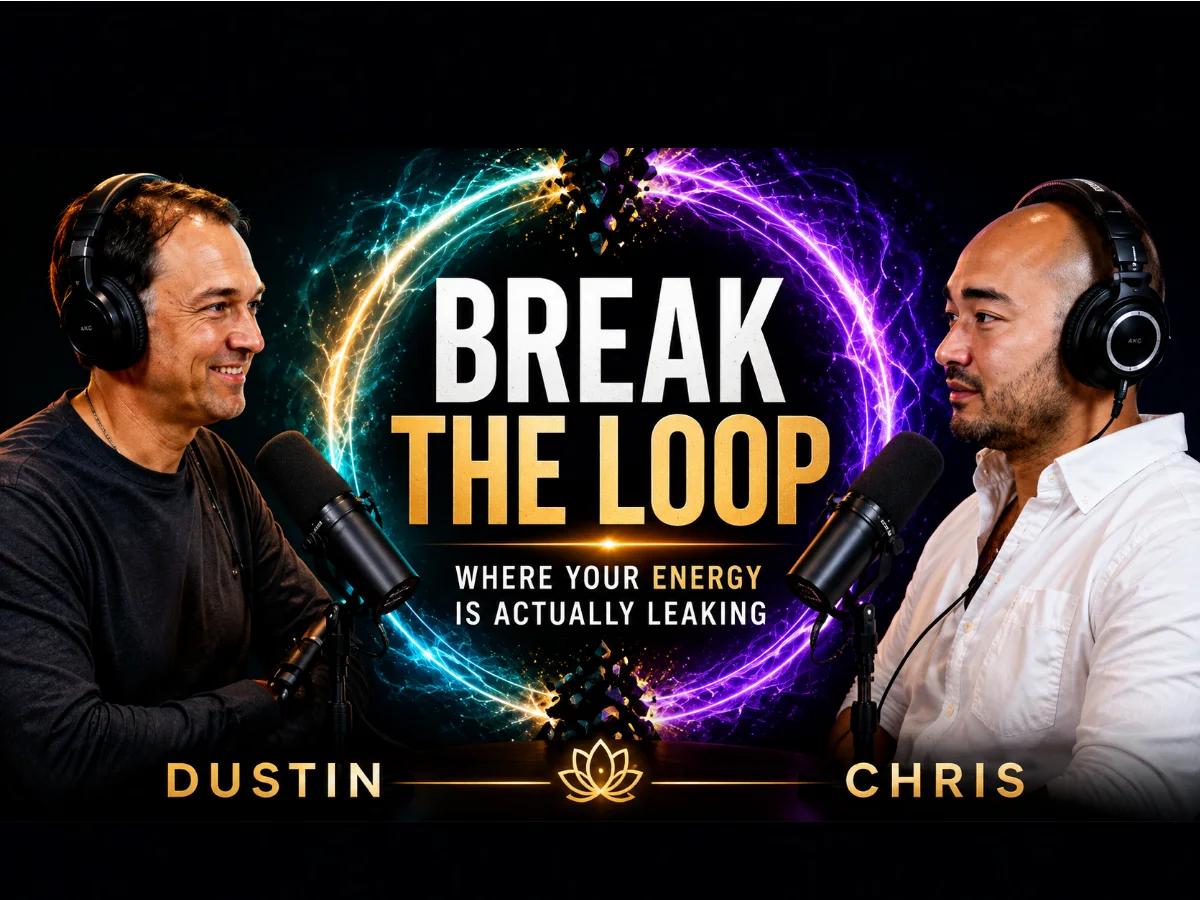
Break the Loop — Where Your Energy Is Actually Leaking | Ep. 6 | Mind Body Spirit Podcast
Dustin DeFrates and holistic health expert Chris W. break down exactly where your energy is escaping your body and mind — and walk through a five step formula to break any addiction, negative loop, or destructive pattern for good.
Missed the last episode? Episode 5 bridged biblical wisdom with energetic spirituality and mitochondria science.
Listen to Episode 5Episode Overview
What this episode is about
In Episode 6, Dustin DeFrates and holistic health expert Chris W. break down exactly where your energy is escaping your body and mind — and walk through a five step formula to break any addiction, negative loop, or destructive pattern for good.
Episode Guide
In this episode you will learn
- Why your brain optimizes for what feels safe not what is good
- How sexual energy is your biggest energy leak or greatest driver
- Why overstimulation fragments your focus and kills coherence
- How gluttony sloth and emotional loops drain your mitochondria
- Why insomnia is your body trying to detox at night
- How self forgiveness is the only way to break the loop
- Why gratitude removes fear judgment and shame simultaneously
- How your breath is the gateway to the present moment
- How one small action hits the window and starts the chain
Episode timestamps
- 0:00 — Welcome To Episode 6
- 0:16 — Breaking Free From Addiction Depression And Negative Patterns
- 2:07 — Energy Leaks: Where Your Power Is Actually Escaping
- 2:56 — Energy Leak One: Sexual Energy And Stem Cell Conversion
- 3:58 — Energy Leak Two: Overstimulation And The Need For External Things
- 5:04 — Napoleon Hill And Sexual Energy As The Driver Of All Success
- 7:13 — The Seven Chakras And The Three Lower Energy Centers
- 8:39 — Energy Leak Three: Gluttony Of Food And Drink
- 10:02 — Energy Leak Five: Emotional Loops Shame Guilt And Fear
- 11:06 — Energy Leak Six: Insomnia And Losing Touch With Your Body Cycle
- 12:15 — Why Your Brain Runs At Night: Emotional And Physical Detox
- 13:21 — Dustin's Weed Withdrawal And The Chakra Cleanse That Helped
- 16:11 — Five Steps To Break Any Addiction Or Negative Pattern
- 16:37 — Step One: Forgiveness — Your Brain Was Just Optimizing For Safety
- 17:09 — Safety Reward And Relief: Why Every Addiction Gives You Something
- 22:22 — Matthew 18:21 Forgive Not Seven Times But Seventy Times Seven
- 23:44 — Step Two: Embrace The Process And Become Grateful
- 25:06 — Gratitude Puts You In An Active State And Removes The Negative
- 27:44 — The Four Brain Areas Fighting Against Your Change Right Now
- 29:05 — Step Three: Use Breath As Your Gateway To The Present Moment
- 31:31 — New Wine In Old Wineskins: Why Your Past Patterns Ruin New Habits
- 33:06 — Sour Patch Kids At Midnight: The Breath That Could Have Saved It
- 36:13 — Step Four: Prepare And Act — Remember The Night Is Coming
- 37:06 — Jesus Said Those Who Humble Themselves Will Be Exalted
- 39:22 — Plan The Night Before So The Day Does Not Choose For You
- 40:43 — Missing A Window Sends An Incoherent Signal To Your Mitochondria
- 45:08 — Close Out Your Day So Racing Thoughts Cannot Chase You To Bed
- 46:28 — Step Five: Remain In Your State Regardless Of The Outcome
- 47:16 — Your Circumstances Do Not Matter Only Your Next Step Does
- 50:44 — To Whom Much Is Given Much Is Expected: The Responsibility Side
- 55:32 — Jesus Said My Yoke Is Easy: What That Really Means In The Body
- 1:03:20 — Fake It Until You Make It Means Practice It Until You Feel It
- 1:11:20 — Five Step Summary: Forgive Grateful Breathe Act Remain
- 1:14:19 — No Good Tree Produces Bad Fruit: The State Determines The Fruit
- 1:15:38 — Roger Federer Won Only 54 Percent Of His Points And Still Dominated
- 1:19:25 — Diego Ripped The Card And Then Gave His Best One Away
- 1:26:35 — Find An Accountability Buddy And Tell Someone What You Are Working On
- 1:29:11 — Thank You And See You Next Episode
Mentioned in this episode
- Napoleon Hill — Think And Grow Rich
- Matthew 18:21 — Forgive Seventy Times Seven
- HeartMath Institute — heart-brain coherence studies
- Default mode network and four brain areas research
- The seven chakras and energy center framework
- Roger Federer point win rate study
About this podcast
Hosted by Dustin DeFrates — real estate entrepreneur and five-year wellness seeker — alongside Chris W. Breaking down body, mind, and spirit science weekly.
Transcript
Full editorial transcript
Open the transcript
Dustin: Okay, here we are guys. Chris Wear here is here today and um we are talking about breaking free from addiction, depression and negative patterns. Now uh this is something that I've been struggling with for a very very long time but I think it's something that we all struggle with. Um um everybody gets into loops into cycles and in some of our previous episodes we were talking about why loops and cycles exist and the science behind those loops and cycles and and most importantly breaking free. Let's talk a little bit we'll to go in a little bit of the science and a little bit of just the practical application of how to break free. So um catch us up on on what we the the building blocks what have we done so far and uh and where are we going
Chris: exactly? So we have started talking
Dustin: about how the mitochondria and that the body is electrical and that's going to be one of the bases is that our bodies are essentially energy and then we went into kind of the next phases is how do we build the energy? How does that actually work throughout the body? We go into how the heart and the brain start to work in coherence and start to create a symphony within the body but they need certain minerals. they need cells need certain hydration and and then last episode we went to into okay what are some of the applications that we can do what how do we actually apply some of this information so we've gone from the body is energy to how does that energy show up into the organs to how does that show up in into our day-to-day lives right and so kind of thinking along that stack it's like okay we have everything we need right to okay what but why are we not all living our ideal lives
Chris: you and I know this but maybe there's
Dustin: aspects of our lives that we could still want to change or want to improve so what are the things that are preventing us is kind of what we're going to be going into today uh as well as if everything is energy then and if I'm building my energy in different ways which is good what are the ways where my energy literally gets leaked out of the body right we'll call that react reactive oxygen species, right? Ross, um, as we mentioned in the mitochondria, we can start to think of these as negative thought loops, negative patterns, and it shows up in the organs. Um, whenever you're out of coherence, right? So, we can see it on all three levels that we talked about. So, what are these energy leaks? What are the biggest ones? and just kind of briefly listing some of these uh before we go into how do I actually break free from those addictions, depression, negative patterns. So the the biggest energy leak is always going to be sexual energy and it's so important and you can see how children naturally that have that have these lesser sexual urges, they're very present. They have a ton of energy. They heal very quickly. And so just on a on a small on a high level, I don't want to get into sexuality too much on this episode, but essentially that a lot of our sexual energy gets converted into stem cells. These stem cells start to rejuvenate our body. And if we are not using our sexual energy in a productive manner, in a effective manner, then it's certainly going to become one of the biggest energy leaks throwing us out of coherence. um destroying our mitochondria, creating a lot of ross uh and also creating different patterns in our in our brain and feelings. So
Chris: that's sexuality. Then we have over
Dustin: stimulation and over stimulation if we are using stimulants, if we are using any sort of drugs, if we are you basically anything that is outside of you when you're saying oh I need that it could be the next Netflix show. It could be checking your phone constantly. It could show up in people that need to always wash their hands, right? Like anything that is outside of you that you that you absolutely must need is a form of overstimulation
Chris: because you're not actually listening to
Dustin: your body and it's throwing your body out of coherence. It's it's messing up your mitochondria. Your mitochondria is getting out of coherence and of course it's you're not going to be able to focus. And the whole point of getting the energy is to a level where you're able to now focus on your goals, focus on who you want to become. But if you're constantly forgetting, you're overcaffeinated, you're stressed out, you're starting to worry about what's in your stomach, what's in your body, how can you actually focus on your goals? You need a nice calm body that can listen and start to receive your message from your spirit versus a body that's wanting to go a million miles an hour, wants to do everything. It it becomes very difficult
Chris: certainly.
Chris: And then we
Chris: maybe maybe before we go into this I
Dustin: just give you a quick quick example. So uh Napoleon Hill think and grow rich um he he communicates that um sexual energy is the biggest driver of everything, right? And so I I thought it was interesting that um he he created a parallel that all of the massively successful men all had someone that drove them. And sometimes it was their wife, right? Sometimes it was the their their wife who just gave them so much passion and so much energy and showed up for them for the wife every single time. But sometimes it was a nonsexual relationship with the pretty secretary. and the this successful man shows up every single day, not because of his family out here, but he's he's just driven because he's got that pretty secretary sitting right there and and just the internal drive to perform in front of women especially is a massive massive opportunity. And so, you know, without talking about, you know, the chemical interactions or the stem cells or the loss of minerals because of, you know, ejaculations or things like that, just the pure focus or the capability for you to be able to manifest things driven by sexual energy creates so much opportunity if you can put that into the right space, you know. And so, um, example, I'm I'm recently divorced and I'm in dating. And so speaking of sexual energy and over stimulation, those dating apps are are all of the above, you know, and it's an addiction. It really is. Like there's instead of instead of me waking up and, you know, doing my meditation, I'll I'll look and who pinged me. Oh, she's cute. You know, let's see what's going on here. And then it just it just drives me away from what I need to be doing. And and that is definitely not a positive thing for my life personally. And so it's interesting to hear, you know, the science of it, but also just the practical application of it. So I I wanted to jump in with the over stimulation and the sexual energy.
Chris: Yes. Yes. And and Dustin, I'm glad you
Dustin: did because that kind of brings us back to one of the previous episodes where we were talking about the seven energy centers or the seven chakras of the body. And it's important to remember that those lower three are going to be the biggest life force drivers and motivators. because they're g they're literally fueling the rest of our body when we're channeling that energy upward. So, at our root chakra or or our lowest energy center, we have all that sexual energy. That's going to be one of the main drivers, right? And and the sexual energy and survival. And then we move up and we have our gut. And so, all this food that goes into our stomach and that's kind of going to lead us perfectly into the next one, right? And then as we go up higher, it's going to be this emotional energy. And if we're charged with anger and these different things, well, how are we going to be able to focus it into our heart? And so, we can already start to tie together all how all these actions, whether it's sexual, the food, it it's going to drive us. And especially while sexuality can be one of our greatest energy leaks, it can also be one of our greatest u energy drivers as well. All of these things can be used in a good way that motivates us and they can also be used in a way that distracts us and fragments us.
Chris: Certainly.
Chris: So, it's just how we use it and and
Dustin: certainly the more powerful of a tool that it is, it can go both ways.
Chris: Well, let's keep on going through some
Dustin: of these other energy leaks. And I have a couple other examples that I'd like to bring up. Yeah.
Chris: So, yeah, we we'll we'll go through
Dustin: here. We got six in total. So, sexuality over stimulation. Then we have gluttony of food and drink. And and this one uh can seem obvious if if you've had two, you know, maybe you had two burritos, a few beers, you start to feel a little bit more sluggish, right? Versus you you had a meal that was maybe lighter, fueled you, and and you feel great, right? Uh slothfulness and distraction. So all of this is going to come into distraction versus focus. Uh how focused can we have our energy versus how fragmented and distracted and separated it is? and slothfulness essentially when you are veging out to Netflix screens. Uh you're listening to somebody talk but you're not there. Anything where you're not present we can consider as slothfulness. Basically you're you're trying to turn off your brain and you're you're in this overstimulated pattern and everything is not in coherence. So maybe you even want to go to the gym, but your body's not prepared. Your mind's not prepared. And this creates a lot of this slothfulness just because we're out of coherence. We don't have the energy for it. And and it's made worse by all the sights and sounds and all the dopamine hits that we get. And so this this one's a big one during uh modern times. And then we have emotional loops and self-t talk. And and this one's especially dangerous because we when we're in states of shame, guilt, and fear. We often don't have the self-recognition that we are even in these states. And so we can be in these states of shame, guilt, and fear. And we just keep thinking these thoughts, thinking these thoughts until something finally clicks us out of it. And so that's where our diligence, that's where our resilience is going to come in because we we and if if we're over stimulated and we don't have sexual energy and we've been glut we've had a gluttony of food and drink and and we've been slothful, well, the loop of shame, guilt, and fear gets even harder to get out of. If it's only the shame, guilt, and fear, we can usually squash it right away.
Chris: We have all this sexual energy. We've
Dustin: been eating super clean. uh we we haven't had we've been meditating, we haven't had this slothfulness, we've been doing what we needed to do. All of a sudden, we have a shameful or guiltful thought and and it just becomes an instant reaction. Oh, I shouldn't have said that thing to that other person. Let me go apologize right away. I feel good. Right? And so it's not a loop anymore. But certainly when we start to stack all of these energy leaks on top of each other, they get even worse. And then the last one we have is insomnia. And this is affecting more and more people in the modern times. And we're losing touch with the cycle of our body and the purpose of sleep. And our body is having to do more physical work to get even get into sleep. We're not preparing the body for sleep. And there's different cycles that we go through throughout the day. We we're kind of brushing up on the circadian rhythm of it, but we aren't also brushing up on there's not as much talk as far as when and what you want to eat, how much you want to hydrate, what what cellular salts you want to have at different parts of the day. There's not a lot of information out there. And a lot of people are getting overstimulated. They don't have energy. their body is trying to detox at night primarily is what keeps a lot of people up. We're either emotionally detoxing, physically detoxing, or detoxing from a lot of these negative loops. A lot of people their brains will start to run run at night and they're like, "Well, it's now it's the only time that you've had to even detox if you've been in shame, guilt, and fear. You're going to feel it the most at night because you actually haven't detoxed it." And and it's a good thing if you feel if if you're staying up at night and you're feeling that, just realize that it's a symptom that your body is trying to detox. And so don't realize like the shame, guilt, and fear, especially at night, in the middle of the night, it's going to come up the most. And I speak for for everybody, if you've ever had a night where you couldn't sleep, you were just so worried about something, you were so stressed out about something, this is just the body's natural way of detoxing it out. Yes, it might be painful, but we can't judge and make it worse and and and start to think that we're just this shameful, guilty person or that I have anxiety. Let it work itself out. Let it flow. And you might have a night where you don't rest, but also you're getting rid of that strong emotional charge that was going to show up in your life in other ways.
Chris: I love that. I also love that you
Dustin: brought up the the the chakras. Um, I uh this episode's almost made for me, you know. Uh, addiction. I'm a very highly addictive person, you know. So, like it doesn't matter what I'm addicted to. If I drive fast, I will always want to drive fast. If I smoke some weed, I'll want to smoke more weed. If I have a cocktail, I will want to have another cocktail. And so, all these things. And so, me personally, I slept terribly last night. I am um I've stopped smoking weed. And so, I'm going through withdrawal symptoms of of that. And so um being then and then this morning I so I want to encourage everybody to check out the body section of our podcast. Right? So this morning we had our our seven chakras that we did the metal element and and one of the movements was cleansing the seven chakras, right? And so before when we were preparing for this episode, my brain just wasn't functioning. I was I was out of it, you know, but as soon as we got through that the the the exercise and the movement, I'm all of a sudden, hey, here I am. I'm back, you know. And so it's an amazing thing that that's what I want to encourage everybody is that this this shit's real. It works. You know, it really does work. And so you can you can use mind, body, or soul to get yourself out of any of these loops. And if you're not in the moment where you want to go to the gym, then go read a book. If you're not in the moment where you want to read a book or go to the gym, pray, meditate, whatever you want to do. And so it's it's fun to see these practical applications and how they actually they actually work, you know. And so let's let's keep on let's keep going. And that's what we're trying to do for people because I think oftentimes we over complicate what is actually going on with the body. We have a lot of medical jargon. We have a lot of just different verbiages that that makes it difficult to understand what's going on. And often times we associate complex with being the optimal and best solution. Whereas in reality often times the best solution is oh I just needed to listen to my body. Oh, I needed to understand why I was feeling anxiety. I'm not I'm not a person with anxiety, per se, but it was showing up. And maybe I keep making decisions that show up in anxiety. And we start to think that's a personality trait. But we can break addictions at any time. And often times we even get addicted to feeling anxiety. We get addicted to feeling stress. It makes us feel alive. It makes us feel like we don't necessarily have to take on the responsibility of the world when when we're always stressed out, right? And and we're going to we're going to get into all of this, but uh that that's kind of the the first part of it is that setting the stage. We're going to go through five steps that we can do to break any addictions. And they're going to be simple steps, but it's not always easy to apply just because I said it's simple, right? it it's not necessarily easy. If I tell you, okay, a fiveday fast is going to fix XYZ in your body, very simple. Well, you still have to do the fiveday fast, right? If I tell you to work out hard and push yourself to full failure in a workout, well, you still have to
Chris: you you're going to have to prepare and
Dustin: hydrate before you're going to have to make sure you've had enough sleep. Like, to even get to that level requires a lot of preparation for it. And so, setting the stage The first thing that we need to realize is that our brain and mind is always going to optimize for what it it thinks is best in the moment.
Chris: And so this doesn't always mean
Dustin: the the best uh outcome for us because this can show up in a lot of ways and this is how we even develop the negative patterns or these addictions is because we start to perceive that there is some benefit for us, right? And I I might enjoy coffee and I know how caffeine affects me as well, but there might still be a pull from the caffeine because okay, my brain might perceive it as okay, it gives me this energy. I'm going to feel less tired. Oh, it's going to make me feel good temporarily. And it's not always optimizing for what's coming after for different scenarios. It's kind of figuring out, okay, what is best in this moment? And so oftentimes that's safety, reward or relief.
Chris: And so in in the coffee example, it
Dustin: could be both the reward of feeling good on the coffee. It could be the the maybe I enjoy the taste of coffee as well, right? And then also the relief of not having that to go through that tired state as well and and work on getting my natural energy. So there is something in there. And if we look at any addiction, any any thought pattern, any negative pattern that we want to get rid of in our life, we have to also recognize that it's giving some us something.
Chris: So that's step one is safety, security,
Dustin: and release relief. And so then what you're saying is that um your body it things feel good not necessarily because they are good. It's because your brain is used to putting yourself into that state. And so you get to put a blanket around you and say, "Oh, I I know what this feels like. This feels really great." And and that may not be what is actually good for your body, but your brain's telling you that because that's the natural state of what you know what you know already. Yeah. Exactly. Exactly. If it's your first time doing a meditation and you don't even know the benefits, maybe you just read a book, but you haven't actually experienced them for yourself. You've never gone into that deep state yet. You're going to say, "I meditated for three minutes and my body just wanted to move and and it didn't really benefit me at all." Well, why is the brain going to pick meditation next time when it can pick okay like, okay, if under stimulation is bad, maybe I need to drink three coffees here and smoke some tobacco or whatever might happen, right? Maybe some sexual energy. And all of this all of a sudden the brain's like, "Yeah, that sounds way better."
Chris: Because it's perceiving that to be much
Dustin: more beneficial than why did I do this? This was painful. This didn't help me at all. And so often times it's we have to actually experience it. And and that's where we have to have grace on oursel. And that's step one is forgiveness. Our brain was just optimizing for what it thought was best at the time. And we just have we have to override the brain. We have to learn how the brain works and and start to recruit new areas of the brain. If we want new thought patterns, we got to use new areas of the brain.
Chris: And so often times it's just self self
Dustin: forgiveness, acceptance of ourselves. We don't want to judge ourselves because then we we perpetuate the loop. Oh, I didn't do that. Now we think we're a lazy person. Well, if we think we're a lazy person, we're going to start to do more lazy acts. It's going to happen the same way the next day. And our life becomes one great big giant loop of where even though things are kind of changing on the outside, we're also making the same internal decisions and those same internal decisions are going to show up in okay, I didn't know what to do at uh 7:00 at night and I made this same decision. And if we if we don't have any structure, schedule, or things to root us back in, the next day, we'll be forced into a similar situation, right? And this shows up in so many ways. It's it's the person that maybe they want to lose weight, right? and they finally start to hit a gear and then they get an injury
Chris: or they they finally start to lose
Dustin: weight but but they're trying to uh improve their diet and all of a sudden they get these intense cravings. Somebody brings a pizza into the office. All of a sudden all this food just shows up in their face. And so the the world is going to start to even when you're out of coherence of who you want to be, you're starting to go into coherence of of maybe the lazier person, right? And so the world is going to start to to to give you situations in which you will either have to change or handle them. And often times it gets even more painful. Um but that that's everything to do with with forgiveness. And so the Bible verse that you and I have here Dustin is Matthew 8:21 is Peter approached him and asked Lord how many times must I forgive my brother or sister who sins against me as many as seven times. And Jesus replied I tell you not as many as seven but 70* 7. basically saying a big number as many times as we need to forgive ourselves that's how many times we need to forgive ourselves because it is difficult it sounds simple but recognizing this this is such an important first step and I don't want people to to skip this because if you do not forgive yourself and you're still judging yourself and you're like okay yeah yeah I know what happened I shouldn't do that take a second to pause forgive yourself because we need to recognize what good our brain was trying to optimize for
Chris: 100%. And so I have I have a note here,
Dustin: meet yourself where you are, right? There's there's so many things that I admire in mentors that have done things that are just holy cow, how how do you I have a mentor that um teaches yoga to prisoners, you know, like I don't have the mental capacity or space or time or anything to do those things. But that is something that I thrive to want to do or to do at some point. But I can't do that right now. I've got children and I've got work and I've got I'm just in a different phase of life. So I have to meet myself where I am and say everything is okay and then I look to the future to saying this is where I would like to be but I can't judge myself for not being there or else you create that negative loop and then you make it harder for yourself to get to where you are. Yeah. Exactly. Exactly. And that that's a perfect setup for step two, right? Because we forgive our we've forgiven ourselves. Okay, what do we do next? Right. We want to teach yoga to those prisoners, but maybe we have all these other things that we need to do. And so step two, we have labeled as embracing the process. And so we illustrated how the brain is actually trying to serve us. And so the second step of this is once we've forgiven ourselves, we can start to become grateful even for that small action like okay I'm grateful that I have this idea to do yoga in front of these prisoners and it's showing me that that's a part of myself that I want I want to be right. So I'm grateful even though I'm not doing that yet. I'm still grateful for the idea that's showing me, okay, there's this new aspect of myself that's waiting to be discovered. I don't have to necessarily knock on that door now, but it's nice to even see what's on the other side of that door.
Chris: Definitely.
Chris: And so that that becomes important
Dustin: because if we're not practicing gratitude, we will naturally start to fall into more of these negative loops. we will naturally fall into envy and jealousy and anger if we are not actively working on the process. we start to become we we the brain starts to uh fall into using like the amygdala or the lyic system and we have different parts of the brain the default mode network that just kind of take over subconsciously and so gratitude is one of those things that puts us in an active state and it's very difficult to have fear or worry or judging yourself when you're in the grateful state. It's it's not just all about the good benefits. Sometimes gratitude is about it's it's removing a lot of the negatives as well. It's transmuting that energy into into a new energy. And now we can start to uh cleanse our thinking a little bit. we start to come up with new thoughts versus when we're in the state of fear or judgment or uh whatever we're in, we're going to have the the the impulses to completely neglect this step. Why can why should I be grat grateful that I lost money? Why should I be grateful that I had this injury? Why should I be grateful that that that my boyfriend or girlfriend just broke up with me? Right? like and these are things that they're hard, but we also need to recognize as as we're embracing the process that there is something there even however small. And if we can if we're focusing on those negatives, oh, I lost all this money and it's taken away all these opportunities and this is this isn't fun. Or I love this girlfriend or boyfriend so much and and they just up and went out of my life. if I don't understand it and I don't this is no fun
Chris: like all of these things are no fun but
Dustin: they're also serving us in some way
Chris: and and we can learn a lot from them
Chris: love that I I give you example last
Dustin: night along the lines of not sleeping and going through withdrawal symptoms and all these things that that negative loop is so easy oh man you know like um you just you get in the I get in these cycles and so all of a sudden I'm in this cycle and last night I was in the cycle and I just couldn't sleep because I I couldn't sleep period. But then I also couldn't sleep because instead started going negative. Oh, I can't sleep. Everything's terrible. You know, and and that's exactly what I did is I I just needed to I just started thanking for some of the terrible things that are going on in my life right now. I'm saying thank you for those terrible things. And sure enough, inside of, you know, 10 minutes of me hating the fact that I was going through these negative thought loops and then just saying I even though I didn't really feel it, I just saying I'm grateful for these terrible things and I'm grateful for these terrible things and then all of a sudden I fall asleep and slept mine afterwards, you know. So I I completely agree with that and the practical applications. So it's um as you suggested, it's hard. It's not it's not an easy thing to do.
Chris: Very difficult
Dustin: and we're going off of I think it's important to to remember we're going off of past conditioning. We're going off of our current hormonal states. We are working sometimes against subconscious beliefs. We are working against our inner narrative. We are working against all of those energy leaks that we talked about, the over stimulation, the gluttony, right? And so oftent times we're combining these energy leaks with these actions and now it becomes harder and we we have four different areas of the brain that we're trying to get uh to calm down a little bit. We have the amydala which puts us in survival thoughts. We have the basil ganglia which puts us into habits. We have the prefrontal cortex which is going to use a lot of logic. And then we have the lyic system which is going to drive emotional response kind of calm down and have all four four parts of this uh of our beautiful brains start to actually work together. And now we have a little bit of the survival response, a little bit of the habits, a little bit of logic. They still serve a purpose, but they're not overactive. They're not overstimulated, and they're they're not uh running running the course. But exactly what you're saying that this is all practical and even though how simple it sounds, this will actually change your life if you're if you if we're able to all of our lives if we're able to focus these steps.
Chris: Love that.
Chris: So step three is so we talked about
Dustin: forgiving ourselves and then becoming grateful, right? uh we're not going to judge ourselves for what we did. And then we're also going to find at least a few things that are good from that scenario. And then the next step is we want to start to reync our brain and our heart and our body to align with with who we prefer to be and the actions that we want to do. Because if if any addiction is essentially we want to make some change but because of our conditioning because of our states because of our energy leaks we're not able to do that because that change requires more energy than we have stored up at the end of the day that's what's going on and we're not in the right state to make the right action. the action and state of mind, state of hormonal state, right? Your emotional state, everything needs to be aligned to be able to take that action. We're just so used to taking all these past actions. That that's all that's all that we know. And so that's going to break the resistance to the change is is going to be broken by your breath.
Chris: And if you can start to remain in the
Dustin: present moment, you can start to choose your present moment. You can't choose your future. You can't choose your past. But you can choose this current moment. And the breath is our gateway to the present moment. When we're actively controlling our breath or allowing life to breathe through us, we are very present. And now we can start to make these decisions easier where even though we might not have felt the gratitude, now we're going to start to feel it a little bit more when we start to sync it up with our breath. And I'm not saying we actually start to feel grateful to a certain degree because we're always talking about more or less. And we're going to start to feel more grateful or start to feel less fear. And the goal isn't to instantaneously switch, but with every breath that we take, we're moving into a state that we more prefer. It will still take time because of everything that we listed, the energy leaks, the conditioning. we're not going to instantly feel it. Unless you're, you know, you're you're you're a person that um isn't carrying much karma or past conditioning with you, then you'll be able to change it very quickly.
Chris: Um and this kind of goes back to the
Dustin: story of the new wine and the old wine skins. And so when you're trying to create a new habit, a a a new routine, a new pattern in your life, you don't want to take on all of these old wine skins, all of these old habits and emotions and behaviors that you have because you're you're going to start to ruin that new change that you were trying to make. You you pour the new wine skin into that old wine skin that's all contaminated and all dirty. It's it's not going to age the wine in the way that you want to.
Chris: Mhm.
Chris: And that's exactly what uh Jesus is
Dustin: cautioning between what we're trying to do every day. Well, we have to make sure that we start to align different things and our breath is going to be that gateway to that present moment because that's what's going to allow us to actually drop the past conditioning even for a breath. And the longer that we can do that, we allow we allow this new wine to actually be poured into the new wine skin. And when we forget our breath, we're basically going into default that default mode network again. Our brain doesn't have enough enough oxygen. Our heart doesn't have enough energy. And so when we don't have enough energy, we're going to optimize for whatever was less energy or whatever is that instant energy hit, even though we know it's not good for us. Yeah, certainly. I I think I brought up this example in a previous um episode, but um uh I when I'm especially tired, um I will go past the pantry and I will look at the junk food and I will go in there and and I will open up a bag of usually, you know, Sour Patch Kids or some kind of, you know, whatever whatever it is and and I will eat it as quickly as I can so that I don't have that regret, you know. So, I'm just And then all of a sudden I did it and so now it's gone and I can't think about it anymore. But if I would have taken the moment for um taking a breath before then I would have been able to say you gain energy from the breath, right? And so I would have been able to create enough energy within myself to be able to walk away from the sour patch kids and not um destroy my body right put a bunch of sugar in my body right before I'm going to bed to hurt the next cycle of the day and all these things. And so it's so critical and and and and I I you know I I it took me a long time to recognize what breath actually can do. And and so I want to encourage everybody that you know meditation is really hard ADHD brain like we were just talking about this with Dearius earlier and so um I can I had a hard time meditating and a really hard time feeling what those things what we've been talking about what those things were and it took me a long time but once you do you can say oh okay so those baby steps iterative steps in order to get to the point if you can't meditate or if you have a hard time um getting to dropping out and it's the best thing in the entire world when your body can no longer you know you're you're there but you're barely there you know so that drop out is such an amazing amazing feeling that I want to give people the encouragement to go and find for themselves but until you get there a few breaths is the practice in order to get you there eventually. Yeah, exactly. And and going to your example like how would that apply in your example? And when we slow down to take those breaths, all of a sudden instead of being motivated by some future state, right? Like, okay, if I eat these, I know I'm gonna feel good. I know I'm going to have that sugar and maybe like even my body is craving that energy, right? And and our minds are living in the future. And as soon as we bring ourselves back into that present and we're starting to taste every sugar crystal or whatever it is, not only is that going to have a less detrimental effect, like even when we eat food with full presence, it's it's going to have a is the same amount of food, the same exact thing that we were eating. But when we're eating it with full presence, not only are we actually going to enjoy it more, but we're breaking free of that maybe that that future pull. and we can actually enjoy it for what it is. And if we we could still eat the entire bag, but now it's going to be more beneficial for us. And we slowed down to realize,
Chris: is it really the Sour Patch Kids that
Dustin: I'm craving or was it that perceived mental reward in the future? And if I'm chasing that future reward, well, it's very difficult to chase anything in the future. It becomes hard because we want more and more. The future never actually comes. And so now now if we're chasing that future feeling versus if I'm chasing the the Sour Patch Kids, let me enjoy it as much as possible. Let me enjoy every sugar crystal and and there's never any need to judge ourselves negatively here too, right? And it avoids the shame and the guilt. So I love that example
Chris: fully.
Dustin: So step four is once we have forgiven ourselves, we've become grateful, we've started to slow down into the present moment by utilizing our breath as a gateway, what happens next is we naturally want to prepare and act.
Chris: And so we have a another Bible story
Dustin: here in which Jesus mentioned that those who humble themselves become exalted while those who exalt themselves become humbled. And so we we must remember during the day you must remember that the night is coming and vice versa. And this sort of applies to the body and the mind. When when we're feeling great, we want to prepare. Uh just like when when we're overstimulated, it's going to be hard to not to feel as much gratitude to as much love to be as compassionate. Likewise, when we're in a state of love and compassion and gratitude, it's important to prepare to feel more and prepare for whatever could potentially deter us. Because if we start to root ourselves and we start to take these actions and all of these actions are going to uh start to carry certain vibrational energy that that we've been talking about, all of these actions, all of a sudden you you can't do any wrong. And so anytime we prepare ourselves, we keep taking the deep breaths, maybe we straighten up our posture a little bit more. We we we remind ourselves to remmineralize our body because even if I stress myself, okay, now I have these minerals to rely on. Now I have my posture to rely on. Now I maybe have my breath to rely on. And because we're going to be challenged, we're going anybody who's going through an addiction and we're pretty much all addicted to something at this point. Our phones being at least one thing for most people, right? We're we're all checking our phones. Maybe we're all addicted to to to having more money, right? Like it's it's very difficult that you see somebody who's completely fine with this exact amount. Don't need more. Don't need less. it's just this is the amount that I have and I'm completely fine with it. Most of us were going to say okay would love another 10,000$100,000 million whatever it might be. Um so so so that's just another aspect here right and so we we must prepare during the day for the night. The night requires certain actions. We must prepare our sleep before our sleep. Uh we're we're thinking about our actions that we want to take uh during the next day before they happen. Right. We're just preparing ourselves a little bit to be able to withstand that stress.
Chris: Absolutely. I like I like that a lot.
Dustin: And so another personal example, it's um uh because I'm going through this withdrawal um I'm not sleeping very well and I don't take naps during the day. I I have high energy all of the time and so Monday, Tuesday, Wednesday, all three days I I just in the middle of the afternoon I'm I'm crashing, you know, and so I I have to take a nap. And um I've never had to have that in my entire life, but it it's it's happening. And so luckily, I've been working my ass off for the past four months, basically. And so my body's, you know, whatever that is, my body is finally sayingh. And so, you know, that that's it's it's tough to see the future, but you know that you're going to go have ups and you're going to have downs. And so, if you're in an upcycle, then take advantage of it. Create create um build create those building blocks so that you're now here. And when you have a down cycle, you just don't fall as much. You're you're you're you know, not going to fall off the cliff. you're going to just kind of trip a little bit and and you'll be stronger and then you'll get back into an upcycle and then you'll be able to create more building blocks and then the next down cycle will be less affected on you. Yeah,
Chris: absolutely. And and building building an
Dustin: example for our listeners, it's kind of like when you're feeling really good and really fit and all of a sudden you have it's like, okay, I should go work out right now. Well, it's easy, right? But even in that state, if we say, "Oh, I should go work out right now." And then you choose not to, the body's going to say, "Oh, I thought we were in this fit state." Like maybe we're in this slightly less fit state. Okay? Right? And it's going to give you another choice, another window. But every window that we miss to take an action on something starts to that's actually another energy leak as well. that starts to wear us down because we're sending in congruent signals to our body. Our body said, "Okay, this type of person, they want to work out. Boom. You have the energy. You feel good. It would actually make you feel good, too." Right? And and we skip that. Well, that's going to put us in a certain state versus when we're tired and demineralized and have no energy and we're we're wanting to work out. Like, it's going to be so easy to skip that workout, right? It's going to be harder to skip it when we're feeling fit and good, but it's also going to be detrimental when we don't. And when we are in this negative state may perhaps and we still go through with the workout realizing that it's not going to flow as easily. It's not going to be as easy as when I'm fit and mineralized and hydrated well and sleeping well and everything's going great, no stress. Well, that's also sending a signal to our body as well. So our actions can start to override because our mitochondria, they're going to be listening and adjusting to what we have been doing.
Chris: And so that's that's one of the ways
Dustin: that we start to reverse is by taking an action in the state that we want. And if we took a second to pause and forgive ourselves and put ourselves into gratitude and and we're dropping that judgment of what happened and now we've taken these deep breaths. Well, now all of a sudden this micro action that we needed to take, it becomes easy. And it doesn't have to be a big thing as as far as I needed to build this business and and I need to squat 500 lb. It can just be the small goal of oh, I needed to put my shoes on in this moment.
Chris: Yeah. And maybe the next part of my
Dustin: building my business was I needed to to look up how uh how to use this software. Like let let me figure out uh what tool I needed, right? Okay, I needed to send an email to this guy to to check up on something. It's all these small tasks and if we're if we're hitting them in the windows that they need to be hit, it actually doesn't take as much of our energy because our energy is just flowing. And but when it it's when we miss the windows and our body now has to recalibrate. Am I this person or not? Uh what is going on? Because it's listening to our thoughts, words, actions, everything. And so it has to constantly recalibrate if we're if we're missing these windows. But thankfully, if we're following all of these steps, we can start to hit them in order, in sequence, in rhythm, and and we're timing ourselves with our heart, and everything becomes it becomes joyful. it becomes a game.
Chris: Totally agree. And so then I guess I
Dustin: guess um you know one of the things that I have been doing recently is spending more time planning out my day ahead of time, you know, and so it's so easy when you're in the moment or in the stress or in the, you know, chaos, whatever those things are, if you allow yourself to be subjected to that stress or that chaos or, you know, we're trying to be in the moment, but I'm going to use the moment as a negative thing. You know, in the moment of the chaos. If you're allowing yourself to be pulled into that, it becau a lot of the times it's because you didn't have a plan. You didn't decide ahead of time that you were going to be purposeful about A, B, C, and D. And if you did that ahead of time, then it would be so much easier because you created the the synchronicities within your own life by saying, "I'm going to do this, this, this, and this." And then if you don't do those things, then you will get into a funk. But if you do do those things, you will have an up, right? And so it's um there's so many little tweaks twi things that you can do in order to um in the in the night prepare for the day. In the day prepare for the night, right? And so these little tweaks are are so valuable, but they're simple, you know, just wake up and and and decide what you're going to do ahead of time or don't go to bed until you've closed out your day. Um get rid of all the stressors by writing them down. Then close out your day and then you'll sleep better. You won't have racing thoughts at night. for in the morning, write down everything that you're going to do. And when you know that you go into that, maybe you had a burger cuz you had to go to a business meeting and you're you're lethargic after that burger. If you already put in your calendar that you're going to go to the gym at 3 p.m. before you got to pick up your kids, then you will go to the gym at 3 p.m. because you made it so. And and you just become that becomes part of the practice or the habit. So,
Chris: yes. And the beautiful part of that, and
Dustin: I love all these examples that you're throwing in here, Dustin, is the beautiful part of that is when we're actually living in coherence, our brain will just have a thought that will automatically align with what is the most optimal energy. I when we are so focused, it starts automatically problemolving all of these things before it even exists. We don't have even the choice to make the burger because we already prepared one. I'm going to eat the fruit at 10 10:00 a.m. 2 hours before this important meeting. I know I'm hydrating with extra salts and minerals and I'm taking these things. I am there is simply no way that I'm not going to show up with the energy that I need and and the state that I need because I've already done it. I've already prepared. I've already rehearsed it in my mind a hundred times. It's just I just haven't lived it yet. But it's still it's still just a game. And when you have all that energy, it just flows. People can feel it. People can sense it. But it's likewise when when you're trying to fake that state, you know, you you come in completely stressed out. I mean, people can sense that as well. And so it it's hard to lie to our own bodies. It's hard to lie to other people. It's hard to trick our heart. All of it actually stays in coherence. And this brings us to step five naturally uh building upon your stories because then it really doesn't matter where we're at.
Chris: Well, let me before we get to the step
Dustin: five, I just want to I want to I like these words. Pause, forgive, gratitude, and breath, right? So, uh take a moment. Um your your body will tell you, your brain will tell you, your mind, body, soul will tell you what needs to happen. So, pause and see if you can gather intelligence about what's happening. Figure out how to change your mental state and breathe. And so, that's a super simple way to be able to maintain the the building blocks, right? One day at a time and and and I love the forgiveness thing because it's so hard to do everything perfectly. No one's going to do anything perfectly, right? And so if you can pause, reflect back on what was happening, then if it was a negative action, be grateful for the fact that you were able to recognize that as a negative action, which will help you prevent that in the future and take a breath to move on to the next thing. That's that's a super simple cycle that I wanted to call out to make sure that people can ingrain it in people's minds so that they can practice it.
Chris: Yes. And if we practiced those loops and
Dustin: we just stayed in the moment, we we would get everything that we want in life. So, so what what maybe is this last step is going to kind of tie in uh a very very common pitfall
Chris: and this is that we need to remain in
Dustin: this state regardless of what is happening. Now, this is a double-edged sword because on one hand, it's the most beautiful thing that could ever be given to us is that our circumstances don't matter. Wherever you're at, it's all about improving. It's all about taking that next step in sequence. Whatever step that you need to take in your life is going to be different than the step that I need to take in my life is going to be different than every step that each one of our listeners needs to take.
Chris: So in in one hand, our circumstances
Dustin: don't matter. Wherever you are starting out, you just have to take the next step and rema and remain in all of the steps that we've talked about. You're remaining in that state. So on one hand that's the most beautiful thing that we could ever be given because it it takes away from us of being a victim. But on the other hand it's also going to require responsibility and effort and focus and and total radical selfhonesty. What am I doing poorly? What am I doing well? And self- auditing and self-reflection. Did I not Did I forget to breathe throughout the day? I do all the time. Did I forget to forgive myself? I do all the time. Did I forget gratitude? Well, I always root different things in gratitude, but did I go did I go 5 hours without feeling grateful because something happened to me? All of these things happen in our lives and it's difficult. It's very difficult to see all those good things and forgive yourself and oh, I made these same mistakes that I made yesterday, that I made the day before. How can I forgive myself for all of these things? Well, it starts in that moment. It starts in the state. It starts with your being. And we just need to take that next step no matter what. So, on one hand, it's the most beautiful because your past doesn't matter.
Chris: Truly, if circumstances don't matter,
Dustin: your past doesn't matter. The future is going to come the way that you want. And on the other hand, that means it's going to require even more responsibility, even more selfrust, even more respect for yourself. And that kind of reminds me of the Bible verse to whom much is given, much is expected as well. Because you're going to be expected to now have the character and the emotions and the responsibility and all the actions that you need to take. Well, now that's a part of you. And if you don't want that burden, okay, you can have this lesser energetic life, but maybe your body isn't as nice. Maybe your finances aren't as nice. Maybe your your your girlfriend or boyfriend is is getting mad at you or whatever. Relationship issues because we didn't want to have that responsibility, that caring, all of these internal traits need to match whatever is going on in the external world. So often times maybe we want all all the money and and the the wife or and the kids and and we want this life, but we're also not willing to have the discipline and all the things that are needed. And often times all we need to do is to to find the right frequency match between the outer world and our internal world, our thoughts, our actions and our feelings. And all of a sudden it becomes this guide in which when we are in this grateful state of receiverhip when we're not judging ourselves and we're taking the deep breaths to think about just the present moment just the step that I need and then we're acting upon it and we're not attached to the outcome. I didn't do this to uh get the wife or or or get the money right away or whatever it might be. I know it's going to become if I'm just staying and focusing on the responsibility that I need to add in my life, the the trustworthiness that I need to add in my life and hitting the windows that I need to hit with the right attitude. Very very simple. But again, if you could do that even for a month, your entire life would would change. I I've known this stuff for a while. It is still hard to to practice. So, this five-step formula, it's incredible. It will change your life. That being said, don't confuse simplicity with with easiness because this will be one of the most challenging things that you will ever have to do.
Chris: For sure. It's uh I I'll use an example
Dustin: um of of uh Diego. Diego is uh trying out for club soccer, right? And so club soccer is really hard and he's he's a 8-year-old and so there's a lot of pressure on 8-year-olds right now to perform and and do the best they possibly can, but um he has been sheltered from a lot of hard work because he's 8 years old. And so there's there's this dichotomy of life, right? There's there's the when when you're up on this side, then something's going down on this side. And when it goes there's always going to be a push and pull of everything, a yin and yang and of everything. And so, um, being able to communicate to Diego that, um, everything that is worth doing takes hard work is something that he's slowly capturing. But the downside is that he is not starting, right? He's not he's not a starter because he hasn't pushed himself hard enough at up to this very moment. And so, he knows that club uh triyouts is coming up. And so, now all of a sudden, he's like, "Oh [ __ ] I got to do something about this. I got to work really hard." And so now you can see his energy completely changing because his drivers are now different. Yeah. And so you can see that he has this future expectation uh hope belief that he can do this thing and now that he has that future hope and belief that he can do this thing he's working really hard towards it and it just changes the entire perspective on everything. And so, um, yeah, I don't know if I'm trying to make the point. I guess that hard work aspect is that there's nothing in life that is easy. And changing your brain structure is really hard, right? And so, if you're used to being in negative loops or you're used to being addicted to sadness or anxiety or anger or any of those things, you have to rebuild pathways within your brain in order to flip that script. And and that's really hard. It's a lot of work to build new synapses in your brain. And so I just want to encourage everybody that um you can you will you can do these things, but you got to put in the work.
Chris: Exactly. And
Dustin: the the only time it's ever easy is in the present moment.
Chris: And if so, if we're just focusing on Oh,
Dustin: I you could break down a kick even taking a simple kick in practice or moving your foot forward. Oh, I need to slightly move my knee. Can I do that? Sure. Can can I need to slightly flex my toes? Can I do that? Sure. Right. And if we break it down, the present moment becomes just this eternal easy. We're just trying to hit the window when we need to hit it. It doesn't necessarily have to be hard. But of course, if we have these, then how do you balance the long-term goals, right? And that's where faith becomes so important because you have to you have to give everything to the present moment while simultaneously not expecting the certain outcome
Chris: because we don't always know uh what the
Dustin: best thing is going to happen for us.
Chris: That's true.
Chris: And the example that I have wrote
Dustin: written down here, right? And again, Jesus said this as well is that okay, follow me. My my yoke is easy. My burden is light, right? Like it's it's easy when you're in the present moment, right? it. But if we're trying to if we're trying to force this and especially trying to force things that that we aren't who we aren't, right? Like it's hard. You can see people that make free throws in the game of basketball all the time in in in practice and they're draining threes in practice and there's no pressure and then all of a sudden when it there's three seconds left and the game is on the line, it gets immensely harder.
Chris: It's the same thing with Major League
Dustin: Baseball players. they can they bet six percentage points worse, which in baseball is a is a pretty big percentage. You go from 300 to 240, per se. When you have a runner in scoring position ready to score, and now you start thinking, I need to I I need to be able to hit this ball instead of just taking, okay, I I I know I need to make this swing based on whatever pitch. Like, it's it's no different than if I was in batting practice. uh and and the example we have here. So that kind of illustrates when we put all this pressure on the present moment, we're actually not in the present moment anymore.
Chris: And so wrapping all of these steps up
Dustin: and and and building on your example, Dustin, is I have written down here like, "Oh, Chris, I did all these things, but then this girl or guy that I like actually broke up with me, and it didn't work. I thought I was getting myself in this grateful state where this person was was going to to to like me and it didn't happen. This isn't working for me. Right? And this is where again we have to have all that radical self honesty and self-truth and and all of this responsibility to realize that in some way we affected the outcome but also not judging the outcome. So first we're forgiving both of our both oursel and the other person. Okay? There wasn't a wrong wasn't really wasn't a mistake here and then we we are getting ourselves into a state of gratitude right cuz if I told you hey your ideal person is is waiting for you right now and okay but if that person is waiting for you and this girl or guy that you're with is is still with you actually need them to break up with you and you would actually want them to break up with you and now it's a clean break. you don't even have to worry about it anymore. It was their decision and now it's allowing this ideal person who is waiting for you. We we would we of course would want that, right? So like even in these things that that we we don't necessarily prefer, there's always that shred of gratitude that we talked about. There's always the forgiveness that we talked about. Hey, there was no mistake. What happened happened and even though it might be painful, we don't necessarily have to run from the pain. We can say even the pain is serving me in in some way.
Chris: And then we breathe deep. Did we breathe
Dustin: deeply or did we start to hyperventilate and think about all the things that we're losing and start to get out out of this state of gratitude and now we're like now we can only think about that person and all the things that they had about us and now now everything else that we're we're doing in the present moment has lost its luster and and lost its shine and the food doesn't taste as good. Right? All of a sudden, it's starting to affect everything else. And did we prepare and act and and increase our thought capacity in the good times? Did we did we make sure that we were mineralized? Were we already stressed out and that happens? And that's typically when things like that happen anyways is when you're in this negative state, you're you're finding it hard to give up patterns. All of a sudden, other things in your life are going to start to show up, right? Like maybe you had some health issues, but at least you had this relationship that you were thought was really good, but you've been so negative about the health issues that the relationship starts to suffer
Chris: and that gets taken away from you.
Chris: And so all of these things, they work in
Dustin: conjunction. And did we remain in the state regardless of the outcome? And this is the one that's always going to be hard because it's wow I might have you might have thought you loved that person right you you might have thought you didn't want the injury and even though you're in your logical mind is not going to be able to see it it's going to say what good does an injury give me and this is where we have to short circuit it just like we uh just like when we're in a negative state and we force ourselves to work out, it starts to create a a positive loop that we're going on or mitochondria listens to, oh, this person wants to be a person that works out even though they aren't right now. And that's where did we remain in the state regardless? Well, if I am giving off grateful and loving energy, this is often times even when somebody breaks up with us or we lose a friend or or or someone passes away or something like that, very often times we will find someone very quickly who just happens to come back into our life. It's like we pick up that relationship or that friendship or whatever it might be almost like it it it never left.
Chris: Mhm. Yeah. But then we also have to be
Dustin: very diligent on everything that we are holding on to and not letting energy flow. And the mitochondria, all of our body episodes that we have done before, it's scientifically proven that we need the energy to flow. Everything that works in our body, all of the observations, we need all of it to flow. And if we don't actually let go of the past, how are we going to take the action that we need in the present moment? We start missing these timing windows. We start getting our emotions out in flux. Everything becomes harder. Whereas, if we're in rhythm, it becomes easy. You just have to have the faith that it's that it's going to happen. And so, uh, I like to I like to gauge where I'm at in mind, body, and soul by the serendipitous events that happen for me, you know? And so, it is shocking uh when I'm in that flow state that things are just given to me no matter what. And so, like, there's still going to be positives and negatives. There's still going to be cycles and peaks and troughs. But if you're able to maintain that gratitude, if you're able to maintain the positive energy, if you're able to, you know, uh, maintain the magnetic charge, the law of attraction, right? You're you're you attract what you are. And so, if you can, um, fake it till you make it is something that we say in sales a lot, right? And if you're able to fake by you don't want to fake being gratitude. You want to actually practice I am thankful for these things. But if you can't feel that, say it anyways, right? And and so you'll be able to short circuit I liked your word short circuit. You'll be able to short circuit those cycles. And then and then all of those outcomes are you don't have any control over an outcome no matter what. No matter what anybody says, there's no possible way that you're there's an absolute cause and effect in anything in your life. You know, I I know for a fact that if I push this thing, it's going to move, right? But I an earthquake could come and you know that doesn't move because I didn't you know whatever whatever those things are. So, um, fake it till you make it allows you to get into those cycles and then once you're in those cycles, the universe will give you what you need, not what you want necessarily, but what you need in order to um, position you into the next step and create those building blocks to become who you maximization of the energy. Right.
Chris: Exactly. Exactly. and and and
Dustin: yeah, it it's it's it's a fine line between faking it till you make it and just actually like if I if I wanted to be the the best basketball player that I could be, well, it might start with it doesn't necessarily have to be that I'm faking being the basketball player, but maybe it starts with that sip of water, right? and it's like, "Oh, my body needs to be a little bit more hydrated."
Chris: Or, "Oh, I have to be able to focus a
Dustin: little bit more." Right? And maybe maybe reading a book all of a sudden plays a role in that, right? Or having a conversation with a friend where he's like,
Chris: "Oh, you know, you've been you've been a
Dustin: little lazy. You haven't been practicing." And but yeah, it doesn't have to be basketball. Replace basketball with
Chris: anything else.
Chris: Yeah. So then I see what you're saying.
Dustin: So then as opposed to uh faking that you have a Porsche one day, you're going to start saving a dollar a day in order to get a Porsche. And so there's little baby steps that you can take in order to be in coherence with that future outcome even though that future outcome is not yet there
Chris: because and and we start taking the more
Dustin: things that we can start to stack on to each other. Maybe all you can save today is $1.
Chris: But I did that.
Chris: That was my window that I needed to hit,
Dustin: right? And then all of a sudden there's going to be another window. Maybe somebody gives you a discount. Maybe somebody just gives you a Porsche. Maybe maybe you see a random lottery that you never sign up for and and you get the Porsche anyways, right? So like then it doesn't even we don't even necessarily need as much money as we think a lot of the times. Um, but then it it can show up in other ways too because maybe the Porsche was just maybe for you to be the Porsche owner that you wanted, maybe you have to really know the the manufacturer, the guy who made it. Uh, maybe you wanted to look at the the research on it, right? Maybe you needed it can be all even these small things. Maybe there's you have a messy garage right now and you need to just clear out different items to make room for your future Porsche. Like all of these things start to add up. Even though often times our mind is going, "Okay, a Porsche costs 100 grand or whatever. I don't know how much a Porsche costs, but let's say it costs 100 grand. Okay, I I don't have the 100 grand right now. I need to I need to get money. When I get the money, I'll have the Porsche,
Chris: right?" And so that's what our logical
Dustin: mind will always do. But if we can start to follow these steps step by step, forgive ourselves, like when we start to create something called time dilation, and I'm not going to get into that too much here, but we're starting to bring that future state into the present moment, just as the most important thing that I want to stress to anybody listening is just as much as you can, you know, if you're making a good effort or not. And if we talk about love from like like let's say a 1 to 100 scale and you don't have any love in your life right now, you're at zero and maybe all you can feel from zero is just one. I'm I'm at one, you know, 0 to 100 scale and I moved from zero to one. Maybe that's all I had to give. But then at a certain point you're able to jump from 10 to 20 and then maybe there's somebody you you have a conversation with somebody and that bumps you from 20 to 22 and all of a sudden it starts to compound.
Chris: It it just works that way. But if we
Dustin: never took the step that we needed to because the world is also going to give you what you need in the moment. It's not going to crush you with this overly crushing weight. remember that the the yoke is light, the burden is easy. It it's if we stay in the current moment, right? It doesn't have to be about that big goal anyways. We're starting to brace the process. We feel like we already have it and then we're getting the thoughts that we need at the right time because at the end of the day, we truly don't even control our thoughts. Mhm.
Chris: And and there's always that classic
Dustin: example of if I tell you to think of a red elephant or not to think of an elephant or whatever it might be,
Chris: well, you you're naturally going to go
Dustin: more towards the elephant, right? Even though we think we can control our thoughts, right? If some if if something happens, uh we're going to have natural reactions. You know, somebody steps on our toes, we might feel a little pain. And we have these reactions and it's very difficult to control these first bodily reactions. But if we start to forgive ourselves, we start to recenter all these things, they don't hold us back for long.
Chris: Mhm.
Chris: But if we're so attached to what's going
Dustin: to happen, if we're not in the present moment, if we haven't forgiven ourselves, if we're not grateful for what we're already receiving, we're fighting it up. And if we're not acting on it, it's just all in our head, too, right? We need all five components. All five of these steps are very critical. But if you follow all these five steps, families, children, we are able to change the world, we are able to change our own lives. And it requires that responsibility and respect and and and all of it. It's not only going to change what's on the outside and we're going to get nicer things and our living conditions are going to change, but it's also going to prepare us internally to be the type of person who can have responsibility for those things. the type of person who's going to be compassionate and caring and be able to uh use those gifts and and be grat grateful for whatever they had and they have gratitude and they're expressing it and now it becomes a cycle in which we're all just helping each other. It becomes a team game. Life becomes a team game instead of us competing against each other trying to let me see how much I can take from Dustin. What what what's Dustin? And now we we start to look at, wow, what is Dustin's unique strengths? What is Chris's unique strengths? Oh, what what is this unique strength that this person doesn't even know they have? Now, I can start to see it in somebody else. But if we're just thinking about them, like judging people in a in a certain once they get past a certain age, we start to judge people a lot more for taking chances. Whereas if they were a baby walking on the floor and they tripped and they fell, we wouldn't make fun of them. Oh, that's okay. That's okay. Get back in the state. Get back in the state. And babies, children, toddlers, they're able to learn so quickly because they're not judging themselves. They're not expecting to walk right away. They're not doing it to they're just expressing their energy. And they are the ones that make the most progress by far the most of the time. We just need to kind of learn these lessons of how these children are teaching us and how we're teaching each other because truly everybody then has such a beautiful lesson, such a beautiful story to tell and we all have our own unique strengths and weaknesses
Chris: which is awesome.
Chris: So rattle through the five go through
Dustin: the five as a summary if you don't if you if you can come up with them off the top of your head.
Chris: Yeah. So anything happens to us, we just
Dustin: want to forgive ourselves. We want to become in a state of grace. Right? So that's step one. Forgive ourselves for what happened because what happened happened. It's in the past already. Right? We need to bring ourselves back into the present. Two is we want to become grateful. Just as much as gratitude is going to positively reync our body and mind. It's also going to have the hidden benefit of also getting rid of some of these negative states as well. Once we've done that, we're in a state where we can take these deep breaths. We've we've forgiven ourselves. We've detached from what happened. We've found a positive in what happened. And now we're breathing through it. We're reentering into the present moment. Step four is going to happen naturally is that we're going to be able to act and just take that ne next action. Like we said, we're hitting the window when we need to hit it. And then lastly is once we've taken that action, naturally we're going to expect an outcome. And and step five is reminding yourself that the state that you're in is more important than what's going on in the outside. Because just like we forgive ourselves usually when something bad happens, we also need to be able to detach and not get too much of an ego and not and realize that our state is still more important. So even when things are going good, when things are going bad, we're remaining in that state regardless. The the the steps that we just repeated above, we're going to just constantly have to do. It's going to become a cycle. And the more that we're able to remind ourselves and get grateful and become in the present moment and then take the next action, then it becomes just a loop. And that's how you create any change in your life. And then that last fifth step is just
Chris: reminding yourselves all the time that I
Dustin: didn't do this to take an action like, "Oh, this is forgive myself. Oh, this is grateful because even if I wanted the porch and I didn't get it, even if I was trying to make money and I'd lost money, even if I was wanting to find my wife and now now now I'm served with the divorce, there's something there that's happening that is is helping us. And so all of it becomes just this dance and loop with whatever is happening. And if we just forget about one of these five steps, typically that's where we need to focus on. But often times we're forgetting all of these steps.
Chris: All of them.
Chris: Exactly.
Chris: No doubt.
Chris: So I liked uh we're going back to
Dustin: coherence. So that's that's really what we're talking about is um I I love this line. Um no good tree produces bad fruit. That's that's that's such an easy thing to communicate because the tree doesn't have an expectation of what it's going to produce. It just does. That tree is more present than any of us will ever be. And that tree is as long as it's not of in has in in a state of disease disease. As long as it's not um you know, as long as it has the right nutrients and these five steps within it, then it will create that good fruit, right? And so that's really that's the summary here. And especially as it applies to, you know, my children, teaching children, teaching people around you, um your energy will become a magnet or an attraction for other people. So if you can bring that to yourself, then you can bring that to your child. And if your child can bring that to himself, then your child can bring that to his school. And it creates this magnifier or the compounding effect of of one small step takes creates another thing and then it creates another thing and then all of a sudden you've got the beautiful life that you're looking for without an expectation without knowing that you are a strong healthy tree that you're feeding appropriately the good things then you will naturally create the good things.
Chris: Yes. Yes. Exactly. And and we could
Dustin: think of an apple tree only producing apples, a lemon tree only producing lemons. And likewise, we can swap tree with our state of being. If we are in a loving state, we will produce loving actions. And it's kind of easy to think about this in terms of sports as an example. So I play a lot of tennis. And in tennis, you lose a lot of points. It doesn't matter if you're good or bad. Roger Federer said he only won 54% of his points. He's one of the top tennis players of all time.
Chris: And so he only won 54% of your points.
Dustin: So even if you wanted to be that excellent tennis player, you are going to go through times to even be that excellent tennis player, you got to go through times where you are down five games to love. You got to go through times where you thought you could make a comeback. You brought it back to 55, but then you ended up losing anyways. You have to go through all these losses. And we're not necessarily judging the losses because if I remain in the state of being a great tennis player, then I will be a great tennis player. But if I'm judging every moment, oh, I thought I was being a good great tennis player and I lost that match. What gives? Well, maybe that's part of the process. Did you Did you think being a great tennis player would just mean that you were never going to lose again? Like now now you got to take the gratitude and now it's very humbling because you start to realize like no, I'm not doing it to get to get something like, oh, that was part of the process. Oh, I have to humble myself and realize that even though I thought I was being a great tennis player, that's still a step. I still got to get myself into gratitude. I still got to find the forgiveness in myself. I still got to bring it to the present moment. I still got to think about even though I lost the match, what is the next window that I need to hit? Maybe it was like maybe you learn that, oh, you got a little tired at the end and now you got to hydrate better and now you got to sleep better. Or even the the next random thing could just be okay, I need to learn how to not judge this. this. And so all of these small events that don't necessarily make logical sense, right? And we talked about how the prefrontal cortex, it's always active. It wants to make logical sense. Well, we have 13 areas of our brain. They all need to communicate with each other. They all offer a unique gift. Just like all of us offer unique gifts, our brain offers a unique gift. And if we're just using logic, we're just using our prefrontal cortex, well, of course, it's not going to make sense because gratitude often defies logic. Faith defies logic as well, right? Faith being um a belief in something unseen.
Chris: So, you have to have that. You have to
Dustin: remind yourself of that. And if you if we don't have that reminder because when we see something it's very easy to be reminded and it's more difficult to be reminded of all these states within us because we can often times we we don't see what's going on within. We don't see responsibility adding up. We don't see it. And sometimes you could see it as a father. You can see you I'm sure you start to see it click. Maybe Diego does something or or or apologized or or went through a tough time and pushed even harder, right? And like you were saying with soccer practice, maybe he's kicking up his own intensity just because he wants to be on the team. You sometimes other people can see it more clearly, but for us to see it is is very difficult.
Chris: Yeah. I I'll give one more Diego example
Dustin: just along those lines. Diego, um just you know, kids are kids and they do stupid things. I do stupid things. everyone does stupid things. And so, um, he was with his buddy at school and, um, he found a baseball card on the ground and he ripped up that baseball card and he just did it because he was trying to show his buddy that I don't care and this is just fun and but that baseball card belonged to a a kindergarter. Diego was in third grade and the baseball card belonged to the kindergart kindergarter watched him rip it up and that hurt that kindergartener so much. And so Diego comes home and you could just kind of tell something was off and and he didn't he wasn't able to express it and he didn't want to feel judged and so he's just sitting there you know stewing in his own filth basically you know and and so he finally comes out and talks it through and says hey dad I did this and and you know dad you know kind of thinks back and tries to figure out a way to approach it from an emotionally intelligent perspective and say and and well how do you feel about that and like I I feel bad if it makes me feel sad. bad that I hurt that kid. That kid was crying. And well, what can you do about it? And he starts thinking and he's like, "Well, maybe I can give him some of my cards, my baseball cards." And so I was like, "Yeah." And and do you think that would make him happy? He's like, "Well, I hope so." So, and and so he ended up, you know, finding the best baseball card he could in his stack of cards. And he pulls it out and he puts it in his bag to remember it and he goes to school and I follow up with him the next day. Hey, how did it go? Did you give him the card? And he's like, "Yeah, the kid was so happy." And you know, you just see Diego's face light up as he described the the joy that this kid that, you know, went from a sad state where Diego felt bad about what he did to a positive state where Diego says, "I helped somebody feel better that day." And now all of a sudden Diego's day is better. And and that's where you kind of communicated it takes a village. It takes a bunch of people. We we all work together as a team to become something bigger and better than we are. we that that we can ever be ourselves because everybody only has a small percentage of what you really need in life, right? And so like if you only have these talents, then you need to marry yourself, not literally marry, but like or maybe literally marry, but uh you need to marry yourself with other people that have those um things that you're missing in your life. And and then you will have the same joy that Diego has when he was able to complete that loop or or close the loop of the negative into the positive.
Chris: Yes, absolutely. And I I love what you
Dustin: said there, like we all have these different little bits and and all Diego needed was just a little bit of your self-introspective energy, right? He needed to help be guided in that way. And and so some of us are going to be really good at guiding each other's energy. Some of us are going to be really good at just working and and grinding. Other pe people of us are going to be good at seeing the big picture. But we all have these different gifts and we all need different gifts at different times. When we're hungry, that's typically a great time to eat. And when we just ate, that's typically a really poor time to eat, right? Like, and it's all about these windows. And at the end of the day, if we all start working as a team, instead of you after a certain age, after 18, 14, whatever it might be, we start to judge you on we start to judge each other on how good we look, how much money we're making, how, you know, it's just all of these other things. And we're not we're starting to judge people less on, oh, how responsible was this person? like, "Oh, oh, this person treated me really kindly." Like, "Oh, this person's just going through something. They feel guilty that they tore up the card." And at a certain point, we start not seeing the pain and and the own guilt that people are in. Instead of trying to help each other, we just say, "Oh, that person's antisocial. That person's lazy. I don't want to talk to that person." Well, oh, oh, what's up with that person? You can't get yourself out of that state instead of trying to help each other. Like,
Chris: some people have different energies to
Dustin: do different things. And the people that have energy to be able to grind and and often times the people that have the energy for for business insights, they're the they're the ones being rewarded in today's society, typically it's going to be the business gifts and the physical gifts. And so if you're an attractive person or you have business insights and and it came really easy to you and and we're just telling each other like oh just work really hard just do this and this and this this work for me and and we we just need to take a step back like yes we all can we all can do it but also at the same time a a a a good basketball team has different roles for different players and if we put the right player in the right role, we actually create a better team than if we had five of the same players. And that becomes because other people might just be really good at being present. And we need their present energy, but we've we've become in such a society where we only value it if it's making a certain amount of money. It's
Chris: and and money is is paying the bills
Dustin: right now. And sexuality is huge, right? and we and we have less energy to go around. So, of course, sexual energy is going to be more of a theme because it's one of the greatest pleasures when when you're people are looking for pleasure right now. People are not happy and and if you when you're not happy, you're going to naturally be pulled more towards the sexual energy. And when you don't have a lot of things, of course, you're going to naturally be thinking about money a little bit more because you can see it in your prefrontal cortex. you can see how it's going to change your life in a positive way. Um, but that's that's the main message that I want to give anybody is that your circumstances, it doesn't matter. you can follow the five steps and at the same time let's all be compassionate for each other because if if you never showed Diego that moment of compassion maybe somebody else starts saw that gets upset treats Diego that way and we we all just want to have that same compassion for each other and now everybody was actually happier in in Diego's example you're happy because you were able to help him Diego's happy because he was able to help the other kid. The other kid is happy because he he's now been shown compassion and grace and like, "Oh, wow. My card was torn up, but I actually got even a better one." And now he's going to learn not to worry. Now everybody's actually happier when we worked as a team. But it it took you to kind of slow down and pause and get in the president for Diego. But that just sends ripples out and and it's going to send ripples out that that we don't even know of.
Chris: Right. So those are just the ones that
Dustin: we know of, but then it's it's happening all around us all the time.
Chris: Well, I got goosebumps as you
Dustin: redescribed my story. So I appreciate that. And so that's what it is all about is that you know, everybody has sees it from different perspectives and different angles. And so that but the truth is there. And so you just sometimes we all need a little bit of a kick in the ass to get into those five steps. So the thing that I'll end this with is uh uh I love the word accountability buddy, you know, and so it's hard to hold yourself accountable because of the cycles of life, the peaks and the troughs. And so um I have mentors. I have multiple mentors. I have many mentors. And and so I have someone that helps me with various things in various stages of my life. And so um if this is something that you feel you need help with, then um don't rely on yourself. Go and tell the next person. and tell your best friend, tell tell your spouse, tell your child, say, "This is what I'm working on because you will put that out in the universe and it will come back to you tenfold." So, I'd like to encourage everybody to um the five steps of course, but figure out a hack your way into making sure that you're going to actually take action on this because if you do, the universe will give it back,
Chris: right? it becomes troubleshooting and
Dustin: and using the five steps to troubleshoot as well because if we're not telling somebody, okay, what does that signal? That signals we really haven't forgiven ourselves as deeply as we need. Cuz we're still ashame, oh, I don't want to ask for help. I I I can't forgive myself because if I ask for help, that's somehow a worse state of who I am than and then if I don't, right, than if I was just working out well and then I'm not finding the gratitude in what happened, right? and and then I'm not remaining president and then like looking for the mentor and I'm judging the outcome as oh like this was would have been better if I if I didn't make that mistake and so uh we can become our own best mentors and we can also help each other and and we we're all going to have those unique gifts to give he your your mentor might help you in a certain way that really that really helps you. you might help him by financially compensating him or uh being really appreciative or or whatever the the rel doesn't really matter. But at the same time, you both are always helping each other regardless, right? And often times we use kind of money as that medium of exchange of help between each other. Uh
Chris: but we're always having something to
Dustin: give. We each have unique gifts. We each have unique holes that that need to be that holes in our aura, our energetic oric field that need to be filled. Sometimes we have other people that help us. Sometimes we we help ourselves. Sometimes it's the food that we eat. But certainly we're not doing it all by ourselves. We got to drop the ego a little bit because really we can't even think our own thoughts as we were talking about earlier. So I think that's great to end on. Appreciate that, Dustin.
Chris: Yeah. Well, thanks so much Chris.
Dustin: appreciate you and uh looking forward to the next one.
Chris: Yeah. Awesome.
Full transcript from the Mind Body Spirit Podcast, Episode 6. Watch and listen on YouTube.